

The US election night of November 3, 2026, was far more than a routine vote to renew part of Congress and elect several state governors. Results emerging on Wednesday morning revealed a major shift in the American political landscape: the Democratic Party succeeded in regaining control of both chambers of Congress, ending the Republican majority and placing Donald Trump’s administration before two years of governing alongside a legislature controlled by the opposition.
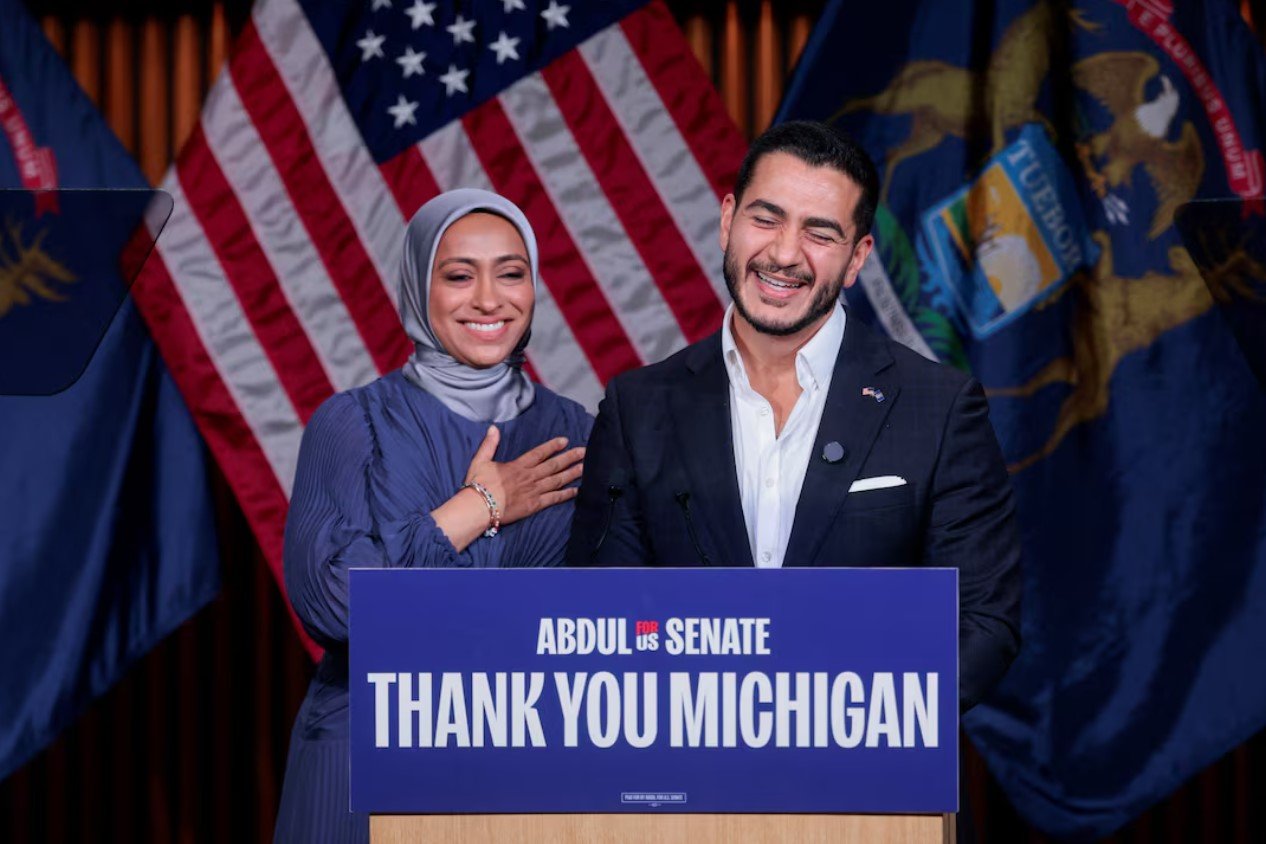
Among the results that attracted particular attention from American and international media was Democrat Abdul El-Sayed’s victory in Michigan. The 42-year-old defeated his Republican opponent, Mike Rogers, who had received the backing of President Donald Trump. El-Sayed thus becomes the first Muslim elected to the United States Senate. The significance of this milestone extends beyond the individual candidate, opening onto a broader debate about the representation of Muslims and Arab Americans within federal institutions.
The son of Egyptian immigrants and a former public health official in Michigan, Abdul El-Sayed did not follow a conventional political path. In 2018, he had already sought the Democratic nomination for governor of Michigan but failed to secure it. Eight years later, he returned to electoral politics in one of the most closely watched contests in the battle for control of the Senate, campaigning on a progressive platform focused on healthcare access, reducing the cost of living and limiting the influence of major corporations over political decision-making.
Speaking to supporters in Detroit as he announced his victory, El-Sayed said: “You took a risk on the candidate least likely to win. Thank you. This is all yours.” His reference to the difficulties of the campaign was more than an expression of gratitude. The Democratic candidate had faced substantial outside electoral spending, a campaign targeting his positions on Israel and the war in Gaza, and attacks directed at his religious background and his loyalty to the United States.
According to the Associated Press, the American Israel Public Affairs Committee, commonly known as AIPAC, spent nearly $30 million opposing his candidacy during the Democratic primary, as part of outside spending that reached approximately $60 million in that contest. He also faced allegations and insinuations concerning supposed links to the Muslim Brotherhood, claims for which his opponents did not provide substantiating evidence and which El-Sayed rejected.
The debate over his identity could not be separated from his political positions. He criticized American military assistance to Israel and described Israel’s actions in Gaza as genocide. Those positions made him a target for his opponents, while also increasing his visibility among voters who increasingly connect American foreign policy with the credibility of domestic political discourse.
His Republican opponent, Mike Rogers, a former member of the House of Representatives and former FBI agent, had the backing of Trump and leading Republican figures. His campaign nevertheless faced the challenge of reconciling loyalty to the president with voters’ concerns over rising prices, the consequences of the war with Iran and trade tensions with Canada. In the final weeks of the campaign, Rogers even expressed positions differing from the president’s on the need to end the war and ease economic pressures.
Michigan’s result carries additional significance because the seat had been held by Democratic Senator Gary Peters, who decided not to seek re-election. El-Sayed’s victory was therefore not simply a matter of taking a Republican-held seat. It enabled Democrats to retain a seat that could otherwise have fallen to the Republicans, at a time when control of the Senate was one of the central stakes of the election.
Congress Changes Hands: The White House Faces an Opposition with Expanded Oversight Powers
In the House of Representatives, Democrats crossed the 218-seat threshold required to secure a majority in the 435-member chamber. The provisional count published by The Guardian showed 228 Democratic seats against 139 Republican seats, while counting continued in several districts. These figures remain preliminary and should not be treated as the final allocation of seats.
The Senate also shifted toward the Democratic camp. Results reported by American media indicated 54 seats for the Democratic bloc, including the two independent senators aligned with it, against 44 Republican seats, with two races still undecided. Republicans had entered the election holding a 53-to-47 majority, while Democrats needed a net gain of at least four seats to regain control of the upper chamber.
Democrats made gains in seven states: Kansas, Iowa, Texas, Ohio, Maine, North Carolina and South Carolina. The significance of these victories lies partly in the fact that several were achieved in states that voted for Donald Trump in the 2024 presidential election. Democrats therefore managed to make inroads into territories traditionally regarded as part of the Republican electoral stronghold.
In Texas, James Talarico defeated Republican Ken Paxton, a particularly significant result given the state’s political weight within the conservative coalition. In Kansas, Adam Hamilton won the seat held by Republican Senator Roger Marshall. In Iowa, Josh Turek defeated Republican Ashley Hinson.
In Ohio, Democrat Sherrod Brown regained his former seat by defeating Republican Jon Husted. In Maine, Troy Jackson defeated Republican Senator Susan Collins. Victories in North Carolina and South Carolina completed the series of seven seats that shifted from Republican to Democratic control.
At the same time, Democrats retained several important seats, including Georgia, where voters returned Jon Ossoff, one of the party’s most prominent figures in a state Trump carried in 2024.
The Democratic gains were not confined to Congress. The party also secured victories in gubernatorial elections in Texas, Ohio, Georgia and Iowa. In Georgia, Keisha Lance Bottoms became the first Black woman elected governor of an American state. In Texas, Gina Hinojosa achieved a historic breakthrough, becoming the first woman of Latino origin to hold the state’s governorship. Amy Acton won in Ohio, while Rob Sand prevailed in Iowa.
According to the Associated Press, Democratic gains included more than twenty House districts, seven Senate seats and four gubernatorial contests. The geography of these victories shows that the Republican setback extended beyond the states traditionally considered competitive.
The War with Iran: When the Cost of Foreign Policy Enters the American Household Budget
The electoral shift cannot be understood without examining the economic conditions preceding the vote. Rising living costs, energy prices and the cost of essential goods, alongside tariffs and the consequences of the US-Israeli war against Iran, dominated much of the election debate.
For the Democratic opposition, these issues provided an opportunity to connect the administration’s military and economic decisions with the daily expenses facing American families.
This connection was not simply a partisan campaign argument. On August 5, 2026, the Chicago Council on Global Affairs published the results of a survey conducted between July 10 and 21 among a nationally representative sample of 2,156 American adults.
The findings showed that 68 percent of Americans believed the costs of the war with Iran outweighed its benefits, while 31 percent considered the war worth its cost. Partisan differences were particularly pronounced: 91 percent of Democrats and 76 percent of independents believed the war was not worth the price, compared with 63 percent of Republicans who held the opposite view.
The figure of 86 percent concerning the cost of living comes from a separate survey conducted by the same organization in May 2026. That survey found that this proportion of Americans believed the war had harmed living costs in the United States. The distinction between the two surveys matters: the 68 percent figure measures public judgment of the war’s costs and benefits, while the 86 percent figure concerns its perceived impact on household expenses.
The Chicago Council’s findings also show that disagreement was not limited to the justification for military intervention. It extended to the way Washington managed the war and the negotiations intended to end it. Sixty-three percent of respondents believed the administration had not done enough to pursue a negotiated settlement. The same proportion felt it had not adequately consulted its allies and regional partners.
These figures help explain the difficulties Republican candidates faced when defending the president’s policies. When a war coincides with rising energy and consumer prices, it ceases to be exclusively a diplomatic or security issue. It becomes part of voters’ everyday assessment of government performance.
A voter facing higher fuel, food and housing costs does not necessarily regard war as an issue separate from personal economic circumstances.
This relationship was reflected in the first political reactions to the election. Vice President JD Vance, in particular, attributed part of the Republican losses to the war with Iran, attempting to explain the result that deprived his party of its congressional majority.
Nevertheless, reducing the Republican defeat to the war alone would not be supported by the available evidence. Tariff policies, inflation, purchasing power and public satisfaction with the president also influenced electoral choices. The results do not establish that every voter who supported Democrats did so in protest against the war, nor that foreign policy was the decisive factor in every electoral district.
Gaza and Arab American Voters: Democrats Recover Some of the Trust They Had Lost
In Michigan, Abdul El-Sayed’s historic victory cannot be separated from the state’s political and social composition, particularly in the Detroit and Dearborn areas, where Arab Americans form an important part of the electoral landscape and Washington’s Middle East policy remains a central political issue.
During the 2024 presidential election, the Democratic Party lost support among sections of this electorate because of the Biden administration’s position on the Israeli war in Gaza. Donald Trump benefited from some of that anger toward the Democrats, promising to end wars and bring peace to the Middle East.
The continuation of the war in Gaza, followed by American military involvement against Iran, placed those promises under a different kind of scrutiny. The debate is no longer confined to assessing the former Democratic administration. It now also concerns the evaluation of Trump’s own policies, particularly as some voters who supported him in 2024 have not seen the transformation they expected in Middle Eastern affairs.
A survey conducted by the Arab American Institute (AAI), commissioned from John Zogby Strategies between October 16 and 23, 2026, among 500 Arab American voters likely to participate in the election, found that 59 percent intended to vote for Democratic congressional candidates, compared with 26 percent for Republicans.
The survey’s margin of error is 4.5 percentage points, a factor that must be taken into account when interpreting its findings. The study also found that 31 percent of respondents identified as independents, while 41 percent identified as Democrats and 27 percent as Republicans.
Economic concerns remained central. Eighty-two percent of respondents said rising prices had caused them economic difficulties, while 56 percent believed the country was moving in the wrong direction.
Regarding Gaza, 90 percent said the issue would be important in determining their choice in the 2028 presidential election. This finding does not directly measure how they voted in 2026, but it demonstrates that the Palestinian issue remains a significant part of their longer-term political considerations.
The survey also found that 65 percent of participants reported experiencing discrimination because of their ethnic background or country of origin, compared with 53 percent in 2023. In addition, 53 percent said that the rise in anti-Arab and anti-Muslim rhetoric had made them more willing to participate in political life.
These findings point to a more complex reality than a simple collective shift in party loyalty. The return toward Democratic candidates is significant, but the high proportion of independents indicates that the relationship between this electorate and the Democratic Party has not necessarily returned to the stability of traditional partisan affiliation.
These findings intersect with a separate survey conducted by The Washington Post in collaboration with George Mason University’s Schar School of Policy and Government between August 20 and September 7, 2026, among a national sample of Arab Americans.
The survey found that 58 percent of registered Arab American voters supported Democratic congressional candidates, compared with 34 percent who supported Republicans. It also found that 80 percent disapproved of Trump’s handling of Israel and Gaza, while 75 percent disapproved of his policy toward Iran. Dissatisfaction with his economic performance stood at approximately 70 percent.
The same survey indicated that around eight in ten Arab American voters supported reducing American military aid to Israel, while six in ten favored ending it altogether.
The significance of these figures lies in the fact that they come from a study separate from the Arab American Institute survey, with a different methodology and sample. Nevertheless, both studies point toward a common trend: declining approval of Trump’s Middle East policy and renewed support for Democratic candidates among a substantial section of Arab American voters.
From Electoral Results to Institutional Accountability: What Changes in Washington?
The Democrats’ return to control of both chambers of Congress does not mean that executive power has changed hands. Donald Trump remains president, and the constitutional powers of the presidency are not altered simply because the congressional majority has shifted. What changes, however, is the relationship between the White House and Congress during the final two years of his term.
In the House of Representatives, the Democratic majority will control the legislative agenda, chair congressional committees and expand hearings and investigations into the administration’s decisions. Federal spending, budget negotiations and appropriations will also become areas of political bargaining between the White House and the House leadership.
In the Senate, Democratic control gives the opposition significant influence over the confirmation of presidential appointments, including judicial nominations and senior administration positions. The upper chamber also retains its legislative and oversight responsibilities.
This majority does not, however, give Democrats the automatic power to impose all their political choices. Trump retains his presidential veto. Overriding that veto requires a two-thirds majority in both chambers, a threshold Democrats do not possess according to the current results. Major policy decisions will therefore continue to depend on political negotiations and the balance of power within both parties.
The first reactions to the election also revealed the extent of the changes taking place within the Republican Party itself. Following the defeat, Republican House Speaker Mike Johnson announced that he would not seek to remain in the party’s leadership position, indicating that the consequences of the election extend beyond the loss of the majority to questions surrounding the party’s internal leadership.
For Democrats, the victory does not constitute an unlimited mandate based solely on opposition to Trump. It places them under pressure to translate their electoral gains into a tangible legislative programme. The issues that dominated the campaign directly concern the cost of living, healthcare, household income and public spending.
Abdul El-Sayed’s victory in Michigan remains one of the most striking images of this political transformation. A candidate of Egyptian origin, openly identifying as Muslim and criticizing American military support for Israel, succeeded in reaching the Senate despite substantial electoral spending directed against him and attacks targeting his background and political positions.
The significance of his victory should not, however, lead to the conclusion that the American electorate has adopted a unified position on Israel, Gaza or the war. The United States remains deeply divided, and the election results themselves demonstrate the persistence of partisan and social divisions.
What the November 3 vote reveals above all is that the American administration’s policies, whether relating to war, trade or the economy, are not beyond electoral accountability. The Republican Party will now have to govern while the principal legislative and oversight powers of Congress are in the hands of its political opponents. Democrats, having regained control of both chambers, must demonstrate that their electoral victory can produce a political alternative that goes beyond opposition to the administration in power.


