

From Tindouf to the End of MINURSO’s Mandate: When Ahmed Attaf’s Narrative Meets the Record of Three Decades of Waiting
A testimony circulated from inside the Tindouf camps has reopened questions about responsibility for the prolonged crisis. At the same time, Algerian diplomacy is facing an outcome it had sought to avoid: the expiration of the UN mission’s mandate after the Security Council failed to agree on an extension. Between Ahmed Attaf’s political interpretation of MINURSO and the reality described by dissenting voices in Tindouf, the questions now extend beyond the mission’s future to the record of conflict management and the prospects of generations whose lives have remained tied to it.
The expiration, on 31 October 2026, of the mandate of the United Nations Mission for the Referendum in Western Sahara, known as MINURSO, did not follow the adoption of a new Security Council resolution agreed upon by consensus. It came after two competing draft resolutions, one American and the other Russian, failed during a session that exposed deep international divisions over the nature of the UN mission and whether it should continue in its existing form or undergo restructuring.
The American draft received eleven votes in favour but was blocked by Russia’s veto, despite three members abstaining. The Russian draft, which proposed extending MINURSO’s mandate for another year, until 31 October 2027, received only three votes in favour, against one American vote and eleven abstentions. The Council therefore adopted neither text, and the mission’s mandate expired without renewal.
This outcome differed from the scenario against which Algerian diplomacy had been warning for months. Algeria was not merely defending the continuation of a UN structure bearing the name MINURSO. It was also defending the political framework associated with the mission’s establishment in 1991 and the reference to a referendum and self-determination in the international treatment of the conflict.
When Algerian Foreign Minister Ahmed Attaf addressed Security Council Resolution 2797 in an interview with AL24 News on 2 November 2025, he presented a diplomatic contest in which, according to his assessment, Morocco had not secured everything it had sought. The minister emphasised what he described as the mission’s threefold symbolic significance: the existence of what he characterised as a colonial situation, the United Nations’ involvement in addressing that situation, and the connection between the international presence and the necessity of organising a referendum on self-determination.
This was not simply a technical reading of a resolution extending the mission’s mandate. In Attaf’s interpretation, MINURSO served a political function extending beyond monitoring the ceasefire. Its continued existence represented the preservation of an international framework whose foundations Algeria did not want to disappear or be redefined around negotiations in which Morocco’s autonomy proposal would become the sole starting point.
Resolution 2797, adopted on 31 October 2025, did indeed contain several provisions deserving closer examination. It extended MINURSO’s mandate until 31 October 2026, while also calling for negotiations based on Morocco’s autonomy proposal. It stated that a final political settlement should be mutually acceptable and provide for the self-determination of the people of Western Sahara, while describing genuine autonomy as one of the most feasible outcomes. The resolution also requested that the Secretary-General submit a strategic review of the mission’s future mandate within six months.
That final provision became particularly significant as the October 2026 renewal deadline approached. The resolution had not terminated MINURSO, but neither was it limited to a routine administrative extension. It had explicitly placed the mission’s future under review, linking that process to developments in the negotiations.
A UN strategic review that went beyond a simple change of name
The strategic review requested by the Security Council was not limited to recommending either the abolition of the mission or its continuation unchanged. It acknowledged the continuing importance of its presence while identifying obstacles affecting the implementation of its mandate: political disagreements between the parties, restrictions on freedom of movement, changes in the security environment, and limitations in technical capabilities and financial resources.
Several possible approaches were considered, including adjustments to the military presence, a reduction in the number of military observers accompanied by stronger technical monitoring and analytical capabilities, or a reassessment of the sustainability of the mission’s presence if the political deadlock continued. In the event of an agreement, its mandate could be adapted to support implementation, including arrangements concerning self-determination, refugee returns, disarmament and reintegration.
These details show that MINURSO’s future had already become the subject of an institutional review. The issue was therefore not simply a Moroccan desire to change the mission’s name or an Algerian demand to preserve its existing status.
The American draft submitted to the vote on 30 October 2026 had itself undergone several revisions. Its initial version proposed making autonomy under Moroccan sovereignty the sole basis for negotiations and gradually transforming the mission into a special political structure, bringing its peacekeeping function to an end. Following objections within the Council, some of the wording was softened. The revised text described autonomy as the most feasible outcome, retained a reference to the principle of self-determination, and proposed changing the mission’s name while reviewing its structure and resources.
Russia and China opposed this direction, arguing that the proposed changes risked anticipating the outcome of negotiations and undermining confidence in the UN framework. Other Council members also expressed reservations about reducing the available settlement options to a single formula before an agreement had been reached between the parties.
When Russia vetoed the American draft, that action did not amount to a vote in favour of Algeria’s position or an endorsement of all the demands of the Polisario Front. It reflected Russia’s position on the wording and political balance of the proposed resolution. Moscow subsequently introduced an alternative draft providing for a conventional extension, but that text also failed to secure the necessary support.
This distinction is essential to understanding the outcome of the vote. Russia’s veto prevented the adoption of the American draft, but it did not guarantee MINURSO’s continuation. The United States, which had pushed for a restructuring of the mission, likewise failed to obtain a resolution endorsing its approach. The final outcome was therefore not a complete victory for either proposal. It was the absence of a renewed mandate.
From presenting the mission’s continuation as an achievement to regretting its expiration
One year after Attaf’s intervention, Algeria’s official position on 31 October 2026 reflected the extent of the change. The Algerian Ministry of Foreign Affairs expressed its “deep regret” over the failure to renew MINURSO’s mandate. It reaffirmed its commitment to a just, lasting and mutually acceptable political solution that would enable the people of Western Sahara to exercise their right to self-determination in accordance with the UN Charter and relevant resolutions.
The statement did not treat the expiration of the mandate as a routine administrative matter. It placed the outcome within a political development opposed by Algeria and attributed responsibility to the American proposal and the process that had led to the failure of renewal.
The comparison with Attaf’s November 2025 remarks therefore reveals a shift: from presenting the continuation of MINURSO and its functions as evidence that Morocco had failed to impose the transformation it sought, to expressing regret over the mission’s expiration one year later.
However, the nature of this shift must be accurately defined. Algeria has not abandoned its position on MINURSO, nor has it officially renounced its stated commitment to self-determination. What changed was the institutional outcome of the UN process.
Morocco’s position also requires careful examination. In a statement issued on 30 October 2026, the Royal Cabinet described the failure to renew the mandate as a significant development and a step towards the definitive closure of the file within the United Nations. It referred to the end of a thirty-five-year chapter and announced the continuation of Morocco’s commitment to the ceasefire.
But the statement also offered a political interpretation of the period ahead when it referred to the end of the Security Council’s periodic meetings, UN reports and briefings devoted to the issue. This is Morocco’s reading of the expected consequences, not a Security Council decision removing Western Sahara from the UN agenda.
For its part, the United Nations confirmed in a statement by Secretary-General António Guterres on 1 November 2026 that it remained prepared to support a just, lasting and mutually acceptable political solution that provides for self-determination. Procedures to close MINURSO’s field presence began following the expiration of its mandate.
The end of the mission’s mandate therefore does not mean that the Western Sahara issue has disappeared from the United Nations’ political and legal framework.
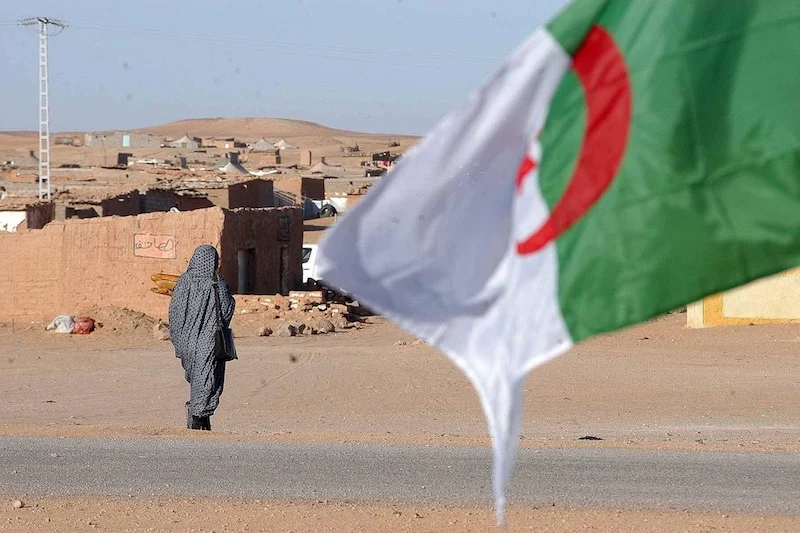
Tindouf: what remains outside the diplomatic narrative?
Amid these competing international positions is a circulated recording described as the testimony of a Polisario member expressing dissent from inside the Tindouf camps. Its potential significance lies primarily in the place from which it is said to have originated, rather than simply in the fact that its author criticises a political leadership or expresses dissatisfaction with an enduring situation.
However, any journalistic use of this testimony requires a distinction between its actual content and the description attached to it by those circulating it. The material provided does not contain a complete, independent transcript of the statements made by the person presented as a protester inside the camps. It contains an analytical intervention about MINURSO. It would therefore be premature to attribute statements about poverty, corruption, leadership responsibility or demands for political change to that individual without access to the original recording.
Nevertheless, the questions raised by the material deserve to be considered within a broader framework. The Tindouf camps are not merely a geographical extension of the conflict. They are also a place where generations of refugees have lived in a situation prolonged over several decades, with essential sectors remaining significantly dependent on international humanitarian assistance.
Reports from the United Nations High Commissioner for Refugees provide measurable evidence of some aspects of this vulnerability. In its annual report on Algeria for 2025, published in May 2026, UNHCR indicated that funding reductions had led to the suspension of certain planned interventions involving the provision of tents. Approximately 16,500 families still required their tents to be replaced. The report also recorded the distribution of 1,005 tent-material kits during the reporting period, while additional tents could not be purchased because of financial constraints.
These figures do not, by themselves, establish the responsibility of any particular political authority for all the difficulties experienced by camp residents. They do, however, demonstrate that the future of the camps cannot be reduced to the future of MINURSO or to the positions taken by states at the Security Council.
Daily needs involve housing, food, education, healthcare and access to water. These are areas for which indicators, reports and funding programmes exist, making them capable of examination and accountability.
The situation of refugees in Algeria also involves the responsibilities of the host state, the work of UNHCR and humanitarian organisations, as well as the administrative and political arrangements governing life in the camps. These responsibilities should not be turned into general accusations without documentary evidence, just as the prolonged nature of the conflict should not exempt any party from scrutiny.
Political discourse invoking self-determination must also be able to address the conditions under which political rights are exercised inside the camps, the representation of their residents, the ability to express disagreement, and the existence of mechanisms through which those responsible for managing their affairs can be held accountable. These are questions of human rights and governance. Their legitimacy does not depend on supporting the positions of Morocco, Algeria or the Polisario Front.
What does a testimony from within the camps actually reveal?
If it is established that the author of the recording is indeed a member of the Polisario Front and is speaking from inside the camps to criticise the leadership’s handling of the issue, the significance of the testimony would lie in shifting the debate away from the diplomatic confrontation between Algiers and Rabat towards questions of accountability within the political environment governing the camps.
But the testimony should not be made to say more than it actually does. Internal dissent, even when expressed by a member of the organisation concerned, does not necessarily mean that support for its leadership has collapsed. It does not prove the existence of a widespread split, nor does it establish that camp residents share a single political position.
It can, however, open a debate about relations between the leadership and its constituency, the ability of existing structures to represent different opinions, and the right of younger generations to discuss political choices that have been made in their name for decades.
This debate takes on additional significance following the expiration of MINURSO’s mandate. The mission was established under Security Council Resolution 690, adopted in 1991, as part of a settlement plan that provided for a transitional period during which preparations would be made for a referendum offering the population a choice between independence and integration with Morocco. The referendum was never held. Disagreements over the definition of the electorate and the foundations of a political settlement continued, while the mission carried on performing the tasks assigned to it by the Security Council.
Over these decades, regional and international circumstances have changed, the balance among major powers has evolved, and Morocco’s autonomy proposal has gained greater visibility in several international positions. Meanwhile, Algeria and the Polisario Front have maintained their commitment to the framework of self-determination and the referendum.
For those living in the camps, the wait for a settlement that has not materialised has continued. The continuation of humanitarian assistance cannot replace a political solution. Likewise, the end of MINURSO’s mandate does not automatically resolve the situation of refugees or guarantee a voluntary, safe and dignified return.
Ending the mandate of a United Nations mission is one matter. Resolving a political conflict that has lasted for decades is another. Between the two remain issues concerning the future of the population, legal guarantees, political representation, humanitarian rights and the conditions required for an implementable settlement.
For Algeria, defending self-determination in international forums also raises questions about the future of the camps, the authorities responsible for their administration, and the guarantees of rights for people living on its territory. For the Polisario Front, its claim to political representation requires that such representation remain open to discussion and accountability, rather than allowing the pursuit of rights to become a process closed to dissent. For Morocco, the development it has officially welcomed remains linked to its ability to continue presenting its political proposal, negotiate on that basis and address the commitments that any mutually acceptable settlement would entail.
As the United Nations reaffirms its readiness to support a political settlement, the practical questions for camp residents concern the conditions of the period now beginning: What guarantees will govern the next phase? What will happen to international monitoring and presence arrangements? How will the status of refugees, their right to choose and the conditions for any potential return be addressed in accordance with international guarantees?
The failed vote at the Security Council settled an important institutional question. It did not resolve the conflict, nor has it yet provided a definitive answer for those who have spent many years waiting for a settlement.
Editorial note: final publication of the comparison with the Tindouf testimony requires the original recording, the speaker’s identity or status if verifiable, and the date of the recording. The complete original interview with Ahmed Attaf dated 2 November 2025 should also be checked. The expiration of MINURSO’s mandate and the beginning of procedures to close its field presence should not be presented as proof that all personnel and equipment had already left the area by 1 November 2026.


