

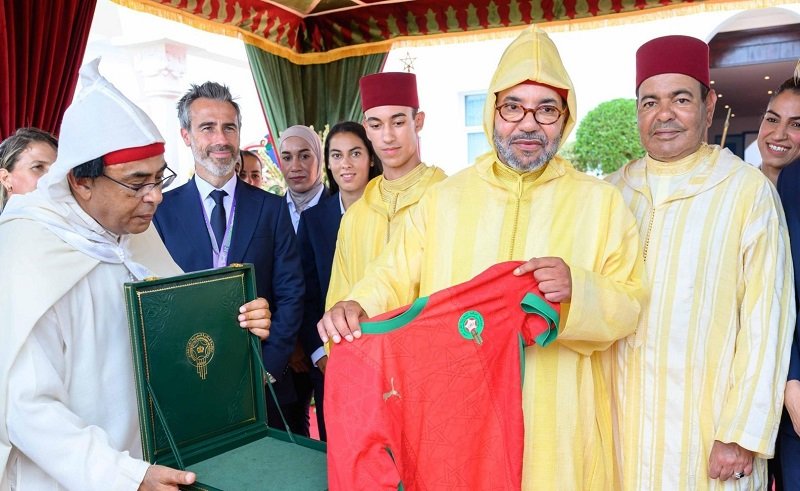
At first glance, the congratulatory message sent by His Majesty King Mohammed VI to the Moroccan national football team following their triumph in the Arab Cup (Qatar 2025) may appear to be a routine institutional gesture, traditionally associated with major sporting achievements. Yet a deeper analytical reading, freed from the immediacy of news reporting, reveals a text of remarkable symbolic depth, where sport is framed as a political, cultural, and social language.
The message goes far beyond the celebration of a trophy. When the King refers to the addition of a second title to Morocco’s record and to the reinforcement of the country’s respected standing in football, the victory is placed within a cumulative and structured trajectory. It is not portrayed as an isolated achievement, but as part of a broader process marked by continuity and long-term vision. Football, in this sense, becomes an indicator of institutional maturity rather than a product of chance.
One of the most striking elements of the royal message is the balanced recognition it offers to players, technical staff, and supporters alike. This tripartite acknowledgment reflects a holistic understanding of success, one that is built on the interaction between performance on the pitch, competence behind the scenes, and popular engagement in the stands. Achievement is thus presented as collective, organized, and sustained by a coherent human and institutional ecosystem.
From a social and cultural perspective, the tribute paid to Moroccan supporters carries particular significance. The crowd is not depicted as a purely emotional mass, but as an active contributor to national prestige. Through their passion, discipline, and attachment to the national colors, supporters play a role in shaping Morocco’s image abroad. In this way, the public emerges as a form of soft power, embodying values that extend beyond sport itself.
Politically, the references to Morocco’s “strong presence on the international stage” and to the country’s “high-level skills and talents” resonate with a broader vision of the modern Moroccan state. Sport is presented as a reflection of strategic national choices: investment in human capital, trust in local expertise, and the projection of an image of credibility and performance at regional and global levels.
The closing lines of the message, which link the victory to the ongoing responsibility of keeping the national flag flying high, transform congratulation into symbolic accountability. Success is acknowledged, but it also implies a duty of continuity and excellence. Triumph is not an endpoint; it is a commitment to sustain standards and ambitions.
In this light, the royal message of congratulations can be read as a condensed political statement: concise in form, yet rich in meaning. It neither overpromises nor exaggerates, but clearly outlines a framework in which football becomes one of the contemporary expressions of Morocco’s national project, situated at the crossroads of identity, performance, and international influence.


