

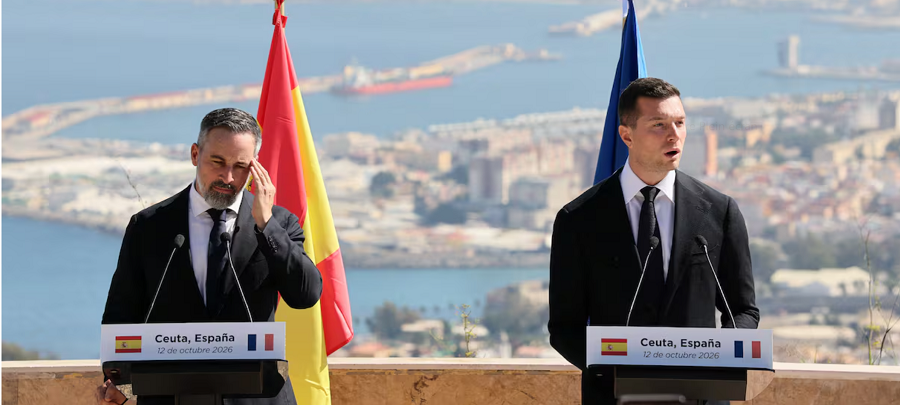
Santiago Abascal, leader of Spain’s Vox party, and Jordan Bardella, president of France’s National Rally, did not need another occasion to demonstrate their political affinity. On 12 October 2026, Spain’s National Day, they chose to visit occupied Sebta, once again presenting the migration crisis as a threat to Spain’s security and Europe’s future. Their visit was accompanied by direct accusations against Morocco and calls for tighter border controls, including the militarisation of border enforcement.
The visit took place as the consequences of the mass arrivals of migrants on 30 and 31 July continued to weigh on the city. Published estimates of those events have varied according to the sources and periods being considered. Some Spanish estimates referred to approximately 72,000 crossings, while other assessments approached 80,000. The difference does not alter the scale of the episode, but it requires caution before adopting a more precise figure without establishing its source and method of calculation.
Construcción de muros en tierra.
Construcción de infraestructuras en el mar.
La Armada vigilando el mar.
Y el Ejército en la Frontera.En España sólo entra quiénes quieran los españoles.Llevamos tiempo diciendo que así es como se soluciona lo de Ceuta. Y lo solucionaremos. pic.twitter.com/3gBzrSLBmf
— VOX 🇪🇸 (@vox_es) October 12, 2026
Abascal chose to turn Spain’s national holiday into a platform distinct from the official ceremonies held in Madrid. He justified his absence by refusing to share the celebrations with the government of Pedro Sánchez, claiming that his place was in Sebta in the face of what he calls an “invasion”. Bardella’s presence, as a French political leader competing for power in his own country, gave the visit a dimension extending beyond Spain’s domestic debate over border management.
Sebta was not merely a geographical stop on the two leaders’ itinerary. The city lies in North Africa and is administered by Spain. Morocco claims Sebta and Melilla as part of its position on the remnants of colonial presence, while Madrid maintains that both cities form an integral part of Spanish territory. This is a longstanding dispute. It cannot be reduced to the migration crisis, just as a political visit cannot determine its legal or diplomatic outcome.
🔴 @Santi_ABASCAL celebra la próxima visita del Rey a Ceuta:
“Espero que Su Majestad el Rey pueda alentar a los ceutíes, darles esperanza y abrazarlos.
Me habría gustado que esa visita se produjera antes, pero más vale tarde que nunca”. pic.twitter.com/2UuPQ3Zgm7
— VOX 🇪🇸 (@vox_es) October 12, 2026
The choice of city and date nevertheless gave the leaders’ message a particular political significance: presenting border control as a central issue, linking it to national and European identity, and then expanding the debate to the future of the continent and its purported civilisational values.
Residents of Sebta—or foreigners in their own city?
During their tour of several neighbourhoods, people accompanying the delegation recalled the appearance of Sebta in the 1970s, when Spanish families lived in districts that today include substantial numbers of families of Moroccan origin. According to the account published by Le360, the discussion shifted to the residents’ nationality before it emerged that some of them also hold Spanish citizenship.
This episode takes on particular significance in light of Abascal’s subsequent statements. He described Spanish residents of Sebta as being under siege, claiming that the people he had seen in the streets were not, in his view, the city’s genuine residents but “invaders”. He then demanded the expulsion of everyone he labels as such from the city and from Spanish territory, without exception, while calling for the border to be structurally reinforced and militarised.
The problem with this rhetoric is not limited to the harshness of its vocabulary. When Moroccan origin or religious affiliation becomes an implicit reason to question whether people belong to a city in which they live and of which some are citizens, the debate shifts from border enforcement to the definition of the community itself: who deserves to be recognised as part of the city, and who is treated as a temporary presence to be removed?
The available evidence does not justify extending this view to every position held by Vox or to Spanish society as a whole. It does, however, allow an examination of the political effect of terms such as “invasion” and “militias”. A migrant who crosses a border irregularly is subject to the applicable laws and procedures. Portraying that person as part of a hostile force gives the debate a military character and leaves less room for discussing the circumstances of the crossing, the situation of minors, people’s rights and the responsibilities of the authorities.
🔴 @J_Bardella denuncia la complicidad de PSOE y PP en la política migratoria europea:
“En el Parlamento Europeo, los socialistas y el Partido Popular han acompañado de la mano el colapso de las fronteras europeas, prefiriendo no ver los peligros que los patriotas han visto,… pic.twitter.com/7nW4o095tg
— VOX 🇪🇸 (@vox_es) October 12, 2026
This does not mean denying Spain’s right to control its borders or its responsibility to manage irregular arrivals. The distinction lies between managing a border crisis in accordance with the law and using that crisis to define acceptable membership of a community according to origin or religion.
Accusing Morocco: What do the facts actually establish?
Abascal attributed responsibility for what he describes as an “invasion” to Morocco, claiming that the Kingdom organised or enabled it, while also attacking the Spanish government’s policy. But the force of a political accusation does not establish its truth.
Any claim that a state organised a mass movement of migrants requires a distinction between three elements: the fact that crossings occurred, the effectiveness or failure of border-control measures, and the existence of evidence establishing that the authorities concerned ordered or organised the operation for political leverage. Evidence of the first element does not, by itself, establish the third.
The July events involved mass crossings and dangerous attempts to reach the city, as well as interventions by Spanish and Moroccan authorities. Reports also referred to deaths during crossing attempts and the return of large numbers of people to Morocco. These events were serious, but they do not, on their own, prove that the Moroccan government ordered the operation.
The position of European institutions also requires careful examination. On 17 September 2026, the European Parliament adopted a resolution on hybrid attacks and the political instrumentalisation of migrants in Sebta, with 339 votes in favour, 225 against and 16 abstentions. The text condemned mass irregular crossings, called for stronger protection of the European Union’s external borders and addressed the instrumentalisation of migration as a potential threat to the territorial integrity of a member state.
The existence of this resolution is a fact that should not be ignored. It would be equally inaccurate to claim that European institutions have never addressed the possibility of migration being used for political purposes. However, the general framework adopted by the European Parliament must be distinguished from proof that the Moroccan government issued specific orders to organise the crossings. The political framing of a resolution cannot replace the establishment of facts or the identification of responsibility on the basis of verifiable evidence.
Conversely, the absence of publicly available evidence establishing a direct Moroccan order does not justify claiming that every circumstance surrounding the crisis has been conclusively clarified. What can be established is that an accusation made by a politician in front of cameras is no substitute for an investigation, documents or evidence open to scrutiny. What remains uncertain must remain so until sufficient information becomes available.
By reducing the case to the word “invasion” and moving immediately to demands for collective expulsions and the militarisation of the border, Abascal places his political conclusion ahead of the evidence needed to establish the responsibility he attributes to Morocco. This distinction is essential, particularly because Moroccan-Spanish relations extend beyond border management to security cooperation, economic interests and shared regional challenges.
Bardella turns Sebta into a stage for speaking about Europe’s future
Jordan Bardella presented his visit as an opportunity to witness what he called an “existential danger” threatening the European continent. He said that what he had seen in Sebta represented Europe’s future unless the continent urgently regained control of its borders. He also reaffirmed his commitment to the security of the Spanish people and Spain’s sovereignty.
Bardella also cited a figure of 86,800 crossings, although the available material does not clearly establish the source or calculation method behind that number. Comparing it with published estimates ranging from approximately 72,000 to 80,000 remains necessary to prevent apparent numerical precision from amplifying the political impact of the statement.
The shift from a local crisis to the prospect of Europe’s “future” lies at the heart of Bardella’s message. He did not limit himself to defending Spain’s position on border control. He connected events in an African city to a broader French political programme: restricting freedom of movement within the Schengen Area to citizens of the European Union, establishing detention centres outside the Union and assigning the European Border and Coast Guard Agency, Frontex, a more restrictive role towards migrants.
Sebta thus became a platform for promoting a programme extending beyond the city’s immediate needs and responsibilities. Bardella’s appearance alongside Abascal linked a Spanish border issue to a wider European political narrative fuelled by concerns about immigration and identity.
Reports of the visit also indicate that Bardella faced questions about domestic French issues, including fuel prices, violence in schools and media reports concerning alleged antisemitic messages published on Facebook in the past. These questions do not, by themselves, establish the French leader’s intentions or the electoral impact of his visit. They do show, however, that a platform presented as an expression of solidarity with Sebta’s residents also gave him an opportunity to address his audience in France.
When civilisational rhetoric meets political history
When Bardella invokes “civilisational values”, his words take on a particular resonance in light of the history of the party he leads. The National Front, founded in 1972, counted Pierre Bousquet among its founders. Bousquet was a former member of the Charlemagne Division of the Waffen-SS and became the party’s first treasurer. The party later became the National Rally as part of a political strategy intended to reshape its image and broaden its electoral appeal.
This does not mean that every current position adopted by the party can automatically be explained through the background of one of its founders. Nor does a party’s history eliminate the need to examine its present-day decisions and statements. It does, however, help explain why references to civilisation and identity invite particular scrutiny when they are used to classify people according to their origins or portray the presence of a group as inherently threatening.
Vox emerged in 2013 following a split from Spain’s People’s Party. Since its creation, it has placed territorial unity, immigration and national sovereignty at the centre of its political discourse. Figures and activists associated with Vox have also taken part in symbolic actions around Gibraltar, a territory administered by the United Kingdom. These included an operation connected to a concrete block in waters near the Rock in 2014, followed by the entry of activists into Gibraltar and the display of a Spanish flag in 2016, according to contemporary press accounts.
These events allow a comparison of how borders are used in political rhetoric, but they do not justify automatically treating legally different situations as equivalent. Each case has its own circumstances and legal considerations. The comparison nevertheless raises a legitimate question of consistency: why can a symbolic act crossing a border be celebrated as patriotism when it serves a national claim, while another border crossing is immediately described as aggression requiring a military response? The issue is consistency in the standard being applied, not the erasure of differences between the cases.
Occupied Sebta: Between the Moroccan-Spanish dispute and partisan escalation
The dispute over Sebta and Melilla predates Abascal and Bardella’s visit and extends beyond the July crisis. Morocco considers the two cities remnants of colonial presence, while Spain maintains that they are part of its territory. A visit by two leaders of the nationalist right cannot change the nature of this dispute or settle it, just as media rhetoric cannot replace diplomacy.
The visit nevertheless has a political dimension worth examining. Abascal, who rejects what he considers foreign interference in Spanish sovereignty, invited a French political leader to accompany him and publicly reinforce his position on the city. The presence of a foreign ally is not, in itself, a legal contradiction. It does, however, demonstrate that Sebta is also being used to build cross-border political alignment between parties that share a hard-line discourse on immigration, identity and sovereignty.
For Morocco, it would be unhelpful to treat every statement as though it automatically represented the official position of the Spanish state. The rhetoric of an opposition party must not be confused with the policy of the government or the positions of state institutions. The more rigorous response is to challenge accusations directed at the Kingdom, demand the evidence supporting them and maintain the distinction between Spain’s domestic political competition and bilateral relations founded on mutual interests and commitments.
This distinction becomes even more important in light of statements by King Mohammed VI, reported on 9 October 2026, that the existing model of migration cooperation with Spain had reached its limits. The King called for a new partnership based on shared development, economic strength and regional stability.
That position places the crisis within a broader framework. Cooperation with Spain remains a strategic choice for Morocco, but it does not mean that the Kingdom must accept political or security responsibility without evidence. Nor does bilateral cooperation turn into a unilateral obligation. Shared interests require shared responsibility, while border management cannot be separated from addressing the causes of migration, protecting human lives and respecting the law.
On 12 October, Abascal and Bardella chose to speak about Europe from a city geographically located in Africa, and about civilisation through a discourse that distinguishes residents considered to belong fully to the city from those portrayed as outsiders. The central question remains the one separating established facts from accusations still requiring proof: how should borders be controlled, who bears responsibility for what happened, and when does a political controversy become a means of assigning serious responsibility to Morocco without presenting the necessary evidence?


