

The Spanish monarch’s visit comes at a particular moment: following a major migration crisis, a royal address rejecting pressure over bilateral cooperation, and amid relations in which economic interests intersect with the dispute over sovereignty.
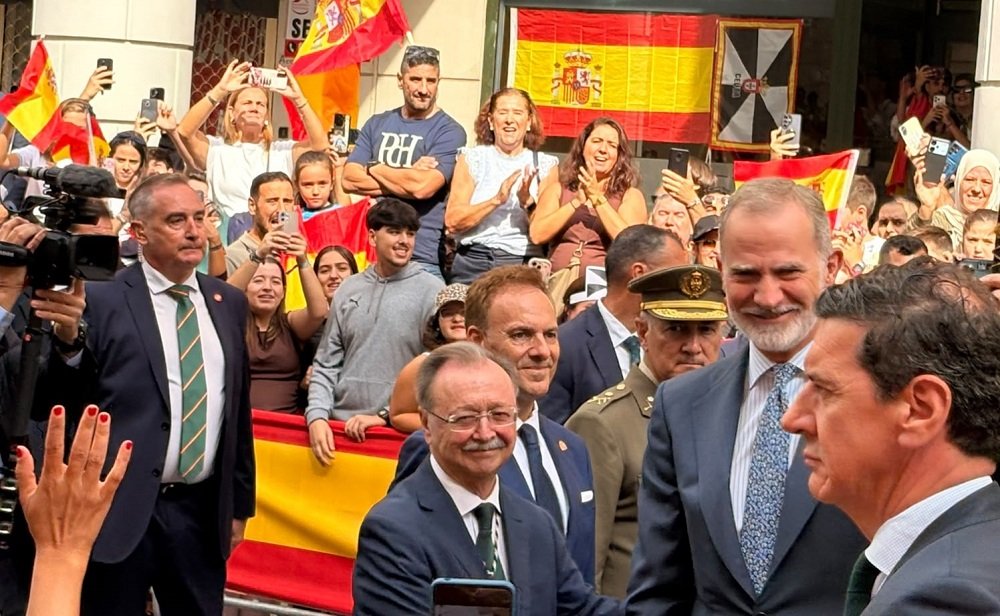
King Felipe VI, accompanied by Queen Letizia, arrived in Ceuta on Tuesday, 13 October 2026. It was their first visit to the city since ascending the throne in 2014. The visit was included in the Spanish Royal Household’s official programme, which scheduled meetings with local authorities and representatives of the community, a visit to an educational institution, and a memorial ceremony for migrants who died at sea on 30 and 31 July.
Residents welcomed the royal couple, waving Spanish flags and chanting slogans affirming their attachment to Spain. The official programme also included the presentation of the keys to the city, meetings with local officials, a school visit in a multicultural setting, and a commemorative ceremony at the Sidi Embarek Muslim cemetery. The Royal Household described the visit as an expression of support for Ceuta’s institutions and residents.
The visit’s first message requires little interpretation: Spain’s king is visiting a city administered by the Spanish state, meeting its officials and residents, and demonstrating the Crown’s presence alongside them. Yet an institutional visit that might be routine elsewhere carries a different meaning for Morocco, which regards Ceuta and Melilla as occupied cities and continues to call for their return.
The visit therefore reaffirms Spain’s existing position. By itself, however, it does not create a new legal reality, settle the historical dispute, or extinguish Morocco’s claim. It would be inaccurate to portray it as a new Spanish victory or a Moroccan defeat simply because the king has set foot in the city.
Ceuta did not suddenly appear on the political map of the two countries this week, and the dispute did not begin with Felipe VI.
In 2007, King Juan Carlos I and Queen Sofía visited Ceuta and Melilla, triggering a diplomatic crisis with Rabat. Morocco recalled its ambassador from Madrid for consultations to protest a visit it regarded as undermining its position on sovereignty over the two cities. That episode remains the most direct historical precedent, but it does not necessarily require the same diplomatic response nearly nineteen years later.
Circumstances have changed. Moroccan-Spanish relations have gone through periods of tension and rapprochement, while economic interests, security and migration have become central to the management of bilateral ties. Comparing the two royal visits should therefore involve more than measuring the scale of Morocco’s current public reaction against that of 2007. The more important question is whether the difference in the visible response reflects a deliberate diplomatic choice, and whether other démarches or official positions exist beyond public statements.
The available reporting does not yet provide enough evidence to settle that question. Spanish media have noted a degree of Moroccan caution, contrasting with the response in 2007. That is an observation about the public posture, not proof of either retreat or diplomatic success.
The crisis preceding the visit adds another dimension.
At the end of July, Ceuta experienced a mass arrival of migrants from the direction of Moroccan territory. The episode placed local authorities under pressure and returned border security to the centre of Spain’s political debate. International reports referred to tens of thousands of crossing attempts, deaths at sea and migrants remaining in the city, including minors. Figures differ depending on the source and the method of counting, however, and should not be presented as one definitive statistical total.
Los Reyes han sido recibidos por los ceutíes a las puertas del Palacio Autonómico, donde han dado comienzo a su visita oficial a la ciudad autónoma de Ceuta.
A continuación, los Reyes han mantenido una reunión de trabajo con representantes de la sociedad ceutí y, posteriormente,… pic.twitter.com/AFLChC22BJ
— Casa de S.M. el Rey (@CasaReal) October 13, 2026
The crisis fuelled disagreements in Spain over border security, return procedures, institutional responsibility and the nature of cooperation with Morocco. Rabat, meanwhile, does not regard migration as merely a technical matter of border control. It forms part of a bilateral relationship in which Morocco assumes responsibilities and expects cooperation that respects its interests and conditions in return.
In his address to Parliament on 9 October, King Mohammed VI discussed the limitations of the current model of migration cooperation. He criticised what he described as the exploitation of the issue by certain political and media circles, stressing that partnership is a sovereign choice and a voluntary commitment, and must never become a tool of pressure, threats or blackmail. He called for a new approach to cooperation based on shared development, economic strength and regional stability.
The speech came only days before the Spanish monarch’s visit to Ceuta. The timing permits political analysis, but it does not prove that the address was directed exclusively at the visit or constituted a direct response to it. The Moroccan king addressed the broader conditions governing migration cooperation without explicitly making the Spanish royal visit the subject of his remarks.
That distinction matters. Interpreting every Moroccan position as a reaction to a Spanish initiative would reduce the Kingdom’s foreign policy to a sequence of responses. The royal address raised wider questions about the terms of partnership, the distribution of responsibilities and the pressures that may accompany migration cooperation.
The sensitivity of the moment cannot nevertheless be ignored. The memorial ceremony for those who died at sea has a humanitarian dimension, and support for local institutions is the stated purpose of the visit. At the same time, the presence of Spain’s head of state in Ceuta carries an unmistakable sovereignty-related message for Madrid. These dimensions can coexist within the same visit without any one of them necessarily providing the sole explanation.
The suggestion that Felipe VI is exploiting Morocco’s political situation or acting to benefit a particular Spanish party would require evidence that the visit alone does not provide. The king is acting as head of state, while the government and political parties debate the management of the migration crisis and its consequences. It is legitimate to examine the possible domestic political benefits of the visit, but presumed partisan intentions should not be presented as established facts.
The history of the dispute over the two cities stretches far beyond the present crisis.
Portugal captured Ceuta in 1415. After Portugal separated from the Spanish Crown, the city came under Spanish rule, a position formalised by the Treaty of Lisbon in 1668. Melilla, meanwhile, came under Spanish control in 1497. Spanish rule over both cities continued after Morocco gained independence in 1956, while their return remained a Moroccan claim.
These historical facts do not, on their own, settle every contemporary legal question. They do, however, explain why Morocco does not view Ceuta and Melilla as simply Spanish cities geographically separated from the Iberian Peninsula. The dispute is connected to the history of European expansion in North Africa, the Kingdom’s process of completing its territorial integrity, and a persistent divergence between Moroccan and Spanish positions.
Nor should this dispute automatically be equated with the question of the Moroccan Sahara, although certain comparisons may be useful. The Green March of 1975 was a major stage in the process of recovering the Sahara from Spanish colonial rule. It was followed by the Madrid Accords and Spain’s withdrawal, after which the Sahara question developed within its own international framework. Ceuta and Melilla have a different history and a distinct political and legal status. The useful comparison between territorial disputes concerns the role of documentation, facts, political change and diplomacy—not an assumption that the outcome of one automatically determines the outcome of another.
Economically, the areas surrounding Ceuta and Melilla underwent significant changes after the border closures during the COVID-19 pandemic, followed by the gradual reorganisation of the movement of people and goods under the Moroccan-Spanish arrangements that followed the 2022 rapprochement. The disruption of informal cross-border trade severely affected some workers and families whose livelihoods depended on that activity.
The claim that six thousand families left Ceuta and Melilla for other parts of Spain because smuggling was halted, however, requires an independent source establishing the number of families, the period in which they moved and their reasons for leaving. It should not be confused with figures concerning migrants who entered Ceuta during previous border crises. The economic argument will be stronger if supported by verifiable data on employment, trade, income and population movements.
What is clear is that economic relations between the two countries extend far beyond the two cities. They encompass trade, investment, security cooperation, migration, infrastructure and regional stability. The 2022 Moroccan-Spanish roadmap reaffirmed the importance of dialogue, cooperation and the gradual normalisation of the movement of people and goods. This does not erase the sovereignty dispute, but neither does the dispute make all forms of cooperation impossible.
For Morocco, defending its national claim does not require turning every Spanish visit into a diplomatic crisis. Preserving shared interests does not mean accepting the status quo as the final word, either. The issue concerns the state’s ability to manage different files according to its objectives, maintain a clear national position and distinguish restraint in public communication from any possible abandonment of its claims.
Some media coverage has described the visit as a provocation, while other analyses have focused on its institutional dimension and the migration crisis. These interpretations should be assessed on the basis of their arguments. Journalism must distinguish the sovereignty message conveyed by the visit, the presumed intentions behind its timing, and the actual consequences that may follow. Forceful language cannot replace evidence, just as the absence of escalation does not, by itself, prove that a strategy has succeeded.
The visit is an official act by Spain. Ceuta remains a Moroccan sovereignty issue, while relations between Rabat and Madrid extend beyond the territorial dispute and rest on a network of mutual interests. Morocco’s diplomatic response cannot be inferred from media speculation alone. It must be assessed through official positions, subsequent diplomatic steps and their ability to protect the Kingdom’s interests and claims within a relationship that neither side can reduce to a single royal ceremony.


