

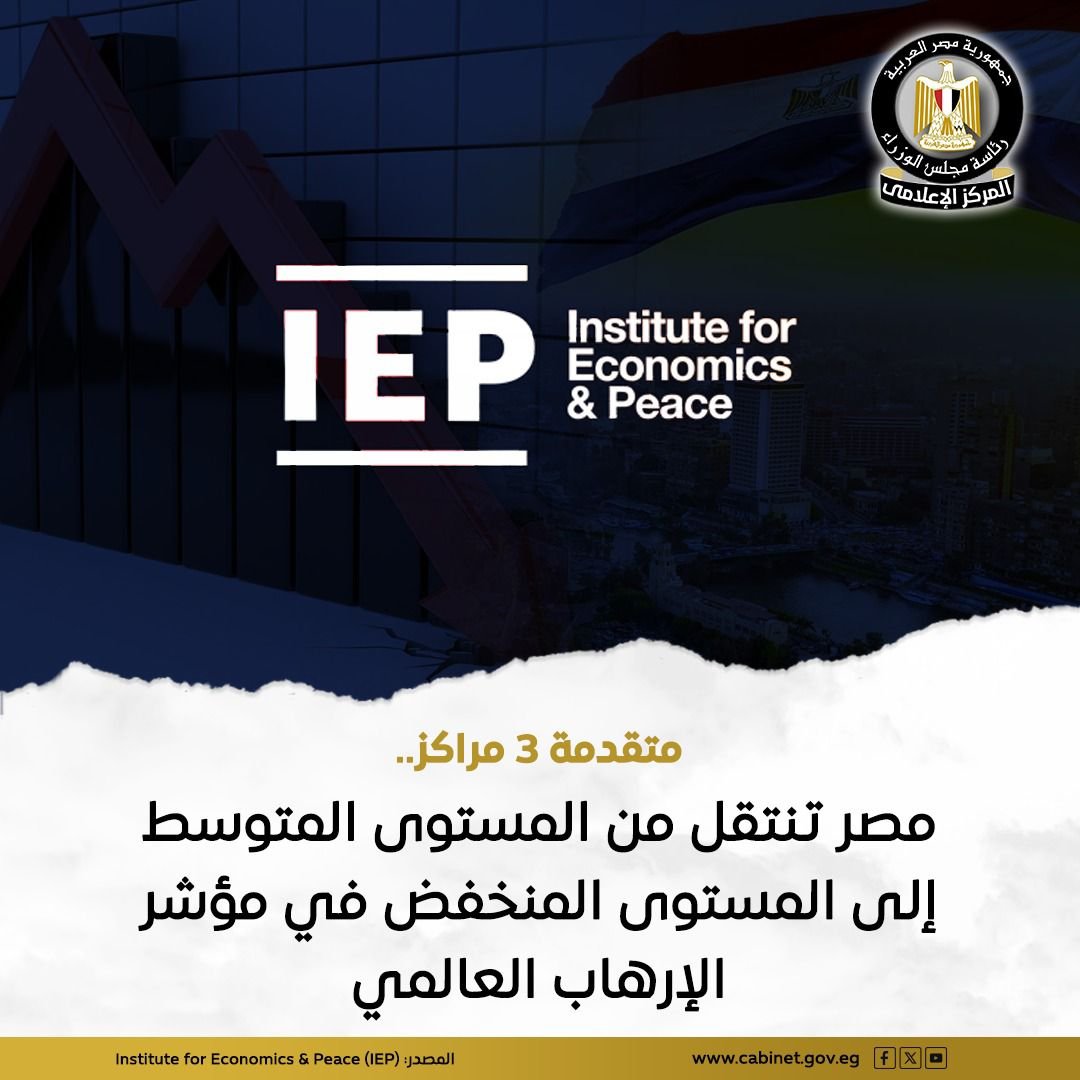
According to the Global Terrorism Index issued by the Institute for Economics and Peace, Egypt has shifted from a “medium” to a “low” level of terrorism, ranking 32nd globally in 2026, compared to 29th place in 2025.
This was reported in a post published by the Egyptian Cabinet’s Media Center on its official Facebook page.
It is important to note that the index ranks 163 countries based on four key indicators: the number of terrorist incidents, the number of deaths caused by terrorist groups, the number of injuries resulting from such attacks, and the number of hostages taken within a given year.
Methodology: A Composite Measure Beyond Attack Numbers
The Global Terrorism Index, published by the Institute for Economics and Peace, is considered one of the most important analytical tools used by governments and decision-makers to understand the evolution of terrorism worldwide—not only in terms of the number of attacks, but also their broader impact on security, economic conditions, and global stability.
According to the institute’s official website, the index is based on an extensive database covering more than 66,000 terrorist incidents since 2007. The results are calculated using a set of indicators that include the number of attacks, fatalities, injuries, and hostages, weighted over a five-year period to provide a more accurate picture of long-term trends.
The institute further explains that the aim of the index is to “provide a comprehensive understanding of the global patterns and trends of terrorism,” thereby helping policymakers develop more effective counterterrorism strategies.
Reports from the institute, drawing on the Global Terrorism Database maintained by the University of Maryland, confirm that the index relies on one of the most comprehensive datasets in the world, covering more than 190,000 terrorist incidents across 163 countries.
According to data from the Global Terrorism Index 2025, the world witnessed a significant 28% decline in terrorism-related deaths, falling to approximately 5,582 fatalities—the lowest level since 2007.
How Egypt Rebuilt Its Counterterrorism Framework Since 2013
Since 2013, Egypt has faced one of the most complex waves of terrorism in its modern history, particularly in the Sinai Peninsula and parts of the mainland. This prompted the state to adopt a comprehensive, multi-dimensional counterterrorism strategy that combines security, military, intellectual, and developmental tools, as confirmed by official government data.
A Comprehensive Approach: From Security Response to Root-Cause Mitigation
According to Egypt’s State Information Service, the country has, since the June 30, 2013 revolution, adopted a strategy based on “addressing terrorism in all its dimensions, not solely through security solutions.” This approach incorporates economic, social, educational, and ideological dimensions.
The Egyptian Ministry of Foreign Affairs’ 2021 National Counterterrorism Report also emphasized that the state views terrorism as a “complex transnational phenomenon,” requiring the simultaneous addressing of its ideological and intellectual roots alongside security measures.
The report indicates that this approach aimed to preserve national state institutions and prevent their collapse, forming the strategic foundation for Egypt’s domestic and foreign policy actions.
Security Operations: Preemptive Strikes and Network Disruption
On the security front, Egypt’s Ministry of Interior has played a central role in carrying out preemptive operations against terrorist groups. Egyptian media outlets such as Youm7 reported that security forces conducted “decisive strikes against terrorist cells and extremist networks,” contributing to the foiling of numerous hostile plots.
This strategy also focused on dismantling the organizational and financial structures of terrorist groups, alongside expanding intelligence operations—leading to a noticeable decline in these groups’ capacity to carry out large-scale attacks in major urban centers.
Official data reflects a critical shift from reactive responses to proactive prevention, marking a significant evolution in Egypt’s security doctrine.
Sinai as a Model: Military Action Coupled with Development
The Sinai Peninsula stands as the clearest example of Egypt’s strategy in action, where large-scale military operations were carried out alongside major development projects.
According to official data and published reports, security operations significantly reduced terrorist activity, while the state simultaneously implemented infrastructure and economic development initiatives to improve living conditions—helping to eliminate the social environment conducive to extremism.
The State Information Service أكد that this integration of security and development is a decisive factor in the success of Egypt’s experience, emphasizing that lasting stability cannot be achieved without addressing the socio-economic roots of terrorism.
Ideological Confrontation: Dismantling Extremist Narratives
Beyond security measures, Egypt has prioritized ideological and religious confrontation, strengthening the role of religious and media institutions in countering extremist thought.
According to the national report, extremist ideology represents the “primary driver of terrorist acts,” necessitating its confrontation through education, media engagement, and the renewal of religious discourse.
The State Information Service has also played a role in communicating the official narrative and countering misinformation, in what can be described as a “counter-information war” aimed at undermining extremist messaging.
International Dimension: Cross-Border Cooperation
Egypt’s efforts have not been confined to the domestic arena but have extended internationally. According to Ministry of Foreign Affairs statements, Egypt has consistently called for enhanced global cooperation to combat terrorism as a universal threat not confined to any single country.
Cairo has also participated in numerous international initiatives and sought to share its counterterrorism experience in global forums, particularly emphasizing the importance of comprehensive approaches that go beyond traditional security solutions.
Tangible Results: Declining Terrorism and Improved Stability Indicators
Official reports and published analyses indicate that these efforts have led to a significant decline in terrorist activity within Egypt, and its removal from the list of countries most affected by terrorism, according to international assessments such as the Global Terrorism Index.
This has also been reflected in improved internal stability, which Egyptian media reports have described as a “shift from an existential threat phase to a stage of security control”.


