

An analysis of revelations by « Le Desk », a media outlet close to state circles and decision-making centres, on Russian-Moroccan contacts, the advance preparation of the Royal Statement, and the limits of diplomatic coordination with Washington and Paris.
Information published by the news outlet Le Desk on Saturday, October 31, 2026, claiming that Moscow had informed Rabat in writing, before the Security Council vote, of its intention to veto the US draft resolution on the Moroccan Sahara, offers a different perspective on the events of Friday, October 30. It raises questions about how far Morocco had anticipated the possibility that the renewal of the mandate of the United Nations Mission for the Referendum in Western Sahara (MINURSO) would fail, and about the diplomatic preparations behind the Royal Cabinet statement issued after the vote.
These claims, however, need to be examined by distinguishing information reported by the outlet on the basis of confidential sources from facts established by published official documents and statements. The alleged advance Russian notification, the prior drafting of the Royal statement, and the reported briefing of Washington and Paris are three connected elements in Le Desk’s account, but they do not necessarily carry the same level of independent verification.
Moscow reportedly left little room for ambiguity
One of the most significant details in Le Desk’s reporting concerns a written communication that Moscow allegedly sent to Rabat before the vote. According to the outlet, Russia explained its opposition to the US draft, informed Morocco that it intended to use its veto, and presented a competing draft resolution designed to maintain MINURSO within its existing framework.
If this correspondence is confirmed, it would mean that Rabat was not treating a Russian veto as a merely theoretical diplomatic possibility. Instead, it would have received direct information from the country preparing to exercise that power. Such a notification would carry a different significance from simply interpreting Russian public statements or following the usual diplomatic exchanges between the two capitals.
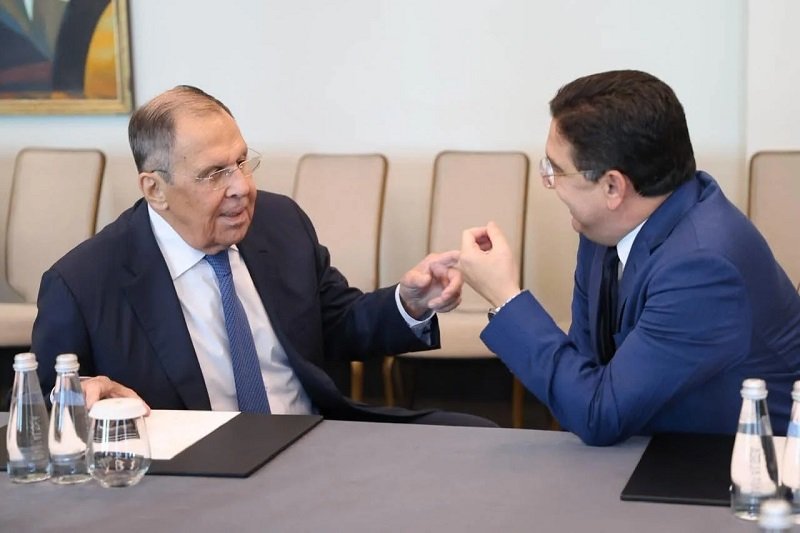
The reported communication takes on added significance when viewed alongside the contacts that preceded the vote. According to another report published by Le Desk on October 31, Moroccan Foreign Minister Nasser Bourita held a telephone conversation with his Russian counterpart, Sergey Lavrov, on October 23, at Morocco’s initiative, before meeting him in Moscow on October 28 on the sidelines of the third Russia–Africa Summit. The outlet also reported that Russian Foreign Ministry spokesperson Maria Zakharova had reiterated that Moscow’s position on the Sahara had not changed.
The timing of these contacts matters. They took place during the final stage of the US draft’s preparation, as the proposed text moved towards making Morocco’s autonomy initiative under Moroccan sovereignty the basis for negotiations, while also proposing a change to MINURSO’s name and the removal of the reference to a referendum from its title.
Russia’s statement that its position had not changed was not an announcement of support for the American draft. Moscow continued to defend the existing UN framework and opposed any attempt to prejudge the nature of a political settlement or alter the mission’s mandate without consensus within the Security Council.
That position became explicit during the vote. Russia vetoed the US draft despite eleven votes in favour and three abstentions.
Moscow did not stop at voting against the American text. It also submitted a competing draft resolution proposing a one-year extension of MINURSO’s mandate, until October 31, 2027, while retaining the mission’s existing name and functions. Russia’s Permanent Representative to the United Nations, Vasily Nebenzya, presented the proposal as an effort to preserve the UN presence, arguing that it relied on language previously adopted by the Council and did not introduce new elements that would alter the established framework.
The Russian draft received only three votes in favour, against one vote opposing it from the United States and eleven abstentions. The legal and political distinction is important: the American draft was blocked by a Russian veto, whereas the Russian draft was not defeated by an American veto. It failed because it did not obtain the nine votes required for adoption.
The two votes therefore did not produce an identical outcome. The Russian veto prevented the adoption of the US draft, while the Russian alternative subsequently failed to secure the minimum support needed to renew the mission’s mandate.
The Royal statement: timing and the substance of the message
The Royal Cabinet statement issued after the two votes went beyond expressing Morocco’s position on the failure to renew MINURSO’s mandate. It described the development as an important step towards the definitive closure of the Moroccan Sahara file within the United Nations and stated that the mission’s presence in the Kingdom’s southern provinces, including its personnel, equipment and symbols, should come to an end in the coming days.
The statement also linked this development to a deeper transformation in the parameters governing the file. It referred to the end of a 35-year period and called for an end to the Security Council’s periodic meetings, UN reports and briefings relating to the issue. It further stated that Morocco would continue its diplomatic efforts at the bilateral and regional levels.
This was not simply a brief statement reacting to a voting result. It set out a political and diplomatic interpretation of the new situation and identified the consequences that Rabat believes should follow from the failure to renew the mission’s mandate.
It is at this point that Le Desk’s claim about the advance preparation of the statement becomes particularly relevant. The outlet says that the text was not drafted hastily after the result was announced, and that Washington and Paris had been informed of its contents before publication, as part of the diplomatic exchanges preceding the Security Council meeting.
If accurate, these claims would indicate that Morocco had already prepared its position for the period following the vote and that the Royal statement was not an improvised reaction to the Russian veto.
However, Le Desk has not published the alleged Russian communication, a document establishing when the Royal statement was drafted, or correspondence confirming that Washington and Paris received its contents in advance. These details therefore remain claims attributed to the outlet’s confidential sources and should not be presented as independently established official facts.
The official statement published through Morocco’s institutional channels confirms the content and date of the Royal position. It does not, by itself, establish when the text was drafted or which foreign capitals had seen it before publication.
What the vote establishes, and what it does not settle
Morocco’s position needs to be understood against the evolution of the Security Council since the adoption of Resolution 2797 on October 31, 2025.
That resolution extended MINURSO’s mandate until October 31, 2026, and reaffirmed the Council’s support for negotiations based on Morocco’s autonomy proposal, noting that genuine autonomy could represent one of the most viable solutions.
The resolution also requested the Secretary-General to provide a strategic review concerning the future of the mission’s mandate, taking into account the outcome of negotiations. The October 2026 American draft was therefore not an isolated initiative. It came at a stage when the strategic review was expected to help determine the mission’s operational future.
The US draft sought to move this process into a new phase. It proposed making autonomy under Moroccan sovereignty the basis for negotiations, changing MINURSO’s name, reorganising its responsibilities and reducing its military component. It also included provisions concerning the registration of the population in the Tindouf camps.
Russia’s objections, as expressed by its representative at the Security Council, were not limited to the proposed change in the mission’s name. Moscow argued that the US draft weakened the principle of balanced negotiations, prejudged the outcome of a political settlement and marginalised one of the parties to the conflict. Russia maintained that retaining MINURSO in its existing form was necessary to preserve the international presence and the monitoring arrangements.
This is Russia’s official explanation for its position, but it is not necessarily the only way to interpret the vote. The position also reflects wider disagreements between Washington and Moscow over how the UN should manage the issue and how far the mandate of a mission established in 1991 can be changed.
The reactions following the vote revealed different interpretations of the outcome. The United States considered that the Russian veto had obstructed progress towards a settlement based on Morocco’s autonomy initiative. Russia defended its own draft as an attempt to preserve the UN presence. France criticised what it described as Russian obstruction, arguing that Moscow had placed the mission in an especially difficult position by blocking the American proposal and then submitting an alternative that failed to obtain sufficient support.
The Security Council was therefore not facing a straightforward confrontation between countries supporting Morocco and countries opposing it. The disagreement concerned the future of the UN mechanism itself and the framework that should govern the next phase of negotiations.
The end of MINURSO’s mandate does not automatically close the UN file
One legal distinction deserves particular attention when examining the Royal statement: the difference between the expiration of MINURSO’s mandate and the end of the Security Council’s authority to consider the question of the Sahara.
Resolution 2797 did more than extend the mission’s mandate until October 31, 2026. Paragraph 6 also stated that the Security Council decided to remain seized of the matter. This is a separate provision from the duration of the mission’s mandate, and it does not state that the mandate’s expiration automatically removes the issue from the Council’s agenda.
Consequently, the failure to adopt a new resolution means that the existing mandate reaches its scheduled expiration date unless the Council subsequently takes further action. It does not, by itself, amount to an explicit decision ending the United Nations’ jurisdiction or closing the file at the Security Council.
The same distinction matters when considering the departure of mission personnel and equipment. The absence of a renewal places the mission’s legal and operational presence in a new situation, but the arrangements for ending or reorganising its deployment require institutional and UN-level handling. They cannot be reduced to the result of the vote alone.
The Royal statement expresses Morocco’s position on the consequences that should follow from this development. It is an official political and diplomatic position. However, treating the voting outcome itself as a UN decision to close the file would go beyond what the result legally establishes.
Moscow and Rabat: a Security Council disagreement does not erase the interests of their partnership
The alleged Russian notification takes on another dimension when viewed within the broader relationship between Morocco and Russia.
The two countries marked the tenth anniversary of their strategic partnership, signed in 2016, in 2026. Political and economic contacts have continued despite differences over several international issues.
According to information reported by Le Desk in its separate analysis, the two countries have economic interests involving imports of hydrocarbons, wheat and sulphur, alongside wider trade relations and cooperation in several fields. Their bilateral relationship therefore extends beyond the Sahara issue, even when significant disagreements emerge at the Security Council.
The meeting between Nasser Bourita and Sergey Lavrov in Moscow on October 28, two days before the vote, deserves particular attention in the chronology of events. Yet the continuation of diplomatic contacts does not establish that the two countries had reached a prior agreement on the voting outcome. Likewise, if the alleged advance Russian notification is confirmed, it would not mean that Rabat approved or adopted Moscow’s position.
What is established is that Russia moved from abstaining during the vote on Resolution 2797 in 2025 to using its veto against the American draft in 2026. This change in Russia’s voting behaviour deserves to be examined in light of relations among the major powers and Moscow’s position on the UN framework. It is not, by itself, sufficient evidence of a change in Russia’s position on Moroccan sovereignty.
What Rabat will need to monitor after October 31
The expiration of MINURSO’s mandate raises practical and legal issues that political statements alone cannot resolve. These include the future of the UN presence on the ground, the monitoring arrangements associated with the ceasefire, the status of arrangements established during more than three decades of the mission’s presence, as well as the role of the Secretary-General, his Personal Envoy and the possibility of renewed consultations within the Security Council.
Maintaining the ceasefire remains a separate issue from the debate over the mission’s name or mandate. The Royal statement itself reaffirmed Morocco’s commitment to the ceasefire, while emphasising respect for its territorial integrity, national security and the peace of its citizens.
On the diplomatic front, attention will also focus on how international positions supporting Morocco’s autonomy initiative are translated into practical measures, and whether that support continues within the Security Council and beyond.
The American draft received eleven votes in favour. This is an official voting result that the Russian veto does not erase.
That figure becomes more significant when compared with the Russian draft, which received only three votes in favour. The Council adopted neither text, but the difference in voting support reveals distinct levels of backing for the two proposed approaches to MINURSO’s future.
The Russian communication reported by Le Desk remains the most sensitive element of this sequence. If documents emerge confirming its content and date, and if the advance briefing of Washington and Paris on the Royal statement can also be established, these would provide additional evidence for understanding how Rabat managed the period leading up to the vote.
For now, the official documents establish that Morocco has entered a new phase following the expiration of MINURSO’s mandate, and that the Security Council adopted neither the American nor the Russian draft. Whether this development will lead to the closure of the UN process in the terms expressed by the Royal statement will depend on the diplomatic and legal initiatives that follow.


