

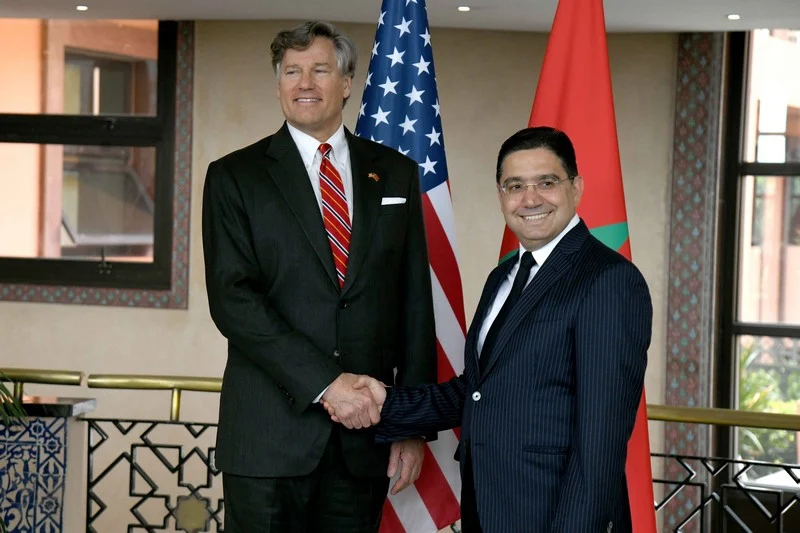
At a critical regional juncture—where security concerns, energy stakes, and geopolitical competition intersect—the interview broadcast by France 24 on the visit of the U.S. Deputy Secretary of State to Algeria and Morocco goes far beyond a routine diplomatic discussion. Beneath its surface neutrality lies a deeper struggle of narratives, where media framing itself becomes a decisive factor in shaping perceptions of the Moroccan Sahara issue.
From the outset, terminology emerges as a revealing indicator. The repeated use of the term “Western Sahara” is not merely descriptive; it reflects an implicit editorial positioning embedded in certain international media traditions. Yet, a closer reading of the discussion exposes a clear contradiction: the diplomatic realities highlighted—particularly by the Moroccan perspective—point toward a growing international endorsement of the autonomy initiative as a realistic and credible solution.
The American visit thus appears as a strategically layered mission. On one level, it aims to strengthen economic and security partnerships across the Maghreb, especially amid intensifying global competition for influence in Africa. On another, it responds to urgent security challenges in the Sahel, particularly in Mali, positioning Morocco as a central pillar of regional stability.
At the core of the discussion lies the Moroccan Sahara dossier. The Moroccan analysis underscores a key shift: the issue is no longer an open-ended conflict but is gradually moving toward a structured resolution framework, supported by successive resolutions of the United Nations Security Council. This reflects a broader transformation in diplomatic dynamics, where the autonomy plan is gaining legitimacy while separatist narratives lose momentum.
Conversely, the Algerian viewpoint attempts to preserve a traditional interpretation, distancing Algeria from direct involvement and framing the conflict as one between Morocco and the Polisario Front. However, this stance increasingly clashes with evolving international perceptions that recognize Algeria as a central stakeholder. The media discussion, by not fully interrogating this contradiction, reveals the limits of its claimed neutrality.
Another notable gap in the debate is the lack of attention to the socio-economic development taking place in Morocco’s southern provinces. These dynamics are crucial, as they form a cornerstone of Morocco’s approach—linking political resolution with tangible development outcomes that directly affect citizens’ lives.
As for the United States, its role appears less as a neutral mediator and more as a pragmatic actor, aligning regional stability with strategic and economic interests. Resolving the Moroccan Sahara issue is thus seen not only as conflict management but as a gateway to a more integrated and economically viable Maghreb region.
Ultimately, this media exchange highlights a fundamental reality: the Moroccan Sahara issue is no longer confined to diplomatic corridors—it is equally contested within the global media arena. Between competing narratives and shifting realities, a new understanding is emerging—one that increasingly favors pragmatic stability over ideological fragmentation.


