

At a delicate political moment where the diplomatic trajectory intersects with the imperatives of UN discretion, the question of the Sahara returns to the heart of the international agenda, but more under the seal of “strategic silence” than that of open communication. As the Security Council met on April 24, 2026, behind closed doors to follow up on the implementation of Resolution 2797, the United Nations appears to have chosen to manage this sensitive file through controlled opacity, while promising to later publish the briefings of its Personal Envoy, Staffan de Mistura, and the head of MINURSO, Alexander Ivanko.
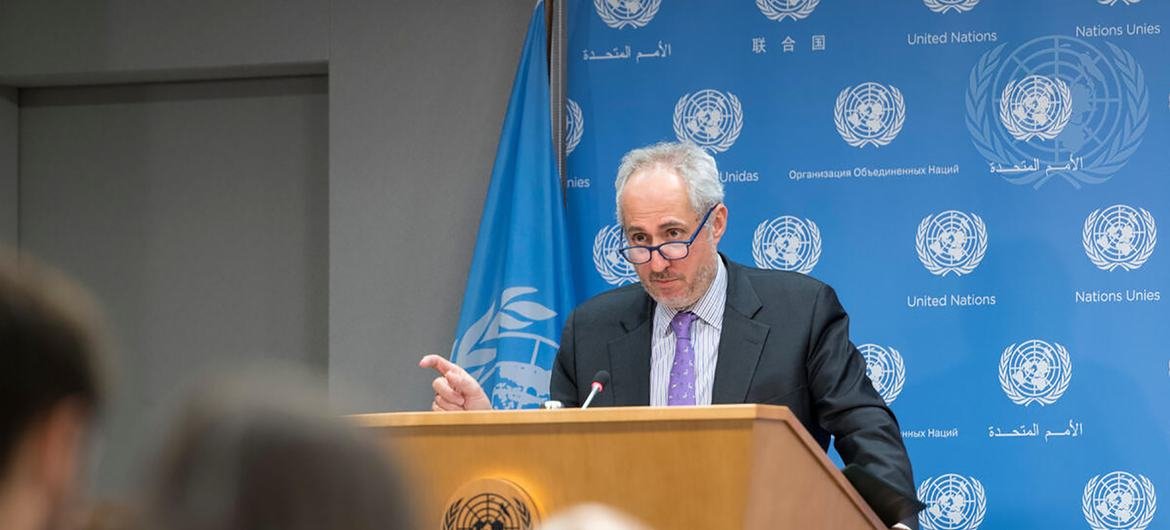
This commitment, expressed by the spokesperson of the Secretary-General, Stéphane Dujarric, during the daily press briefing, goes beyond mere procedural formality. It rather reflects the nature of the current phase, where quiet diplomacy takes precedence over media exposure, in an attempt to contain tensions and offer negotiations space to progress away from public pressure.
Dujarric confirmed that the two officials did indeed present their briefings before the Security Council, without revealing their content, referring instead to a later publication on official UN channels. This deliberate silence fits within a broader strategy aimed at limiting leaks around highly sensitive issues, especially when political processes are still under construction.
The Security Council meeting falls within the framework of following up on Resolution 2797, which explicitly calls for direct negotiations between the concerned parties, on the basis of the autonomy proposal presented by Morocco in 2007. This repositioning of the negotiation reference reflects, according to several diplomatic readings, a shift from a logic of “conflict management” to a logic of “realistic framing of the solution.”
This dynamic has begun to materialize through rounds of discussions organized in Washington, under joint UN and American co-chairmanship. The UN had also specified that the same parties that participated in the Madrid discussions — Morocco, Algeria, Mauritania, and the Polisario Front — were also present in this new round, a sign of a will to rebuild an inclusive but more structured negotiation framework.
However, what particularly marks this phase is what Dujarric described as “strategic prudence.” He stressed that the UN envoy is, for now, favoring silence in order to “give negotiations the best chances of success.” A formulation that reflects an awareness that any premature disclosure could weaken a process that is still fragile.
In a broader reading, this approach reveals a shift toward a diplomacy of “managing expectations,” where information itself becomes a lever of negotiation, rather than a simple tool of communication. This explains the choice to delay the publication of details, despite their actual presentation before the Council.
In the background, Resolution 2797 remains the structuring framework of this new sequence, seeking to relaunch a political dynamic under UN supervision and American impetus, in a regional context marked by sensitive balances. Between calculated silence and promises of delayed transparency, the UN moves along a narrow line, trying to preserve the continuity of dialogue without exposing it to media turbulence.
A central question therefore remains: are we witnessing the gradual emergence of a political solution, or a reconfiguration of conflict management mechanisms without immediate resolution? A question whose answer still seems, for now, in the making, even within the UN circles themselves.


