

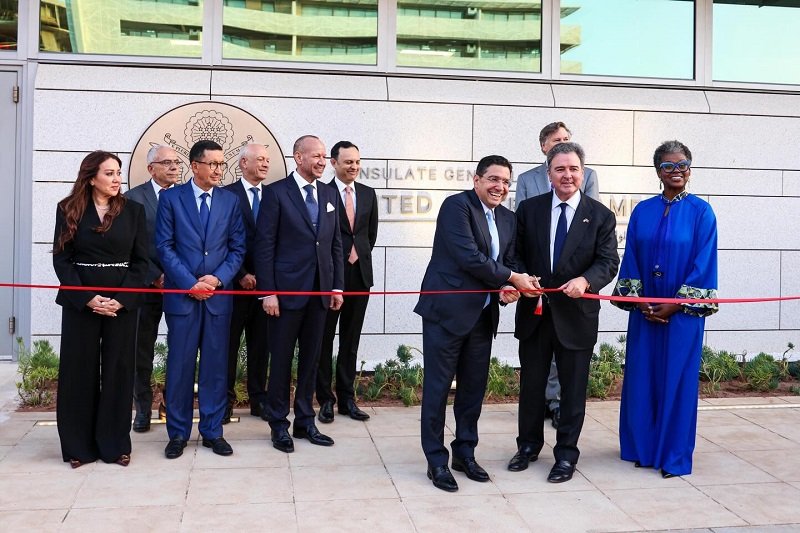
Far from being a mere protocol-driven ceremony, the inauguration of the new U.S. consulate in Casablanca unfolds as a moment dense with strategic meaning. It reflects a deeper shift in how Washington positions itself within Morocco, where symbols, location, and high-level attendance all converge to signal more than administrative expansion. Alongside U.S. Deputy Secretary of State Lando and Duke Buchan III, the opening of what is now the newest American diplomatic facility in the world marks a new chapter in a relationship spanning nearly 250 years.
The contrast is striking: from American Legation in Tangier—a relic of early diplomatic recognition—to this newly established consulate at the heart of Casablanca Finance City. The shift is not merely architectural, but conceptual: from traditional diplomacy to an economically anchored presence, where financial centers become arenas of geopolitical influence.
This evolution is further underscored by the level of Moroccan representation, notably Nasser Bourita and Fouad Ali El Himma. The latter’s rare appearance at such an event elevates its significance, suggesting that the moment transcends routine diplomacy and enters the realm of strategic signaling at the highest level of the state.
At its core, this inauguration points to a quiet redefinition of diplomatic tools. Consulates are no longer limited to administrative functions; they are evolving into operational platforms that facilitate investment flows, support business ecosystems, and embed influence within key economic nodes. Casablanca, as a gateway to Africa, becomes a critical anchor in this broader global competition.
Morocco, in turn, appears not as a passive host but as an active architect of this transformation. By reinforcing its role as a bridge between Africa, Europe, and the United States, it leverages its geopolitical stability into economic capital. The consulate thus reflects a dual dynamic: an अमेरिकी strategic projection and a Moroccan ambition to integrate more deeply into global value chains.
From Tangier to Casablanca, the Moroccan-American relationship continues to evolve, bridging history with forward-looking strategy. Beneath the surface of this inauguration lies a more intricate reality—one in which diplomacy is increasingly intertwined with economic geography, and where each such event signals a recalibration of global alignments.


