

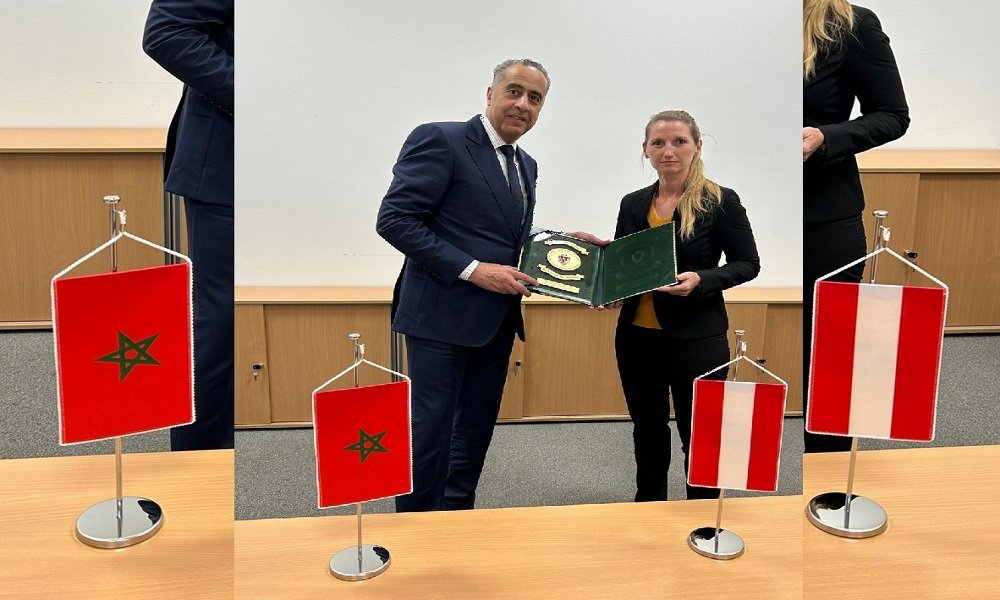
Moroccan security visits to major international capitals are no longer mere diplomatic protocol. Over the years, they have evolved into political and strategic indicators of Morocco’s rise as a regional and international security power capable of asserting itself at the heart of the world’s most sensitive and complex issues. From Vienna — the city hosting United Nations offices and some of the world’s most important intelligence and security coordination centers — the Director General of National Security and Territorial Surveillance, Abdellatif Hammouchi, continues to strengthen Morocco’s image as a country that no longer merely consumes security, but increasingly produces and exports its expertise in combating terrorism, extremism, and transnational crime.
Hammouchi’s working visit to Austria from May 5 to 7 cannot be interpreted as an ordinary series of technical meetings. What is unfolding behind the scenes of these international security gatherings reveals that Morocco has entered a new phase of strategic influence within global security decision-making circles. When Arab, regional, and international intelligence agencies gather under the umbrella of the United Nations and the Moroccan model stands out as one of the most discussed and studied experiences, the matter goes far beyond simple participation. It reflects an implicit recognition that Morocco has become a key actor in the equation of global security.
Vienna — where major intelligence agencies operate with extreme discretion — did not receive an ordinary security official this time. It welcomed the man whose name has become associated over recent years with dismantling numerous terrorist plots not only inside Morocco but also across European territory. It was therefore unsurprising that the Director General of Austria’s State Protection and Intelligence Services, Silvia Mayer, praised the significant intelligence support provided by Moroccan services, which contributed to foiling dangerous terrorist operations and arresting extremists on Austrian soil itself. This represents yet another European acknowledgment that Moroccan security services are no longer working solely to protect national borders, but are now actively contributing to European and international security.
The deeper message behind this visit is that Morocco has successfully built what could be described as a genuine “security brand” within the international community. At a time when many states are suffering from security fragility and intelligence failures, Morocco, under Hammouchi’s leadership, has managed to establish a model based on proactive intelligence work, integrated security coordination, technical professionalism, and international cooperation, while simultaneously maintaining internal stability that has turned the Kingdom into a rare island of security within a highly unstable regional environment.
What increasingly attracts the attention of international partners today is Morocco’s ability to confront not only conventional terrorism, but also a complex web of interconnected threats: irregular migration, human trafficking, money laundering, arms smuggling, cybercrime, and the expanding networks of extremism across global conflict zones. These are precisely the issues that are becoming major concerns for Europe amid the geopolitical upheavals generated by wars and successive international crises.
In this context, the meetings held by the Moroccan delegation with Austrian, Turkish, Pakistani, Iraqi, and Omani security officials go far beyond temporary coordination. They reflect Morocco’s strategic effort to build a multidimensional security network that positions Rabat as a balancing intelligence hub linking Europe, the Arab world, Africa, and Asia. It is a strategy that reflects the vision of a state fully aware that future battles will no longer be won solely through conventional military power, but through strategic intelligence, anticipatory capabilities, and the ability to neutralize threats before they materialize.
At a deeper level, these Moroccan security achievements are also reshaping the country’s international image. For decades, Morocco was primarily presented as a tourism destination or a moderate economic partner. Today, however, it is increasingly viewed within international security forums as one of the most credible and effective models in counterterrorism and anti-extremism operations. This status did not emerge by chance, but rather through years of silent intelligence work, institutional modernization, and sustained investment in human resources and security technologies.
Domestically, this growing security dynamic reinforces among Moroccans the belief that the stability and security enjoyed by the Kingdom are not accidental, but rather the outcome of a constant invisible battle fought daily to shield the country from the chaos and collapse scenarios that devastated several states across the region. Within this collective perception, the name of Abdellatif Hammouchi has increasingly become associated with the image of a vigilant state that never ceases working to preserve national stability.
Yet behind this strong security image lies an even deeper diplomatic and geopolitical dimension. Every Moroccan security success automatically becomes a strategic asset strengthening the Kingdom’s position in international relations and sensitive negotiations. In today’s world — where disorder and instability dominate global politics — countries capable of producing security are becoming indispensable partners.
Thus, the visit of Abdellatif Hammouchi to Vienna appears far more significant than a routine diplomatic mission. It represents a new demonstration of Morocco’s emergence as a discreet yet influential security power, capable of asserting itself within the world’s most sensitive security files, at a time when Moroccan security expertise is becoming one of the Kingdom’s most powerful instruments of international influence and strategic credibility.


