

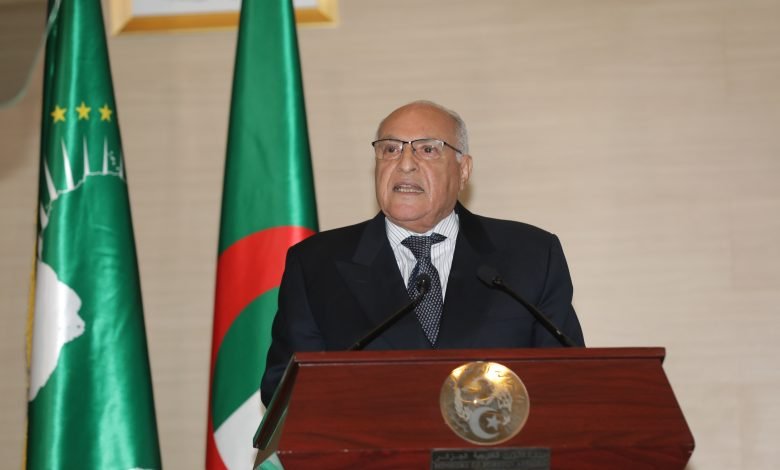
At a critical political juncture where regional balances surrounding the Western Sahara issue are being gradually reshaped, Algeria’s recent public stance appears noticeably different from the tone that has long dominated its diplomatic discourse. The statement by Foreign Minister Ahmed Attaf, welcoming the “negotiation process” launched under the joint auspices of the United Nations and the United States, goes beyond routine diplomatic language. It is widely interpreted as a signal of a gradual shift in Algeria’s approach to a conflict that has become central to Maghreb stability.
This discursive shift takes place within an international context shaped by renewed diplomatic activity under the framework of the United Nations, involving the main stakeholders of the dispute: Morocco, Algeria, Mauritania, and the Polisario Front. What is changing is not merely the acceptance of the term “negotiations,” but the implicit acknowledgment of an expanded political framework in which Algeria is no longer external to the process, but structurally embedded within it.
🚨 Conférence de presse d’Ahmed Attaf : « Les 2 parties du conflit sont le royaume du Maroc 🇲🇦 et le Front POLISARIO 🇪🇭. » En gros, allez négocier dans le cadre de l’ONU 🇺🇳. Ça ne nous regarde pas 😀. pic.twitter.com/tYfvR0s3FB
— Springfield (@springfield_dz) May 24, 2026
This evolution becomes more significant when read alongside recent United Nations resolutions, which increasingly highlight the Moroccan autonomy initiative as the most realistic basis for a political settlement. Within this emerging diplomatic environment, traditional rigid positions are giving way to a logic of negotiated compromise shaped by geopolitical constraints.
Statements by Algerian President Abdelmadjid Tebboune, which have recently appeared more cautious and less confrontational, further reinforce the perception of a gradual recalibration. The shift from confrontational rhetoric to a more institutional language centered on the “UN-led process” reflects a subtle but meaningful transformation in official discourse.
This development cannot be separated from the broader regional security context, particularly rising instability in the Sahel and growing concerns over spillover effects into the Maghreb. In this setting, the Western Sahara issue is increasingly framed not as a frozen bilateral dispute, but as a factor directly linked to regional security architecture.
At the same time, evolving positions by Western powers—particularly the United States—have contributed to accelerating this recalibration. Recent statements condemning certain actions attributed to the Polisario Front and urging a renewed political process reflect a stronger push toward ending prolonged stalemate management.
Against this backdrop, Algeria appears to be entering a phase of strategic adjustment, seeking to align its discourse with shifting international realities where rigid positions are becoming harder to sustain.
Ultimately, what is unfolding is not only a change in language, but a deeper transformation in political grammar—caught between historical narratives and contemporary geopolitical constraints. The central question remains open: is this a genuine strategic redefinition of Algeria’s position, or a tactical adjustment driven by changing global power dynamics?


