

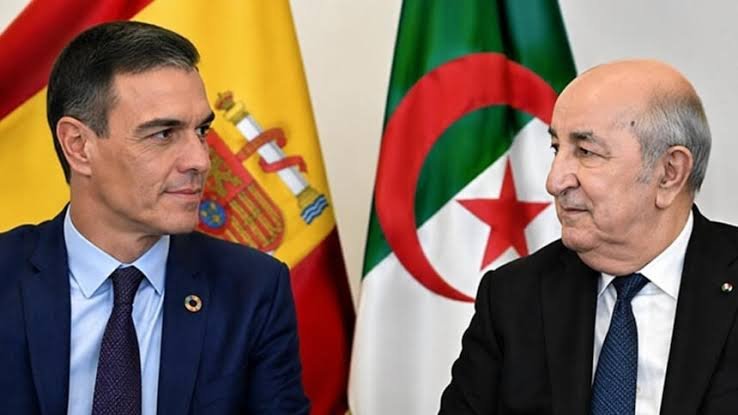
The arrest of Algerian businessman and former media owner Ayoub Aïssou at Barcelona airport has brought back to the surface a question that goes far beyond his personal case. Detained at El Prat airport in July 2026 following a request from Algeria and held pending examination of the extradition procedure by the Spanish courts, Aïssou now finds himself at the intersection of two competing narratives: Algiers presents the case as a judicial and financial matter, while his defense argues that the proceedings are also connected to his media activities and political positions. In such cases, the central question is not simply what Algeria legally accuses him of, but whether the judicial proceedings can genuinely be separated from the political context in which they have unfolded.
Aïssou is not an unknown figure in Algeria’s political and media landscape. His name is closely associated with “Djazaïria One,” the television channel he owned before it was shut down by Algerian authorities in August 2021. His career has also been marked by economic and media activities that placed him at the center of several controversies. British official records identify Aïssou as a person exercising significant control over a company connected to the channel. His international trajectory, including periods spent in France, Italy and the United Arab Emirates, gradually turned him into a figure living outside Algeria while remaining the subject of judicial proceedings initiated by Algiers.
In December 2025, Algerian courts reportedly sentenced him in absentia to twenty years in prison, a conviction that was subsequently upheld on appeal in March 2026. The accusations concern, among other matters, financial and economic offences, giving Algiers an argument that is legally different from a straightforward prosecution of a political opponent. That distinction is likely to become central to the legal battle in Spain. Being an opponent does not, by itself, automatically transform criminal proceedings into political persecution. But if the defense can demonstrate that the criminal charges are also being used to punish Aïssou for his media activities or political positions, the nature of the case could look very different from the perspective of a Spanish court.
Spanish law places clear limits on extradition. It excludes surrender in cases where there are serious reasons to believe that a request is intended to prosecute or punish a person because of political opinions. It also provides safeguards concerning the death penalty and the risk of treatment contrary to human dignity or physical integrity. A Spanish judge therefore cannot reduce the matter to the existence of a foreign warrant or conviction. The court must also assess the concrete consequences that surrender could have for the person once returned to the requesting state.
This is where Aïssou’s case intersects with the recent history of Algerian opponents who were returned to Algeria after passing through Spain. The case of Mohamed Abdallah remains particularly sensitive. The former Algerian military officer, who had sought refuge in Spain, was returned to Algeria in August 2021. Human rights organizations subsequently reported his detention and his allegations of ill-treatment and torture. His case helped place on the European agenda a difficult question about the safeguards available to Algerian opponents when Algiers seeks their return.
But it was the case of Mohamed Benhalima that gave the issue an even more serious dimension. A former military officer and activist who had taken part in the 2019 protest movement, Benhalima left Algeria and sought asylum in Spain. Amnesty International publicly called on Madrid not to return him, warning of the risk of torture, arbitrary detention and serious human rights violations. He was nevertheless deported to Algeria on 24 March 2022. Human rights organizations considered the decision a violation of the principle of non-refoulement, which prohibits returning a person to a country where there are substantial grounds for believing that they face a real risk of torture or inhuman treatment.
What happened to Benhalima after his return made the precedent even harder to ignore. He was detained and prosecuted in Algeria. In May 2022, he learned that he had been sentenced to death in absentia by a military court while he was still in Spain. Weeks later, he told an Algerian court that he had been tortured. The Benhalima case does not establish that every Algerian opponent returned from Spain will face the same fate, but it constitutes a significant element in assessing the risks Spanish authorities must consider when a new request for surrender comes from Algiers.
That is precisely why the Aïssou case deserves close scrutiny. The proceedings have not yet reached their conclusion and he has not been surrendered to Algeria. His case therefore remains legally distinct from those of Mohamed Abdallah and Mohamed Benhalima. But the precedents exist, and they give his defense concrete grounds to argue that the Algerian request should not be examined solely as a formal matter of judicial cooperation. The question will be whether the guarantees provided by Algeria are strong enough to rule out the possibility of political persecution, inhuman treatment or judicial proceedings incompatible with European legal standards.
Behind this legal battle lies another reality, more difficult to measure and more delicate to prove: the strategic relationship between Madrid and Algiers. Algeria is not simply, for Spain, a neighboring state with which it maintains judicial cooperation. It is also a major energy partner. According to official data from Enagás, Algeria was Spain’s largest gas supplier in 2025, accounting for around 35 percent of total supplies. Those figures do not mean that Spain is entirely dependent on Algerian gas, but they demonstrate the strategic weight Algeria carries in Spain’s energy security.
This is where the expression “gas against opponents” must be handled carefully. The available evidence establishes an important energy relationship between the two countries. It also establishes that several Algerian opponents were returned from Spain in circumstances that generated serious criticism from human rights organizations. It does not, however, prove the existence of a secret agreement under which Madrid handed over opponents in exchange for energy guarantees or a gas-related advantage. Moving directly from coincidence to causation would turn a political hypothesis into an established fact.
The real question is more subtle. It is about the extent to which strategic interests can influence the political environment in which judicial and administrative decisions are made. A major energy relationship does not necessarily mean that judges receive political instructions. It does mean, however, that decisions concerning Algeria take place within a much broader bilateral relationship involving energy, security, migration, economic cooperation and diplomatic interests. In such an environment, every case involving an Algerian opponent inevitably acquires a political dimension that extends beyond the individual judicial file.
The previous expulsions of Mohamed Abdallah and Mohamed Benhalima occurred during a period when Spanish-Algerian relations had become particularly sensitive. That does not prove that their return was ordered because of gas or in exchange for any Algerian concession. Such a claim would require documents, testimony or independent evidence. But the chronological relationship between individual cases and the strategic interests of the two states is sufficient to justify a journalistic question: when Madrid deals with Algiers over a case involving an opponent, precisely how much room is left for political and strategic considerations around the judicial decision?
The Aïssou case could therefore become another indicator of where that boundary lies. Algeria can present before the Spanish courts a criminal case based on convictions and financial allegations. His defense can argue that the political dimension of his career cannot be separated from the proceedings brought against him. Between these two narratives, the court will have to determine whether the guarantees offered by Algeria are sufficient and whether the risks Aïssou would face upon return are compatible with Spain’s legal obligations.
The principle of non-refoulement is the red line here. It prevents a state from returning a person to a country where there are substantial grounds for believing that they would face torture or inhuman or degrading treatment. The European human rights framework reinforces that obligation, particularly when extradition could expose an individual to a real risk of serious rights violations. In Aïssou’s case, therefore, the question is not simply whether Algeria has a legitimate basis for requesting his surrender. It is whether Spain can legally and credibly guarantee what will happen to him after that surrender.
This is where the precedents acquire their full weight. The Benhalima case provides human rights defenders with a concrete example of what can happen when warnings about the risks of return are not adequately addressed. The Abdallah case adds another element to that record. The new case will therefore not be examined in a historical vacuum. It will inevitably be viewed against what happened before, the guarantees that were invoked at the time and the consequences that followed.
For Madrid, the equation is particularly difficult. Spain must preserve judicial cooperation with Algeria and maintain a strategic relationship in which energy is one of the central pillars. At the same time, it must demonstrate that this cooperation has limits when it collides with its European and international human rights obligations. Judicial cooperation cannot become an automatic mechanism for transferring people to another state when the risk of persecution, torture or inhuman treatment has not been seriously excluded.
That is why the real significance of the Aïssou case cannot be reduced to the question of whether Madrid will extradite him. If he is surrendered to Algeria, attention will turn to what guarantees were obtained and how the risks were assessed. If the Spanish courts refuse his surrender, the decision will indicate that judicial cooperation with Algiers stops where European obligations to protect fundamental rights begin. In either scenario, the case will say more about the limits of Spain’s relationship with Algeria than about the fate of a single businessman and former media owner.
The Aïssou case ultimately brings three realities together in one place: an Algerian judicial request based on criminal allegations, a record of previous returns of opponents that generated serious human rights concerns, and an energy relationship in which Algeria occupies a major position. The headline “gas against opponents” can therefore serve as an investigative question, but not yet as a conclusion. What can be established is the strategic importance of Algerian gas for Spain, the existence of judicial precedents and the documented warnings concerning the fate of certain opponents after their return to Algeria. What remains to be demonstrated is whether any form of quid pro quo exists between Madrid’s energy interests and Algiers’ demands for the return of its opponents.
It is precisely this grey zone that gives the Aïssou case its political significance. It forces Spain to demonstrate that, in a relationship where strategic interests are considerable, the law remains the ultimate boundary. If Madrid decides to surrender Aïssou, it will have to show that his extradition does not expose him to a risk incompatible with Spain’s legal obligations. If it refuses, it will send Algiers the message that judicial cooperation has limits. In either case, the decision will reveal far more than the fate of Ayoub Aïssou alone: it will test Spain’s ability to maintain a credible separation between its strategic interests with Algeria and the obligations imposed by its own rule of law.


