

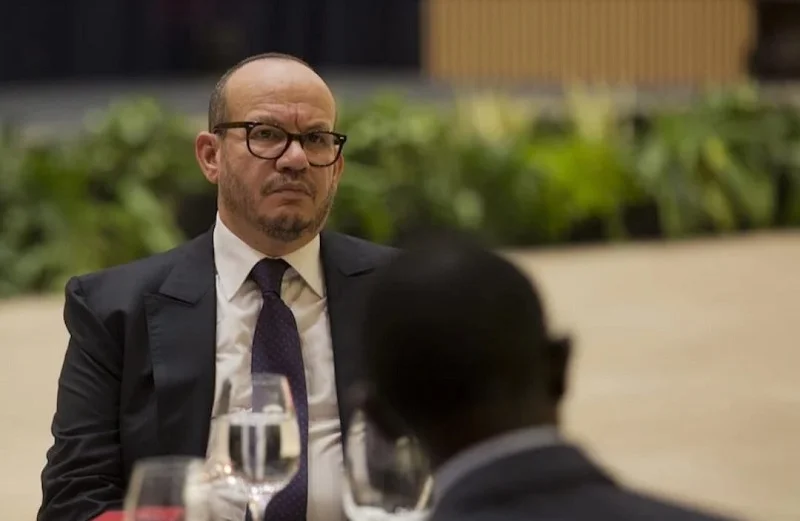
The investigation published by The Objective into the recent events in Ceuta deserves to be read beyond its spectacular headline and the political and media attention it has generated. The issue is not limited to interpreting the migration wave that affected the occupied city. It also lies in the way the newspaper moves from a complex set of border-related facts to a political narrative that places Fouad Ali El Himma, Adviser to His Majesty King Mohammed VI, in the position of the person who allegedly made the decision, or even the architect of what happened. Such a shift is particularly sensitive, not only because of the man’s position within the Moroccan state, but also because an accusation against a figure located at the heart of decision-making circles necessarily goes beyond the individual and touches upon the way the state itself is perceived to function. Defending Fouad Ali El Himma therefore requires neither an emotional plea nor a political counter-denial. Above all, it requires dismantling the narrative itself and returning to the question that should govern any journalistic investigation: where do the facts end, and where does interpretation begin?
The article highlights a body of information concerning the scale of arrivals in Ceuta and the political and security context in which they occurred, before establishing connections between these elements that ultimately lead to the hypothesis of a Moroccan decision taken at the centre of power. But the scale of an event, by itself, does not establish its origin. Likewise, the existence of mobilisation or organisation is not enough to establish the identity of the person who allegedly made the political decision to organise it. This is where one of the central issues in the case lies: there are several distinct levels between proving that a mobilisation was organised, proving that there was deliberate security inaction, proving the existence of a political decision, attributing that decision to the Moroccan state, and finally attributing it personally to Fouad Ali El Himma. Each level requires its own demonstration. The last cannot simply be established through the force of precedents.
The figures accompanying the crisis undoubtedly demonstrate the exceptional pressure placed on Ceuta. They do not, however, answer the question placed at the centre of the newspaper’s narrative: who made the decision? The reported facts describe a very large number of arrivals, repeated attempts to cross by sea, and the saturation of reception facilities. They make it possible to measure the scale of the crisis, but not to identify the person who allegedly caused it. Even if the Spanish investigation establishes that the movement was massive and, in certain respects, organised, it cannot move from that finding to the designation of Fouad Ali El Himma without producing a chain of evidence specifically establishing that attribution.
A first weakness therefore emerges: the events did not begin on a single day, nor did they appear out of nowhere. Before the late-July peak, several attempts to cross by sea had already been recorded, while the number of arrivals was increasing and Spain’s legal environment was evolving. On 8 July 2026, in particular, Spain’s Supreme Court ruled that people arriving in Ceuta and Melilla by sea could not automatically be subjected to the same mechanism of devolución en caliente as those crossing border-protection barriers. Their situation was instead required to fall under the ordinary return procedure. That ruling, issued before the late-July peak, constitutes an objective factor that would be difficult to exclude from an analysis of the calculations made by migrants and the networks facilitating their crossings. Spanish Supreme Court
This does not, of course, mean that the judicial ruling alone explains what happened. That would reproduce precisely the error we are seeking to avoid. It does, however, show that the legal environment governing attempted crossings had changed before the crisis erupted, and that this change could have altered the calculation of risks and chances among those considering the crossing. When an investigator has, at the same time, a new legal factor, digital mobilisation, migration networks, social and economic factors, and a succession of attempts already under way, moving immediately to the hypothesis of a political decision emanating from a specific Moroccan personality does not broaden the investigation. It narrows it.
Subsequent developments further reinforced the importance of the legal factor. After the crisis, Spanish authorities began considering the maritime protection of Ceuta and the mechanisms for controlling arrivals, precisely in a context in which the judicial ruling had redefined the limits of interceptions at sea. This means that the Supreme Court ruling was indeed part of the operational environment in which the crisis must be understood. It was not merely a peripheral legal detail that could be discarded in favour of a pre-established political narrative.
Another factor deserves the same attention: the digital environment preceding the mass arrivals. Reports concerning the crisis referred to videos, photographs and messages circulating on social media, as well as their influence on young people who decided to join the attempts to cross. Testimonies reported after the crisis indicated, in particular, that some young people had seen on Instagram images of people who had managed to enter Ceuta before deciding to leave themselves. This does not prove that the movement was entirely spontaneous. But it does demonstrate the existence of an autonomous channel capable of producing collective mobilisation without requiring, at this stage, the assumption of a central political order.
It would be equally erroneous to confuse organisation with political decision-making. Closed groups can coordinate schedules, routes and gathering points; pages can circulate misleading or encouraging information; smuggling networks can exploit a collective willingness that already exists; hundreds of people can respond almost simultaneously to the same message. Seen from the outside, all of this can create the impression of highly sophisticated coordination. But that appearance does not, by itself, constitute evidence of a political command centre operating at the heart of the state. That is precisely the gap that serious investigative work must bridge with verifiable evidence.
The facts on the ground raise a particularly difficult question for the narrative portraying Fouad Ali El Himma as the person who allegedly decided to open the way for a human wave toward Ceuta. The data reported in the dossier itself refer to the intervention of Moroccan authorities to intercept crossing attempts and rescue people in difficulty, as well as the mobilisation of Moroccan maritime resources. If a central decision had genuinely been made to facilitate a collective wave toward Ceuta, how should these facts be incorporated into the narrative? They are obviously not sufficient, by themselves, to rule out the existence of some political calculation. But they do, at a minimum, make it impossible to move from a political hypothesis to a personal accusation without demonstrating the connection.
Another element broadens the analytical field further: the increase in attempted crossings recorded before the July peak. The data cited in the article indicate that irregular entries toward Ceuta and Melilla had already risen sharply before the late-July events. This does not prove the absence of political intervention. But it weakens the idea that the crisis suddenly emerged from a single decision. The migration phenomenon already possessed its own momentum, one that requires a plural explanation.
This is also why the use of the 2021 events must be handled with considerable caution. The Ceuta crisis of May 2021 unquestionably became one of the most sensitive episodes in Moroccan-Spanish relations, and Fouad Ali El Himma’s name appeared in some Spanish interpretations of that period. But a political precedent does not automatically become evidence in a case occurring five years later. It may help explain a context, reveal a particular perception of power relations, or illuminate a method of interpretation. It does not demonstrate that the same scenario was repeated in 2026. If the newspaper wishes to establish that the same role was played by the same man, it must produce evidence directly connecting Fouad Ali El Himma to the events of 2026.
The same caution must be applied to attempts to connect the Ceuta crisis with Morocco’s internal political rivalries. Referring to the relationship between Fouad Ali El Himma and Aziz Akhannouch, and then suggesting that the crisis was used to weaken the head of government or influence the electoral landscape, is not simply an extension of the investigation. It is the core of an entirely separate political narrative. It therefore requires a higher evidentiary standard. Political competition exists in every system, and the proximity of an election does not automatically turn an external crisis into an electoral instrument. Likewise, even if the existence of a political decision were established, that would still not demonstrate the specific purpose attributed to it.
The questions therefore become unavoidable: What precise objective was allegedly being pursued? What decision was supposed to be changed? How was the Ceuta crisis supposed to achieve that objective? And what evidence establishes a direct link between that objective and Fouad Ali El Himma? These are not defensive questions. They are the questions the investigation itself necessarily raises. If it places the man in the position of the person who allegedly made the decision, readers are entitled to know the trajectory of that decision: who proposed it, who made it, through which channel it was transmitted, how it was implemented, and what evidence establishes the personal role of the King’s Adviser.
The broader context of Moroccan-Spanish relations must also be incorporated into this reading. Before the July wave, coordination mechanisms between the two countries were publicly operating in the migration field and within the framework of Operation Marhaba. Morocco and Spain were also pursuing cooperation on regular migration and border control. These facts do not prove the absence of political tensions between Rabat and Madrid, nor do they demonstrate that disagreements did not exist on other matters. They do, however, show that any interpretation presenting the Ceuta events as the expression of a single hostile Moroccan decision must also explain the institutional and diplomatic framework that existed before the crisis.
This is precisely where the distinction between the state and the individual becomes fundamental. The Moroccan state, with its institutions, administrations, services and decision-making centres, is not a single person. And a Royal Adviser, regardless of his importance and proximity to the centre of decision-making, does not automatically become the personal author of every decision taken by the state or the person responsible for every crisis occurring within its environment. This distinction does not diminish Fouad Ali El Himma’s position. On the contrary, it protects the very meaning of institutional responsibility: the closer a public figure is to the centre of decision-making, the more precise the accuser must be in distinguishing what is known from what is inferred.
The use of anonymous sources demands the same rigour. Investigative journalism can perfectly legitimately work with confidential sources, particularly in cases involving centres of power and sensitive services. But the anonymity of a source does not exempt an investigation from its obligation to demonstrate its claims. An unidentified source can be decisive if that source has direct access to the information, if the account is corroborated by independent sources, if the details provided can be verified, and if several elements converge toward the same conclusion. The more serious the accusation, the stronger the evidentiary architecture must be.
The central problem with the narrative, therefore, is not that the newspaper mentioned Fouad Ali El Himma, nor that he has genuine influence within Morocco’s institutional landscape. The problem begins when influence becomes a presumption of action, alleged action becomes a decision, the alleged decision is then assigned a precise political purpose, and the entire construction is presented to the reader as one demonstrated reality. At that moment, influence replaces evidence, and proximity to power becomes evidence of the exercise of power. That is a logic that would be difficult to accept if journalism intends to preserve the boundary between investigation and interpretation.
The image of Fouad Ali El Himma itself can thus become part of the problem. Because he is known for his proximity to the centre of decision-making and his role in several strategic matters, he can become a convenient interpretive key for explaining events that are difficult to decipher. But it is precisely this convenience that requires greater caution. An influential figure can gradually become, within certain narratives, the character through whom every obscure event is explained. Influence then ceases to be a political fact and becomes a general presumption of responsibility. This is a journalistic risk before it is a political disagreement.
Defending Fouad Ali El Himma, from this perspective, should therefore not mean defending a man against the press. It means defending his right, like that of any individual, to have an accusation against him measured against evidence proportionate to its seriousness. No one is above scrutiny. But neither should anyone become a suspect simply because their position makes it possible to construct an apparently coherent narrative around them. Genuine accountability begins with a specific fact, specific evidence and specific responsibility.
That is the difference between an investigation that opens a question and one that closes the answer before the evidence has been assembled. The first tells the reader: here are the facts, here are the indications, here are the hypotheses, and here is what remains to be established. The second begins with a conclusion and then reorganises the facts to reinforce it. In the case of Ceuta, caution is all the more necessary because the event consists of several layers: a judicial decision preceding the peak, digital mobilisation, migration networks, social factors, individual decisions transformed into collective movement, and closely intertwined Moroccan and Spanish security management. These elements do not exclude the possibility of political calculation. But they make attributing the entire phenomenon to one individual particularly demanding in terms of evidence.
Developments after the crisis provide another revealing element. Spain itself began reassessing the security and legal mechanisms governing the protection of Ceuta and the management of arrivals, while the question of whether Spanish services had prior information about the scale of the wave also became the subject of institutional inquiries. This shows that the question of who knew what, and when remains open within the Spanish institutions themselves. It has therefore not become an established truth capable of automatically assigning individual Moroccan responsibility.
The debate over the fate of those who entered Ceuta after the events also demonstrates that the crisis did not end at the moment of crossing the border. It continued through legal, diplomatic, security and humanitarian dimensions, including the question of returning those who entered irregularly and the practical application of Spanish procedures. Here again, the full story of the crisis lies in a succession of decisions and interactions on both sides of the border, not in the search for a single figure to whom the entire phenomenon can be attributed.
The fairest position, therefore, is to acknowledge that the question of possible organisation, deliberate non-intervention or political decision-making remains legitimate. But the legitimacy of the question does not mean that the proposed answer has been demonstrated. New information may still emerge and alter the analysis. Journalism cannot, however, turn a hypothesis into truth before those elements have been established. This principle is not a favour granted to Fouad Ali El Himma. It is a minimum requirement of evidence.
Ultimately, the case requires neither turning Fouad Ali El Himma into an untouchable figure nor making him the convenient person responsible for everything that remains obscure in Moroccan-Spanish relations. Fouad Ali El Himma is an Adviser to His Majesty the King, and his position within the state gives any accusation concerning him particular significance. That is precisely why his defence must be based on a principle rather than personal loyalty: individual responsibility cannot be inferred from influence; a decision cannot be inferred from proximity; and an accusation does not become truth simply because it is repeated.
If The Objective possesses direct evidence or a chain of independent sources specifically linking Fouad Ali El Himma to a decision concerning the events in Ceuta in July 2026, those elements should constitute the heart of the debate. They would make it possible to discuss the man’s responsibility on a concrete basis. But if the construction rests on his position, his influence, previous narratives, a hypothesis of political rivalry, and a general interpretation of events that ultimately leads to his name, then what is being presented remains a debatable political narrative, not a definitive conclusion regarding the man’s responsibility.
This is where the defence of Fouad Ali El Himma ultimately becomes a defence of journalism itself: a man close to the centre of decision-making cannot become a substitute for evidence; a precedent cannot automatically become proof that history has repeated itself; and a presumption cannot become a conviction. Ceuta deserves an investigation capable of establishing what actually happened, who acted, how and why. It does not deserve for a culprit to be chosen before the facts have identified one. Between a question and an accusation lies a distance that only evidence can legitimately cross.


