

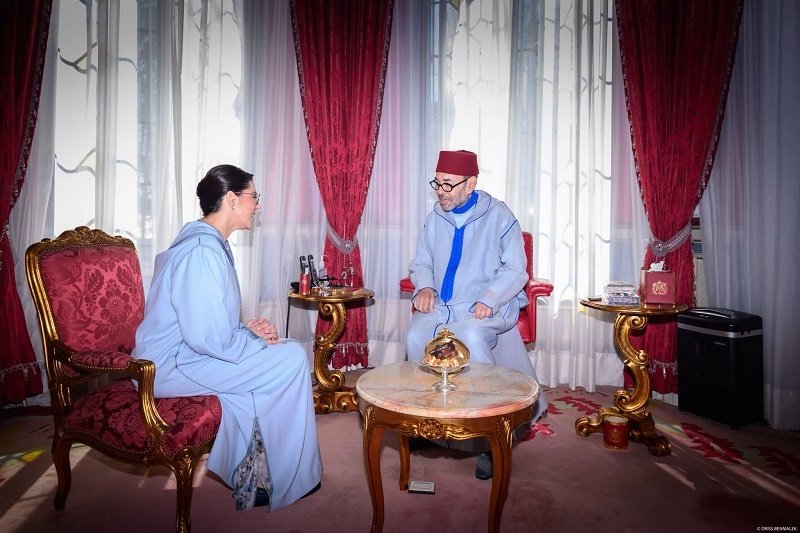
There is no longer any speculation over the identity of Morocco’s next head of government. A few days after legislative elections reshaped the parliamentary map, King Mohammed VI received Fatima Zahra Mansouri, coordinator of the collective leadership of the Party of Authenticity and Modernity (PAM), at the Royal Palace in Rabat on Tuesday, September 29, 2026, and appointed her head of government, tasking her with forming the new government.
Fatima Zahra Mansouri Appointed Head of Government: The Appointment Is Settled, the Government Starts Now
فاطمة الزهراء المنصوري رئيسةً للحكومة.. التعيين حُسم، أما الحكومة فبدأت الآن pic.twitter.com/5EJMHXixyH— Diplomatique.ma الدبلوماسية (@diplomatique_ma) September 29, 2026
The appointment follows the PAM’s first-place finish in the legislative elections, with 97 seats, ahead of the National Rally of Independents (RNI), with 66 seats, and the Istiqlal Party, with 65. The Justice and Development Party (PJD) won 54 seats.
The appointment may appear to be a direct continuation of the election results. But the Constitution places another stage between the electoral outcome and the formation of a government, and that stage is no less important: choosing the head of government from the party that came first is one matter; building a parliamentary majority capable of supporting the government is another.
Article 47 of the 2011 Constitution provides that the King appoints the head of government from within the political party that comes first in the elections to the House of Representatives, on the basis of their results. The members of the government are then appointed by the King upon a proposal from the head of government.
Fatima Zahra Mansouri therefore enters office with a task that goes beyond the announcement of her appointment. The name is now known. But the parties that will form the majority, the composition of the government, the distribution of portfolios and the nature of the political agreements remain to be worked out.
That is where another political phase begins.
Despite coming first, the PAM does not have enough seats on its own to form a parliamentary majority. Its 97 seats give it the leading position, but they leave the question of alliances open. The results place the RNI, Istiqlal, PJD and the other parliamentary forces in a new configuration, without meaning that any particular coalition has already been decided.
Mansouri herself had recalled, after the results were announced, that the appointment of the head of government falls within the King’s constitutional prerogatives. She now formally assumes the responsibility around which political and media discussions had focused since the election results emerged.
But there is another change, one that cannot be measured in parliamentary seats.
With her appointment, a woman becomes head of government in Morocco for the first time in the country’s history. This is not the first time a Moroccan woman has reached a central position within the country’s decision-making institutions. It is, however, the first time that a woman has taken the helm of the government itself.
The trajectory did not begin today. Zoulikha Nasri was the first Moroccan woman to serve as an adviser to the King, beginning in 2000, and remained in that position until her death in 2015.
Within state institutions, Zineb El Adaoui heads the Court of Auditors, a constitutional institution responsible, among other things, for the supreme oversight of public finances and the evaluation of a number of public policies and programmes.
Mansouri, for her part, is not arriving at the head of government without political experience. She previously chaired the Marrakech Municipal Council, served in Parliament, and later became Minister of National Territorial Planning, Urban Planning, Housing and City Policy in Aziz Akhannouch’s government, before taking over the leadership of the PAM. Her career has therefore moved through local government, parliamentary work, executive responsibility and party leadership.
The significance of her appointment cannot therefore be reduced to the fact that a woman has reached the head of government. The more immediate political question is how she will use this new position at the head of the party that leads the largest parliamentary bloc, and how she will work within a House of Representatives composed of several political forces.
Here, the numbers are clearer than the speculation.
Ninety-seven seats are the starting point. What comes next requires political negotiation: a majority, a government programme, ministerial portfolios, the choice of ministers, priorities and the terms of cooperation between the parties. Nothing in Article 47 means that appointing the head of government automatically settles the appointment of the other members of the government or the formation of political alliances.
The coming days will therefore be different from those that preceded the appointment. Before it, the question was: who would the King choose? After the appointment, the practical question becomes: what government will emerge from this multi-party parliamentary configuration?
Mansouri arrives at the post with established political and executive experience, but also with a government that will face major issues: employment, public services, investment, social reforms, the continuation of strategic national projects, and preparation for the major events awaiting Morocco in the coming years, including the 2030 World Cup.
Those issues alone, however, will not determine the shape of the next government. The equation begins in Parliament, and in the ability of the appointed head of government to turn an electoral victory into a stable political majority and a government programme capable of being implemented.
The arrival of the first woman at the head of government is an institutional event with clear significance in the history of women’s political participation in Morocco. But the concrete significance of this change will also be measured by what follows the appointment: the composition of the government, the way the majority is managed, and the decisions taken once the government moves from being an expected team to becoming a government responsible for public action.
The appointment has closed a constitutional question that was still open.
The real political question begins today.


