

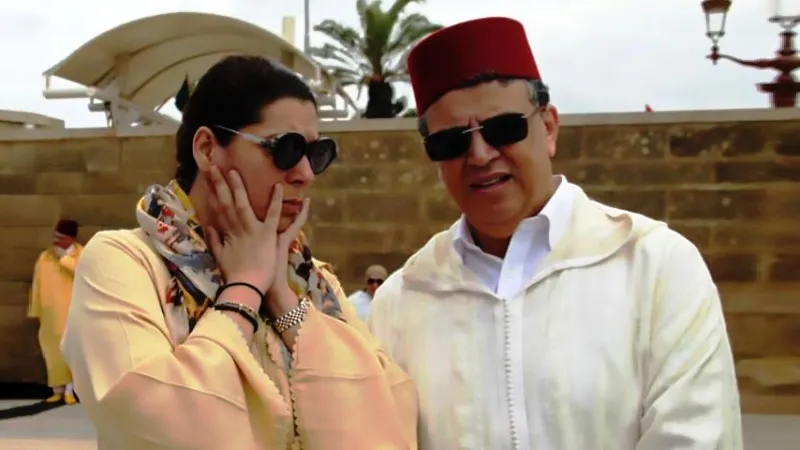
The Party of Authenticity and Modernity had little time to absorb the significance of its lead in the legislative elections, with 97 seats, before finding itself confronted with a very different kind of test. Just as the PAM had emerged at the top of the 23 September vote, a case that began with a suitcase containing election papers in Tangier gradually expanded from polling stations into a judicial investigation and eventually reached one of the party’s most prominent local figures: Monir Limouri, mayor of Tangier and the PAM’s provincial coordinator.
The Public Prosecutor’s Office at the Tangier Court of Appeal had announced that the initial investigation had resulted in the arrest of five suspects, including two polling-station presidents and their deputies, as well as another individual. According to the prosecution’s statement, preliminary inquiries showed that ballot papers had been taken out of a polling station before being returned, while the ink used on some of the papers differed from the ink used inside the two polling stations concerned. On that basis, the prosecution requested a judicial investigation into suspected violations of electoral operations, forgery and participation in such acts.
A more sensitive development followed on Monday, 28 September. Security services arrested Monir Limouri immediately after his arrival at Ibn Battouta Airport from Málaga, in execution of a search warrant issued against him. He was subsequently placed in police custody as part of the ongoing judicial investigation.
That distinction matters legally. Being placed in custody and being the subject of an investigation do not amount to a conviction. The case remains within the investigative and judicial process, which will determine the facts, any potential individual responsibility and the links, if any, between the different people involved.
The case did not begin with the mayor’s name. It began with ballot papers and individuals directly connected to the operation of polling stations. The investigation then expanded. Nothing in the publicly available information at this stage allows Limouri’s arrest to be turned into either a judicial or political conviction of the party itself, nor does it establish that the PAM is responsible for the acts currently under investigation.
Politics, however, does not always wait for a court judgment before calculating the cost of an affair.
The PAM emerged from the 23 September elections with 97 seats, ahead of the National Rally of Independents with 66, the Istiqlal Party with 65 and the Justice and Development Party with 54. The result gave the party a new weight in the political arrangements of the next phase.
Yet it came at a moment when the party’s name was already difficult to separate completely from a number of judicial cases involving some of its elected officials and prominent figures over the years.
Abderrahim El Kamel, former president of Ouled Sidi Brahim commune and former PAM parliamentary councillor, saw his six-year prison sentence confirmed by the Marrakech Court of Appeal in April 2021 in a corruption case involving the receipt of 110,000 dirhams in exchange for an administrative permit.
In El Jadida, Abdelhakim Sajda, former commune president and former member of parliament for the party, was sentenced at first instance to nine years in prison in a case involving public procurement. The Casablanca Court of Appeal upheld that sentence in September 2025.
In Tangier itself, Mohamed El Hamidi, president of the Tangier-Assilah prefectural council and a PAM leader, was sentenced at first instance in December 2024 to two years in prison, one year effective and one year suspended, in a case involving allegations of misuse and embezzlement of public funds, forgery and abuse of influence. He appealed the ruling and has continued to deny the allegations.
Then came the case known as the “Desert Escobar” affair, which gave this accumulation a much heavier national dimension. It involved, among others, Abdenbi Bioui, former president of the Oriental region, and Saïd Naciri, former member of parliament and former president of the Casablanca prefectural council. In June 2026, the criminal chamber of the Casablanca Court of Appeal at first instance sentenced Bioui to 12 years in prison and Naciri to 10 years, in a case involving multiple charges, including offences related to drug trafficking, forgery and abuse of influence.
These cases are not, legally speaking, one single case. Each has its own facts, defendants, evidence, judicial proceedings and legal trajectory. Turning them into a single collective responsibility of the party would therefore be both legally and journalistically unsound.
But their accumulation raises another question for the PAM, this time a political one: how does a political party manage the public cost of acts committed by people to whom it granted its endorsement, who exercised elected mandates under its banner and whose names remain associated with its political image?
The question is not new within the PAM.
In 2017, when Ilyas El Omari announced his resignation as party secretary-general, he explicitly referred to his responsibility for the choices that had been made, including the selection of certain parliamentarians and local elected officials endorsed by the PAM. Party nominations were thus presented as part of the political responsibility of the leadership, rather than merely as an internal procedure ending with the announcement of election results.
Several years later, the party sought to give that logic a clearer institutional form. In May 2024, its National Council unanimously adopted an ethics charter intended to regulate the responsibilities and conduct of party members. The document was presented as an instrument for promoting ethical standards in political life and as an internal framework through which the party could address misconduct by its officials.
The charter did not remain purely theoretical for long. In 2024, the party suspended Salah Eddine Abou El Ghali from the collective leadership, before its National Council took further organizational decisions concerning his position and appointed Fatima Saadi in his place. Abou El Ghali disputed the measures and offered his own account of the dispute.
Meanwhile, the PAM itself had changed its leadership structure. At its fifth national congress in February 2024, it abandoned the traditional model of a single secretary-general in favour of a collective leadership composed of Fatima Zahra Mansouri, Mohamed Mehdi Bensaid and Salah Eddine Abou El Ghali. A few months later, Fatima Saadi replaced Abou El Ghali.
The party therefore entered the Tangier affair with considerable recent experience of internal crises, ethics procedures and debates over political responsibility linked to the choices made by its leadership and its elected officials.
The current case has arrived at a particularly sensitive moment.
The PAM is no longer simply one of the parties in the outgoing governing majority. It has just emerged as the largest party in the new legislature, with 97 seats. At the same time, Fouzi Lekjaa, who joined the party during the summer of 2026, rapidly became one of its most visible figures during the election campaign and presented several important elements of its economic programme.
Even before the election, Lekjaa’s rapid rise had generated speculation about the future of the PAM’s leadership and the possibility of a change at the top. Fatima Zahra Mansouri, however, publicly rejected that interpretation, saying that Lekjaa “did not come to take anyone’s place” and that an extraordinary congress was not on the agenda.
For that reason, it would be easy—but premature—to turn Limouri’s arrest into the opening episode of a leadership change and immediately construct a succession scenario around Lekjaa.
The available facts do not support such a conclusion.
What does exist is the convergence of three developments: a party that has just won the largest number of parliamentary seats; an electoral case that has expanded in Tangier to reach a prominent local political official; and a collective leadership that has already experienced internal tensions and procedures involving ethics and organizational responsibility.
The connection between those three developments and a possible change of leadership has not, at this stage, become either an announced decision or an officially launched process.
The party’s own language regarding the Tangier affair has also evolved. In the first hours, some reactions referred to a “prepared scenario” and an attempt to target the party. As the investigation progressed, the discourse shifted towards awaiting the conclusions of the judicial authorities and taking organizational and political measures if the involvement of party members or officials were established.
That shift does not amount to an admission of responsibility. It mainly shows that the party had to move from an immediate political reading of the incident towards a more cautious handling of a case now under judicial investigation.
Nor is the case limited to the PAM. The Ministry of Interior announced the dispatch of a central inspection committee to Tangier to examine irregularities that allegedly affected the conduct of the vote in two polling stations, alongside the judicial proceedings.
That adds another layer to the case. On one side is a judicial investigation into specific acts and specific individuals. On the other is an administrative review of the functioning of the electoral process. The two should not be conflated. Responsibility for the management of a polling station is not automatically party responsibility, just as any possible party responsibility does not constitute a criminal conviction.
For the PAM, therefore, the most concrete political difficulty is not that every judicial case involving one of its members should automatically become a trial of the party itself. That would have no sound legal basis.
The more tangible difficulty lies in the cumulative cost of a succession of cases in which elected officials or political figures carrying the party’s colours appear at different levels of involvement. With every new case, the PAM is forced to explain again the boundary between an individual and the organization, between party endorsement and personal responsibility, and between internal disciplinary action and judicial conviction.
This time, the “Tangier suitcase” appeared only four days after the announcement of the party’s electoral victory. The timing carries political weight, but timing alone does not establish a strategy or responsibility.
The judicial authorities still have to determine why the ballot papers were removed from the polling stations, who removed them, under what circumstances they were returned, what relationships existed among the people targeted by the investigation, and whether the widening of the inquiry will establish additional responsibilities.
Until then, the solid fact is that the PAM, after securing its strongest result in this electoral sequence, has immediately found itself facing a test of a different nature: not the challenge of winning votes, but the challenge of managing the political and organizational consequences of choices made at the local level when some of those choices enter the field of judicial scrutiny.
And on that ground, the findings of the Tangier investigation will matter more than all the speculation that preceded them.


