

Moroccan cinema is entering a new phase in which its ambitions extend beyond securing a presence at major international film festivals. The central challenge now lies in its ability to build an integrated industry equipped to develop projects, finance productions, train professionals, secure distribution and reach audiences. The 23rd edition of the Marrakech International Film Festival highlights an important dimension of this transformation, particularly through the expanding role of the Atlas Workshops and their associated professional programmes. The festival is increasingly becoming a platform that goes beyond screening films to contributing to the creation of cinematic projects and supporting them through different stages of their development.
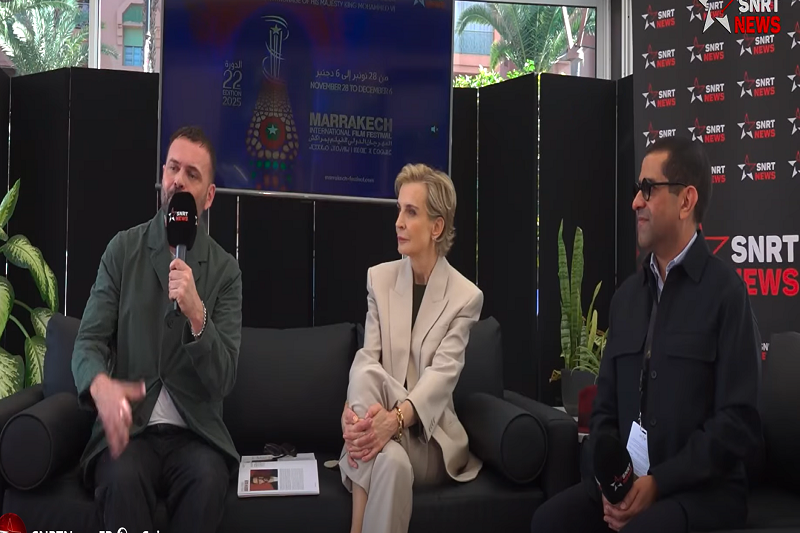
This transformation provides the most relevant starting point for examining the televised discussion broadcast by SNRT News with Mélita Toscan du Plantier, Rémi Bonhomme and Ali Hajji. The journalistic value of their contributions does not lie in listing the guests or describing organisational details and programming arrangements. It lies in the questions they raise about the festival’s position within the changing film industry and Morocco’s ability to move from cultural visibility towards building a production and distribution ecosystem with national, regional and international reach.
The Atlas Workshops: A strategic undertaking that gives the festival a life beyond its nine days
The Atlas Workshops deserve a central place in any analysis of this edition because they represent one of the most significant institutional developments in the Marrakech Film Festival’s history. Launched in 2018, the initiative has gradually evolved into a professional programme designed to support Moroccan, Arab and African filmmakers. It provides opportunities to develop projects at the development and post-production stages while facilitating exchanges with international producers, distributors, programmers and industry professionals.
This evolution reflects a broader transformation in the very concept of a film festival. A cinematic institution can no longer be measured solely by the number of films screened, the presence of international stars or the prestige of its awards. It must also be assessed by its contribution to the creation of films that will reach audiences in the years ahead. This shift is particularly important for Morocco, because building a film industry cannot rely exclusively on organising successful international events. It requires institutions capable of supporting creators, connecting projects with funding sources, facilitating production partnerships and ensuring that completed works reach their audiences.
During the televised discussion, Ali Hajji presented figures reflecting the work accumulated through this initiative: 259 projects and films supported since 2018, including 128 Moroccan projects and films, as well as 42 works that have reached major international festivals, including Cannes, Venice and Berlin, since 2019. He also referred to 55 films that had previously benefited from the Atlas Workshops and were included in the Marrakech Festival programme during this edition.
These figures, considered in context, demonstrate the programme’s ability to establish a connection between project development and access to major international cinematic platforms. However, their significance should not be reduced to the number of festival selections or the prestige of the events concerned. The more meaningful measure of success is whether this support translates into actual production opportunities, whether films can continue their journey after the initial assistance ends, and whether they can access distribution channels that bring them before audiences.
This distinction becomes particularly important when examining the expansion of the programme through Atlas Station, Atlas Press and Atlas Distribution. The objective is to address different stages of the cinematic value chain: developing producers and filmmakers, strengthening film criticism, and helping films reach audiences across the Arab world and Africa. These initiatives now operate within the broader framework known as Atlas Programs.
However, the completion of this chain depends on its ability to connect cultural support with economic investment. A film needs a screenwriter, director and producer, but it also requires a viable budget, production partners, a marketing strategy, a distributor and cinema screens. Weakness in any one of these links can make international recognition an important milestone in a film’s journey without necessarily guaranteeing its sustainability, financial recovery or the long-term professional stability of its creators.
This is the test that the Atlas Workshops will have to meet in the coming years: how many supported projects have become completed films? How many have secured distribution? How many have reached Moroccan, Arab and African audiences? And what impact has the programme had on the ability of Moroccan producers to continue developing and producing new films?
International recognition: An important achievement, but not the only measure of success
The figures presented by festival officials point to a growing presence of films developed through the Atlas Workshops at major international cinematic events. The fact that 42 films and projects have reached Cannes, Venice and Berlin since 2019 is a significant achievement. It demonstrates the ability of projects from Morocco, the Arab world and Africa to move beyond the limitations of their local markets and enter international selection circuits.
Nevertheless, this achievement calls for a deeper examination of the relationship between major international festivals and national film industries. Participation in an international festival can provide a film with artistic legitimacy, media exposure and distribution opportunities. It does not necessarily mean that the film has reached a broad audience or that its producer has succeeded in building a sustainable and repeatable economic model.
The Marrakech experience therefore intersects with a broader question facing Arab and African cinema: how can international artistic recognition be transformed into independent production capacity, rather than remaining dependent on limited funding, occasional co-production opportunities or the selection priorities of foreign festivals?
Moroccan cinema now has a genuine opportunity to expand its international presence. But this presence must go hand in hand with strengthening the domestic market, developing distribution networks, expanding cinema infrastructure and ensuring that Moroccan films remain visible beyond festival seasons and special cultural events.
A festival that helps bring films into existence also needs a national environment capable of receiving and sustaining them once they are completed.
Film programming: Balancing the discovery of new talent with the attraction of international stars
The programming of this edition raises a fundamental question about the role of film festivals at a time when digital platforms and global distribution networks have made an increasing number of films accessible to audiences. A festival’s added value is no longer measured simply by its ability to screen films attracting considerable media attention. It also lies in its capacity to discover cinematic traditions, distinctive artistic perspectives and creative experiences that struggle to find a place in commercial distribution circuits.
This approach is reflected in the combination of highly anticipated films, auteur cinema, documentaries and more experimental works, alongside a particular focus on Moroccan, Arab and African cinema. The 23rd edition, taking place from 20 to 28 November 2026, features 76 films from 39 countries, distributed across the Official Competition, Gala Screenings, Horizons, the 11th Continent, the Moroccan Panorama and programmes dedicated to young audiences and families. The selection also includes ten world premieres.
These figures reflect the breadth of the cinematic landscape the festival seeks to present. Yet the essential question concerns the artistic choices behind that diversity. The Official Competition, reserved for first and second feature films, creates space for filmmakers taking their initial steps in feature-length cinema. It also enables the festival to become a platform for discovering directors who may shape the cinematic landscape of the future.
This approach gains additional significance when examining the themes addressed by some of the selected works. Films from Rwanda, Lebanon, Palestine, Cameroon, the Central African Republic and other countries open up cinematic perspectives on the consequences of war, social and economic transformations, migration, memory and human relationships. These subjects reinforce cinema’s role as a means of understanding the world rather than merely providing entertainment or displaying technical skills.
The Moroccan film Alkibulan, directed by Yassine Marco Marroccu, is included in the Official Competition alongside Waves of Silence, directed by Farzad Samsami, a co-production involving Morocco, Norway and Sweden, featuring Amine Ennaji and Nisrine Erradi. The programme also includes other Moroccan productions in the national panorama and various sections.
This presence illustrates the different ways in which Moroccan cinema participates in the festival: through national productions, international co-productions and films made in the Kingdom.
Yet the presence of Moroccan films at an international festival should also lead to a broader question: has Moroccan cinema become capable of building a diverse artistic identity that combines cultural specificity with openness to international experiences, while producing films that speak to Moroccan audiences without losing their ability to engage viewers abroad?
The answer cannot be found simply by counting selected films. It requires a qualitative assessment of screenwriting, visual language, character development and the filmmakers’ ability to explore Moroccan transformations in depth, without relying on ready-made formulas or imitating external cinematic models.
Moroccan cinema: Production growth requires a market capable of absorbing its output
Festival representatives spoke about the renewal of Moroccan filmmaking generations, the emergence of new women and men directors, and the growing diversity of cinematic genres and subjects. This observation is consistent with developments in national production, but it needs to be examined within the wider structure of the industry.
According to the Moroccan Cinematographic Centre’s annual figures for 2025, Morocco produced 26 feature-length fiction films. Cinema attendance reached 2.19 million tickets, with box-office revenues of approximately 129.78 million dirhams and 87 active screens nationwide. Moroccan films alone attracted more than one million admissions, generating over 56 million dirhams in revenue.
These figures carry two complementary messages. First, Moroccan film production has developed a tangible level of activity, and national films are capable of attracting audiences within the domestic market. Second, the scale of cinema exhibition remains a structural challenge, particularly when the number of active screens is considered in relation to the population and the geographical size of the Kingdom.
Moving from film production to a sustainable film industry requires an exhibition network capable of accommodating national productions, distribution reaching cities and regions, and programming that guarantees the presence of Moroccan cinema beyond festival seasons and special events.
The box-office success of certain films also does not remove the need to diversify audiences and develop a broader cinema culture. An industry cannot depend on a limited audience or on the success of a small number of comedies and commercial productions. It needs a market open to social films, historical works, documentaries, auteur cinema and productions intended for children and young people.
This is where the relationship between the festival and national film institutions becomes particularly important. A festival can open doors for projects and talents, but market development requires integrated public policies covering production, distribution, cinema exhibition and professional training, alongside incentives for private investment and the expansion of cinema infrastructure.
Morocco possesses artistic and human capital, filming locations and production capabilities that could enable it to develop a more competitive industry. The real challenge, however, is to transform these resources into an integrated system rather than a series of isolated successes dependent on individual initiative or occasional co-production opportunities.
Film criticism: The link that allows the industry to develop and renew itself
One of the most noteworthy aspects of the televised discussion was the reference to the development of Moroccan film audiences, the growing presence of students interested in cinema and the increasing number of specialised journalists and critics.
This observation points to a cultural transformation that is no less important than the development of production itself. A society seeking to build a film industry needs audiences capable of interpreting and discussing films, as well as independent criticism able to distinguish artistic value from commercial success and genuine innovation from repetition.
The Atlas Press initiative deserves particular attention in this regard. Launched by the festival in 2024, it aims to strengthen film criticism in Morocco by supporting journalists working in the field and providing training opportunities for students interested in cinematic criticism.
This initiative addresses one of the areas that has long required further development within the national film landscape. Film criticism is not simply the writing of personal impressions about a new release, nor should it become a space for empty praise or personal disputes. It is an intellectual practice that contributes to developing public taste, questioning artistic choices and opening debate on the relationship between cinema, society, memory and cultural transformation.
The existence of specialised film journalism also gives films a life beyond their theatrical release. Analysis, criticism, documentation and interviews with directors and producers all contribute to building a national cinematic memory. They also provide younger generations with the tools to understand the history, achievements and development of Moroccan cinema.
However, the success of this initiative will depend on continuity, independence and the expansion of its audience. Training must not remain confined to the festival calendar. Film criticism requires educational, media and cultural institutions that recognise it as a specialised discipline, alongside publication and discussion platforms that encourage a plurality of perspectives.
Honouring international and Moroccan figures: Preserving memory as part of building the present
Tributes occupy an important place in this 23rd edition, with three personalities being honoured: actor and musician Jeff Goldblum, Moroccan artist Younes Megri and American actor John Turturro.
These choices reflect an effort to combine the international appeal of world cinema with recognition of Morocco’s artistic heritage. Honouring Younes Megri goes beyond celebrating an individual artist. It connects the festival to the history of Moroccan cinema and music, while recognising an artist who has contributed to shaping an important part of the country’s cultural memory.
The presence of John Turturro and Jeff Goldblum, meanwhile, gives Moroccan audiences the opportunity to engage with different international artistic experiences. It also allows the festival to transform these tributes into cultural encounters and exchanges of knowledge, particularly through masterclasses and open discussions.
The value of such tributes, however, should not be measured solely by the international reputation of the guests. It also depends on the festival’s ability to use these occasions to introduce the history of Moroccan cinema, present its creators to international audiences and highlight the artists who have helped shape its identity.
A festival that welcomes world cinema must also ensure that Moroccan cinema becomes part of the memory of its international guests, presenting its history, diversity and emerging generations as an integral component of international cinematic dialogue.
Women in cinema: Moving beyond numerical representation towards equal creative opportunities
Mélita Toscan du Plantier’s contribution addressed the composition of the jury, which includes five women and four men, as well as the process of building this team through a balance of nationalities, professional experience and individual personalities.
This observation opens a debate that goes beyond numerical representation on festival juries to examine the position of women within the Moroccan, Arab and African film industries.
The development of Moroccan cinema cannot be measured solely by the number of women directors participating in festivals. It must also be assessed through their access to production, artistic management, financing and distribution, as well as the ability of institutions to provide equitable professional conditions that allow them to sustain their careers and develop their projects.
Festival representatives highlighted the growing presence of women filmmakers among the new generation and the diversity of experiences they are bringing to cinema. This development deserves close attention, particularly when it produces works that explore social questions and human transformations through different artistic perspectives.
However, a fair assessment must remain based on the quality of the works, access to production and distribution opportunities, and the sustainability of professional careers, rather than on the figures recorded within a jury or a festival programme alone.
Behind the spotlight: A film festival requires an integrated organisational system
Ali Hajji provided an insight into the scale of the organisational effort behind the festival. He referred to more than 600 people working across different departments, from programming and production to technical operations, logistics, communications and protocol. He also mentioned that 40 trucks carrying equipment and technical material had arrived in Marrakech in preparation for the edition.
These details reveal the scale of the organisational resources required to deliver an international event of this magnitude. A festival is not simply a screening programme. It is an event-production system bringing together transport, accommodation, technical equipment, guest reception, venue management and media communications.
Nevertheless, organisational excellence, however impressive, remains a means of achieving cultural and artistic objectives rather than an end in itself. The festival’s success should not be measured solely by the number of staff members, the volume of equipment or the reputation of its guests. It must also be assessed through the impact of these resources on the audience’s cinematic experience, the opportunities created for Moroccan professionals and the value added to the national cultural economy.
This requires examining the festival’s impact beyond its official venues: employment opportunities, professional partnerships, the involvement of cultural institutions, the development of services connected to the film industry and the strengthening of Marrakech and Morocco’s image as destinations capable of hosting major international cinematic events.
Verifying the figures: Accuracy is part of respecting the achievement
Independent journalism also requires examining certain differences between the figures presented during the televised discussion and those published in the official documents for this edition.
During the discussion, the festival representatives referred to 13 films in the Official Competition and 11 films supported by the Atlas Workshops across the programme, including five in the competition. However, the official announcement published on 2 November 2026 identifies 14 films in the Official Competition and states that 12 films supported by the Atlas Workshops are included in the overall selection.
This discrepancy requires careful treatment. The published official documents should serve as the reference for final figures, while recognising that the televised discussion may reflect an earlier stage of programming or a different method of counting, depending on the scope of the statement.
The same principle applies to the cumulative figures presented for the Atlas Workshops. It is essential to distinguish between projects receiving support, films reaching completion, works selected by international festivals and films that have actually entered distribution channels. These are different indicators representing different stages, and they should not be presented as equivalent outcomes.
Accuracy in handling figures is not a technical detail in journalistic writing. It is an essential component of editorial independence and the credibility of the conclusions drawn.
Marrakech and the next challenge: Turning cinematic visibility into Moroccan cultural and economic strength
The 23rd Marrakech International Film Festival reflects an experience that is progressively expanding its role, moving from the organisation of international screenings towards the development of professional programmes supporting talent and projects, strengthening film criticism and improving distribution opportunities for Moroccan, Arab and African films.
This evolution gives the festival an important position within the national and regional cultural landscape. The Atlas Workshops have become a meeting point between filmmakers from the region and international industry professionals, while their various programmes increasingly address several stages in the life of a cinematic work.
The next phase, however, requires a higher standard of evaluation. Morocco needs a film industry that does not merely produce films selected by international festivals, but is capable of building strong production companies, developing screenwriters, directors and technical professionals, expanding cinema networks, opening new markets and guaranteeing the presence of Moroccan films in domestic cinemas and on international platforms.
The country also needs to connect film investment with university and professional training, develop specialised criticism and journalism, and transform festivals into permanent platforms for cooperation and co-production rather than temporary events whose activities end with the final screenings.
The importance of the Marrakech experience lies in the opportunity it offers Morocco to combine its cultural and geographical position, its artistic and creative resources, and its African, Arab and international relationships. These assets could make the Kingdom an important centre for film production and exchange, provided they are translated into concrete, measurable and sustainable policies, projects and partnerships.
Moroccan cinema does not simply need the world to discover it at international festivals. It needs to master the conditions of its own production and distribution, find its natural place in the everyday cultural life of Moroccan audiences, and contribute to presenting a multifaceted image of the Kingdom, its society, its transformations and its collective memory.
From this perspective, the real challenge of the 23rd edition cannot be confined to the success of nine days of screenings and meetings. Its lasting value will depend on what remains afterwards: films brought to completion, talents developed, partnerships established, audiences equipped with a broader cinematic culture, and a national industry better prepared to compete.
That is the standard by which the festival’s strategic value should be assessed. It is also the test that will determine its ability to transform international cinematic visibility into a lasting Moroccan asset.


