

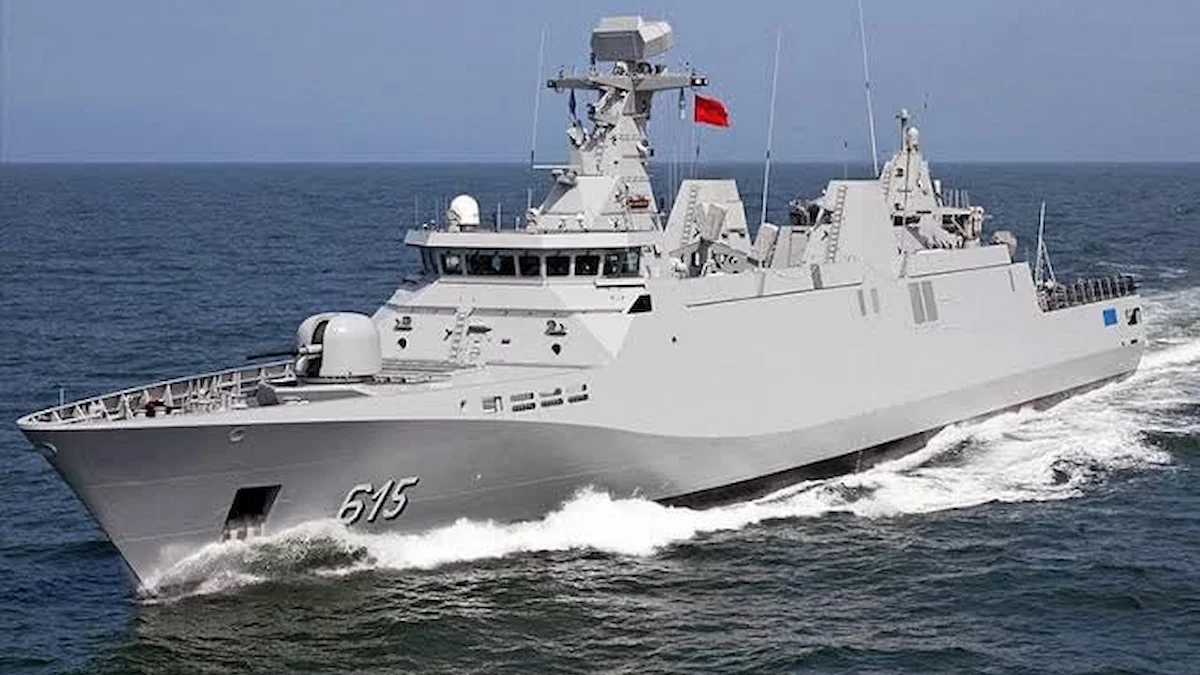
Developments on Thursday, 19 November, and Friday, 20 November 2026, reveal that the widely circulated account of an intervention by the Royal Moroccan Navy to halt Spain’s maritime barrier expansion project off the coast of Ceuta requires careful scrutiny before being presented as an established political incident or a fully fledged border crisis.
While several Spanish newspapers reported a direct confrontation involving the Moroccan Navy and the vessel assigned to the construction works, suggesting that the project had been suspended for several hours, information attributed to Spanish government sources, alongside local media reports and a statement from a professional association representing Civil Guard personnel, offered a different account. According to these sources, construction continued, while the disagreement concerned the technical positioning of the vessel’s anchoring equipment within a maritime area that Rabat considers to fall under Moroccan jurisdiction.
These discrepancies are far from a mere editorial detail. They determine the very nature of the incident: are we witnessing a Moroccan security intervention intended to prevent the extension of a Spanish border installation, or an objection to the placement of technical equipment at a maritime location where jurisdiction remains disputed, an issue that was subsequently contained without bringing the project to a halt?
Information published up to Friday does not establish that a maritime confrontation took place or that Morocco officially ordered construction to stop. It does, however, confirm that the maritime area adjacent to Tarajal has become a practical point of contention in the implementation of a Spanish project with a direct border-security function.
From the narrative of a military intervention to the reality of a technical dispute
Construction officially began on Thursday, 19 November, with the arrival of a specialised vessel from the Port of Algeciras in the vicinity of the Tarajal crossing. The vessel was carrying equipment required for seabed excavation and installation operations. The project is being implemented by the Spanish state-owned company Tragsa on behalf of the Spanish authorities.
According to details published by El Español, Moroccan boats appeared near the vessel at approximately 11:40 a.m., after preparations at the construction site had begun. The newspaper’s sources referred to six inflatable boats and claimed that the crew had been instructed to stop the works. The incident was presented as a direct intervention by the Royal Moroccan Navy that resulted in the temporary suspension of the project.
However, El País, in a report published on Friday, 20 November, offered a different account based on Spanish government sources. According to that version, Moroccan boats approached the construction area to verify whether the operations respected the maritime boundaries that Rabat considers to fall under Moroccan jurisdiction. They reportedly warned against allowing vessels and equipment to enter those waters. The same sources maintained that an examination of the construction site’s position showed that it remained within the limits recognised by the Spanish side, allowing the work to continue normally.
◼️ Continúan los trabajos en el espigón del Tarajal previos a su ampliación.
📍 Tienes toda la información en El Faro de Ceuta a través de nuestro enlace en bio.#Ceuta #Espigón #Frontera pic.twitter.com/uu1mS5JTJO
— El Faro de Ceuta (@ElFarodeCeuta) November 20, 2026
Meanwhile, El Faro de Ceuta, which followed developments on the ground, reported on Friday that the Moroccan boats seen in the area were connected to routine exercises and had not prevented the vessel from carrying out its work.
However, the newspaper revealed a more specific development: Morocco had objected to the placement of anchoring supports, known as tensores, used to secure the construction vessel. Their installation required drilling into the seabed at locations that Moroccan authorities consider to be within their jurisdiction. The holes were subsequently covered.
This detail is particularly significant because it shifts the discussion away from an unconfirmed image of a military confrontation towards a practical disagreement over precisely where equipment belonging to a Spanish maritime infrastructure project can legally be installed.
On Friday, the Unified Association of the Civil Guard (AUGC) also issued a clarification rejecting claims that the Royal Moroccan Navy had stopped the project. It stated that Thursday’s incident involved a limited disagreement over the vessel’s anchoring position, which was resolved by repositioning the vessel, while excavation work continued the following day. The association added that Civil Guard personnel stationed in the area had recorded neither an attack nor a confrontation.
The association’s account deserves attention because of its connection to personnel involved in border protection. Nevertheless, its professional position must be distinguished from an official statement issued by the Spanish government or the Moroccan Ministry of National Defence.
The picture that emerges is therefore more specific: Moroccan boats were present in the area, an objection was raised concerning the positioning of maritime anchoring equipment, and the two sides appear to have different understandings of the permissible limits of the construction site. Claims that Morocco formally ordered the project to stop, or that completed sections of a maritime installation were dismantled, remain unsupported by sufficient independent evidence.
A €9 million border project: What exactly is Madrid building at sea?
Understanding the sensitivity of this incident requires examining the nature of the project Spain has begun implementing.
On 22 September 2026, El País published details of an announcement by the Spanish Ministry of the Interior concerning an investment of approximately €9 million to reinforce the maritime border in the Tarajal area.
The allocation consists of €7 million for extending the maritime barrier and an additional €2 million for establishing a permanent maritime marking and signalling system. This system is intended to support a high-resistance containment net extending down to the seabed.
The project comprises two technical phases.
The first involves an initial extension of approximately 15 metres using concrete units secured by piles, together with metal anti-climbing installations. The second phase предусматри an additional 100-metre extension through a vertical maritime barrier.
The plan also includes a floating system approximately 350 metres long, designed to support a net preventing people from crossing beneath the water’s surface. This would replace the temporary floating barrier installed by the Spanish authorities following the major incidents in August, which was subsequently damaged by waves and rough maritime conditions.
These technical details explain why the project goes beyond the ordinary maintenance of an existing border installation. Spain is seeking to modify the physical configuration of its maritime border at one of the most sensitive points in its relationship with Morocco. It is investing in permanent infrastructure extending into the sea and directly connected to a system designed to monitor and prevent crossings.
The Spanish Ministry of the Interior linked the acceleration of the project to the events of 30 and 31 July 2026, when Ceuta witnessed large-scale attempts at collective entry, placing considerable pressure on security services.
According to El País, more than 70,000 migrants entered during those events, while more than 80 deaths by drowning were recorded, based on figures published by the newspaper.
These figures illustrate the scale of the crisis Madrid invokes to justify its investment. Yet they also raise another question: how can a long-term maritime containment system be constructed in a geographically sensitive area without first establishing a clear understanding of maritime jurisdiction and the need for coordination between the two countries?
Maritime jurisdiction: The legal question that comes before the concrete
One fundamental aspect must remain central to any assessment of the Tarajal incident: the disagreement over maritime waters between Morocco and Spain has a legal and diplomatic history that predates the current project.
The issue concerns the delimitation of adjacent or opposite maritime areas and the determination of the boundaries separating the respective jurisdictions of the two states, particularly in areas surrounding Ceuta, Melilla and the islands and rocky outcrops situated off the Moroccan coast.
The United Nations Convention on the Law of the Sea provides the principal legal framework for addressing these questions.
Article 2 establishes that the sovereignty of a coastal state extends to its territorial sea, including the seabed and subsoil beneath it. Article 3 sets the maximum breadth of the territorial sea at 12 nautical miles. Article 15 addresses the delimitation of territorial seas between states with opposite or adjacent coasts. In the absence of an agreement to the contrary, it provides for the median-line principle, while recognising exceptions based on historic title or special circumstances.
More importantly, the Spanish government itself acknowledged, in an official response to a parliamentary question published in 2024, that the delimitation of maritime waters in areas adjacent to Morocco could only be achieved through mutual agreement and in accordance with international law. The response also made clear that unilateral measures could not be used to impose a fait accompli.
The same document confirmed that the Spanish-Moroccan Working Group on Maritime Cooperation, established in 2003, had held eleven meetings, with the question of maritime delimitation remaining part of the bilateral cooperation agenda.
This official position carries greater weight than the competing accounts circulating in the press because it establishes a publicly stated Spanish government principle governing disputes of this nature.
Spanish parliamentary documents also indicate that the absence of a final maritime delimitation agreement has remained one of the factors behind continuing difficulties concerning the areas surrounding Ceuta and Melilla. This issue was addressed in a document published by the Spanish Congress of Deputies in 2022, which examined the differences between Spanish and Moroccan approaches to maritime jurisdiction in these areas.
Consequently, the presence of a Spanish construction project in maritime waters close to the Moroccan coast raises a legal question that cannot be settled simply by identifying the vessel’s location or relying on statements attributed to security sources.
What is required is access to the precise geographical coordinates of the construction site, the locations where the equipment is being anchored, the nautical charts used by both parties and their consistency with international delimitation principles.
The assertion that the site lies within Moroccan waters requires clear geographical and legal substantiation. Equally, the claim that the entire project falls within Spanish jurisdiction must be supported by a clearly established legal basis.
This does not diminish Morocco’s right to monitor its maritime jurisdiction and defend its national interests. Nor does it, by itself, settle the wider dispute concerning maritime areas surrounding Ceuta. Rather, it places the matter within its appropriate legal framework, avoiding the transformation of competing claims into definitive facts.
A longstanding Spanish project brought back to the forefront by migration
The history of the Tarajal barrier expansion dates back to 2014, when Spain’s then Minister of the Interior, Jorge Fernández Díaz, announced before the Congress of Deputies an allocation of €250,000 to extend the maritime installation.
The announcement followed the deaths of 15 migrants during an attempt to reach Tarajal Beach by swimming in February of that year, amid an intervention by the Civil Guard.
At the time, the project was intended to address weaknesses in the barrier caused by the accumulation of marine sediment. This problem allowed people to bypass the installation almost on foot when water levels fell. However, the announced works were not implemented according to the original programme.
The issue returned to discussions within Ceuta’s Assembly in 2024 and again in 2025, before becoming a government priority following the July 2026 events.
This extended timeline demonstrates that the barrier expansion was not a decision prompted solely by the latest developments involving Morocco. It was a delayed project that moved between political commitments, budget allocations and security considerations until the latest wave of mass crossings brought it back to the top of the Spanish Ministry of the Interior’s agenda.
It is also worth noting that the Unified Association of the Civil Guard did more than reject reports of a confrontation with Morocco. It used the occasion to renew its demands concerning border management.
The association called for a clear timetable, dedicated funding and a defined project for expanding the Benzú barrier, as well as a permanent maritime containment system. It also demanded a written protocol for handling mass crossing attempts, additional personnel and the necessary equipment for units operating in the area.
These demands reveal that, even from the perspective of the Spanish authorities responsible for border protection, the project does not represent a comprehensive solution to the region’s difficulties.
A physical barrier is only one component of a much broader system involving surveillance, human resources, security coordination, intervention procedures and rescue operations.
What does this mean for Rabat and Madrid?
For Morocco, the significance of the incident lies in the need to verify all construction activities that could extend into maritime areas the Kingdom considers to fall within its jurisdiction, particularly when they involve permanent installations linked to border demarcation or maritime surveillance.
Protecting Moroccan interests requires addressing such matters through the competent institutions, relying on nautical charts, geographical coordinates and legal documentation. It also requires avoiding the transformation of every maritime movement into a political crisis before the nature of the incident has been established.
Spain, for its part, faces an equally important responsibility: clarifying the geographical and technical limits of its project.
The Spanish Ministry of the Interior has publicly presented the objective as reinforcing the border character of the maritime barrier facing Morocco. This language, used in the official Spanish discourse, gives coordination with Rabat an importance that extends well beyond the engineering dimension.
The distinction is fundamental. Expanding an existing installation within an area of clearly established jurisdiction is legally different from installing equipment or driving anchoring piles into a maritime area whose delimitation has not been definitively agreed between the two countries.
This distinction makes it necessary for both sides to establish a clear mechanism for prior communication concerning maritime construction works close to their shared areas of sensitivity. Otherwise, technical operations risk becoming sources of tension, while the presence of a vessel, dredger or patrol boat at a particular location becomes the subject of competing political interpretations.
The document submitted by the Spanish government to Parliament in 2024 refers to a joint working group on maritime cooperation involving representatives from the foreign affairs, defence, interior, transport, environment and agriculture sectors, alongside the relevant Spanish local authorities.
This framework could provide an institutional channel for addressing such disagreements rather than leaving them at the mercy of conflicting security statements and media narratives.
The humanitarian dimension of maritime border closure
Another aspect must remain part of the assessment: the consequences that could result from constructing a more solid maritime barrier and installing a containment net extending down to the seabed.
Spanish authorities justify the investment on the grounds of border protection and preventing irregular crossings. However, previous events at Tarajal demonstrate that attempts to reach the coast by swimming can quickly turn into humanitarian tragedies, particularly when people encounter maritime barriers, strong currents and difficult weather conditions.
The Unified Association of the Civil Guard itself has pointed out that its personnel were previously required to intervene in the water, exposing both officers and migrants to danger.
This is a significant consideration that requires the safety of individuals and the obligation to conduct rescue operations to be incorporated into any assessment of new border infrastructure.
Alongside its investment in barriers, Madrid must clarify how rescue operations and emergency responses will be guaranteed, and whether the design of the installation is compatible with the legal and humanitarian obligations governing the protection of human life at sea.
Morocco, which also carries security and humanitarian responsibilities along its northern borders, has an interest in ensuring that these issues are addressed through institutional cooperation that protects maritime jurisdiction and reduces the risks associated with dangerous crossings, without allowing security cooperation to become a concession of national rights or maritime responsibilities.
What remains unanswered?
As of Friday evening, 20 November, the information published by El País, El Faro de Ceuta and the Unified Association of the Civil Guard pointed towards the continuation of construction works, alongside a disagreement over the positioning of the vessel at a specific maritime location.
By contrast, El Español presented a more confrontational account, describing an intervention by the Royal Moroccan Navy and the suspension of the project. Infobae subsequently reported details of that version, including claims of contacts between the Spanish and Moroccan foreign ministries.
However, the substance of those contacts has not been made available through an official document. Furthermore, according to the sources that could be verified, no Moroccan statement had been issued explaining the details of the incident or defining the Kingdom’s official position.
Several essential facts therefore remain to be clarified: the exact coordinates where the anchoring piles were installed, the nautical charts used by both parties, and whether all technical operations were carried out within the maritime area Spain considers to fall under its jurisdiction, or whether some equipment extended into a location challenged by Moroccan authorities.
Public opinion also needs to know whether the Spanish Ministry of Foreign Affairs actually initiated official contacts concerning the incident, and whether prior coordination with Rabat took place before the different stages of the project began.
This question is particularly relevant because the works are not limited to Tarajal. They are also expected to extend to the Benzú area at a later stage.
The issue now deserving close attention is whether the Spanish maritime barrier expansion will proceed according to the announced design, or whether disagreements over the location of construction and anchoring operations will lead to technical adjustments before the project is completed.
What is established is that Spain has begun implementing a major border investment, that Morocco has demonstrated an interest on the ground in monitoring maritime activities close to its borders, and that a disagreement over the vessel’s anchoring equipment has appeared in Spanish local reporting.
Claims of a Moroccan military victory or a Spanish retreat under pressure, however, are not supported by the facts published so far.
The most important document needed to resolve a substantial part of this debate is the nautical coordinate map used to determine the construction site’s location, accompanied by an official Moroccan clarification.
There is a fundamental difference between monitoring a border project, objecting to a specific technical installation and confronting a legal dispute over maritime jurisdiction.
Confusing these three levels risks obscuring the real issue that deserves to be addressed between Rabat and Madrid: the legal status of maritime activities in a sensitive geographical area, the protection of national jurisdiction and the need for transparent bilateral coordination before permanent infrastructure is installed at sea.


