

In his latest intervention, Mohamed Daoudi chose to place several issues concerning Moroccan sport on the same table: Morocco’s delegation to the Mediterranean Games in Taranto, the absence of the president of the Moroccan National Olympic Committee at the delegation’s send-off, the criteria used to appoint the head of the mission, and the way the Sports Directorate has been handling the files of sports federations facing legal and organizational difficulties, including taekwondo, kickboxing, Muay Thai and Brazilian jiu-jitsu. At first sight, these may appear to be separate issues. Yet a reading of the speech as a whole reveals a common question: Who holds decision-making power in Moroccan sport, according to which rules, and who bears responsibility for the consequences of those decisions?
The first point that deserves attention is Daoudi’s shift from discussing the sporting participation itself to questioning the institutions responsible for overseeing it. Morocco is taking part in Taranto 2026 with a delegation of 120 athletes representing 18 sports. Such participation should be a stage in preparing Olympic disciplines, rather than simply an occasion to raise the national flag. But Daoudi does not stop at wishing the athletes success. He turns his attention to the institutional image of those who sent and accompany them.
This is where his remarks about the absence of Faisal El Arraichi, president of the Moroccan National Olympic Committee, from the reception of the delegation become significant. The importance of the observation does not lie in the personal absence itself, but in the institutional message it raises: Can an institution that advocates transparency and good governance itself provide a clear model of presence and responsibility? Daoudi is careful to distinguish personal relationships from institutional responsibility, almost as though he anticipates that his observation could be interpreted as a personal criticism. He therefore insists that the issue concerns functions and responsibilities, not individuals.
The more revealing part begins when he turns to the leadership of the delegation. He questions the choice of the Secretary-General of the Olympic Committee and the president of the Royal Moroccan Swimming Federation to lead the mission, particularly given his reference to the latter having been relieved of his responsibilities at the federation only weeks earlier. Daoudi does not make an accusation; he raises a question. And that approach may be more powerful than a direct accusation, because it leaves the institution itself responsible for providing the answer: What criteria determine the appointment of the head of a national delegation? Are these objective and transparent criteria, or an administrative assessment whose grounds remain unknown?
What matters most is that Daoudi invokes the very concept of governance promoted by sporting institutions themselves. The issue, at its core, is therefore not the individual chosen to lead the delegation, but whether a sporting decision can be explained, justified and assumed publicly. Once governance becomes an institutional principle, its real test begins precisely with decisions that raise questions.
From there, the speech moves toward the Ministry of National Education, Preschool and Sports and the Sports Directorate, where the criticism becomes more direct. Daoudi refers to several sports federations facing legal and organizational problems and calls on the supervisory authority to provide clear answers rather than allowing files to remain suspended in a zone of uncertainty. Morocco’s legal framework does, in principle, regulate the relationship between the state and sports federations, as well as the conditions governing their operation. Respect for legal and statutory rules is therefore an essential component of sports governance.
The problem Daoudi points to is not necessarily the absence of rules, but the gap between the existence of a rule and the way it is actually applied. This distinction is fundamental. When an administration intervenes quickly in one case but takes considerably longer in another with comparable characteristics, the question becomes larger than the legal issue itself: Is there a consistent administrative doctrine for dealing with sports federations, or is each crisis treated as an isolated case?
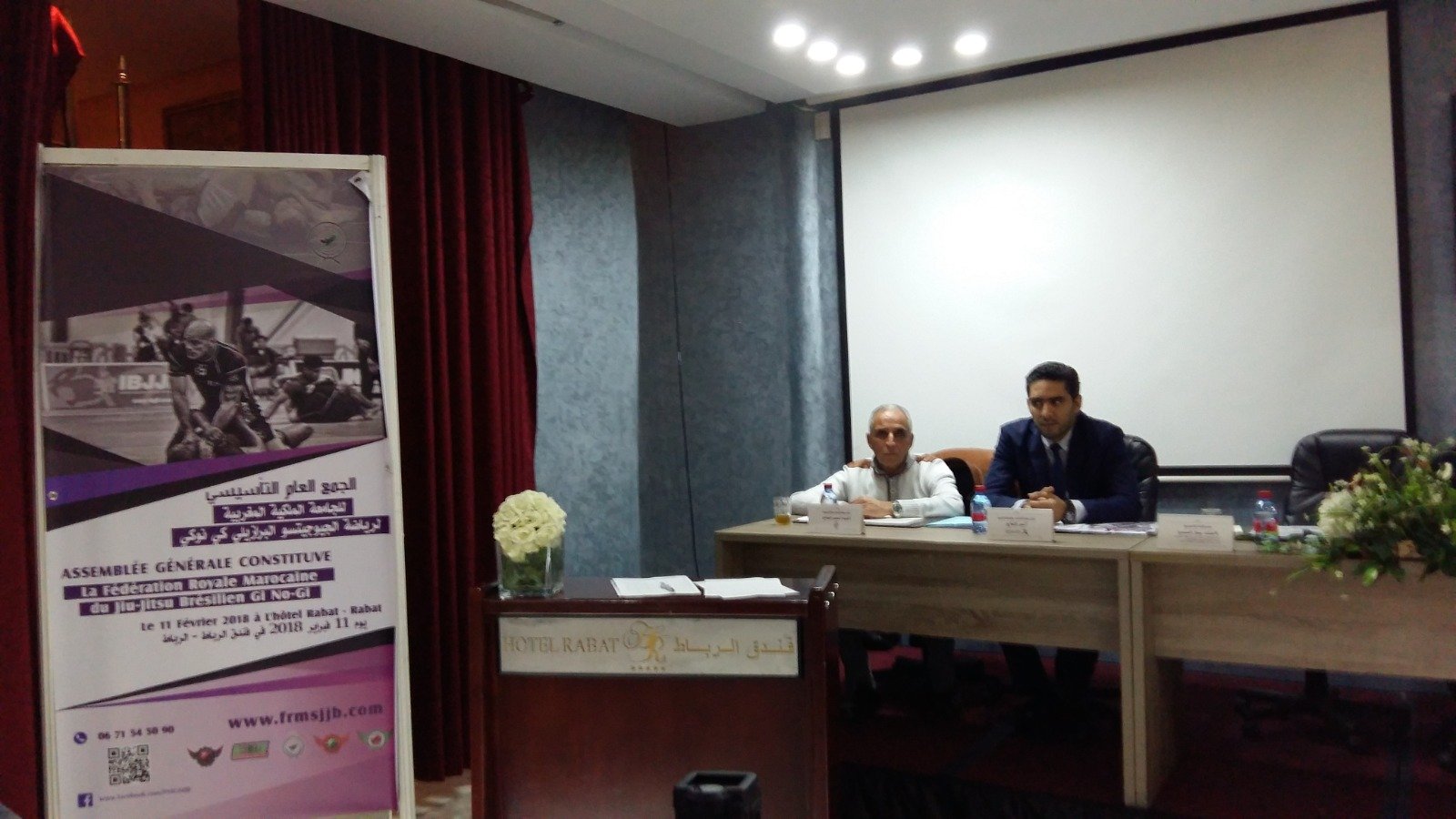
It is precisely here that Brazilian jiu-jitsu moves from the margins of sporting disputes to the heart of the question of legitimacy. In his intervention, Daoudi does not present it merely as a domestic conflict between competing actors. He refers to an international legitimacy associated with the discipline and, even if indirectly, raises the most sensitive question: if an entity has national and international representation and legitimacy in this field, who is seeking to strip it of that legitimacy or transfer it to another entity?
This shift is significant because it places the Sports Directorate before a question that goes beyond the handling of an ordinary administrative dispute. If the issue genuinely involves a conflict between national representation and an international reference structure, then any administrative intervention is no longer merely an internal technical decision. It touches upon the identity of the body entitled to represent the discipline and speak in its name. That is precisely where the sensitivity of the matter lies: are we dealing with the correction of an existing legal irregularity, or with an attempt to redraw the map of legitimacy surrounding Brazilian jiu-jitsu in Morocco?
From this perspective, Brazilian jiu-jitsu becomes more than a name mentioned in passing in Daoudi’s intervention. It may be the clearest test of the very principle he invokes: Is the same rule applied when national legitimacy intersects with international legitimacy? And who has the final say when interpretations of that legitimacy diverge?
When Daoudi subsequently refers to hockey, Brazilian jiu-jitsu, kickboxing and Muay Thai, he is in fact approaching the heart of the broader problem: the multiplication of disputes within sports disciplines should not lead to a multiplication of administrative standards. A federation does not merely need institutional recognition; it also needs clearly defined boundaries of technical and administrative legitimacy, as well as procedures capable of resolving disputes instead of leaving them suspended indefinitely.
In the case of kickboxing and Muay Thai, the warning becomes more serious. Daoudi refers to the absence of the national team from certain international competitions and cites, in particular, an Arab championship in Benghazi where, according to the information he presents, participating teams were provided with travel and accommodation, while Morocco was absent. If the elements he cites are confirmed, an administrative dispute becomes a direct sporting cost. Absence from competition does not merely mean that Morocco is missing from a list of participants; it deprives athletes of experience, exposure and opportunities for development.
This is where one of the most important unspoken elements of his intervention emerges: when administrative dysfunction produces a sporting consequence, the ultimate victim is neither the administrator nor the federation, but the athlete. An athlete who misses an Arab, continental or international competition loses experience, competitive exposure, sometimes ranking opportunities and, in certain cases, an opportunity that may never come again. Administrative responsibility therefore acquires a sporting and human dimension.
When Daoudi reaches taekwondo, his perspective changes once again. He moves beyond institutional governance and begins speaking about generational renewal. He presents the movement taking place within the discipline as a form of public debate and defends the right of a new generation to express itself through social media, while warning against attempts to slow down that momentum. The message therefore extends beyond taekwondo itself: the real conflict is not always about who controls a federation; it can also be about who has the right to define the future of sport.
His statement that “every era has its own men” carries a clear meaning. It recognizes that generations that built a particular period cannot regard their experience as permanent ownership of an institution. At the same time, the new generation faces its own obligation: to prove its legitimacy through competence, knowledge, education and the ability to build, rather than through protest alone. Daoudi is therefore attempting to shift the debate from a conflict between individuals toward a conflict between visions and projects.
Yet this logic also places Daoudi’s own discourse under the same standard he demands from others. If the next phase requires greater governance, transparency and equality in the application of rules, then criticism itself must be grounded in verifiable facts and must clearly distinguish between established information, interpretation and open questions.
This is precisely where the deeper significance of his intervention lies. Behind the names, federations and cases he cites are several questions to which institutions will ultimately have to respond: Why does the speed of administrative intervention vary from one case to another? Who determines the criteria for appointing heads of national delegations? Where does the responsibility of the Olympic Committee begin and where does that of the ministry end? At what point does an administrative dispute become direct harm to a national team? And can the Sports Directorate limit itself to receiving and processing disputes, or must it once again become an institution capable of resolving and anticipating them?
These questions constitute the real unspoken issue. Moroccan sport is not suffering only from a shortage of medals or disputes within federations. In several cases, it is facing a deeper test: the confidence of sports stakeholders in the rules of the game themselves. When the rule is clear, known and applied consistently, a large part of the conflict disappears before it becomes a crisis.
The deeper message in Daoudi’s intervention may be this: a new phase is already taking shape, the means of expression have changed, and younger generations are no longer necessarily willing to remain outside the debate. The best response from sports institutions is therefore not to silence the questions, but to answer them. A question answered with facts and documents can be closed; a question left unanswered eventually becomes a crisis of confidence.
Ultimately, the ball is not solely in Mohamed Daoudi’s court. It is also in the court of the institutions he is challenging: either they explain their decisions, or silence itself will eventually become the answer.


