

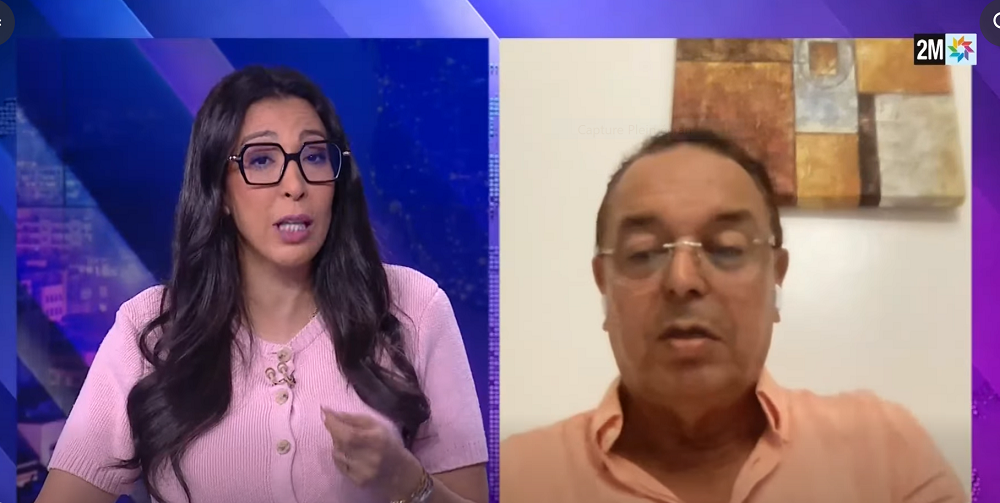
A single tweet can sometimes be enough to become a media story, particularly when it comes from Lahcen Haddad, Vice-President of the House of Councillors and one of the figures who has, over the years, built a presence in debates surrounding Morocco’s image and its international relations. But the real paradox does not lie in the tweet itself. It lies in the question it raises: why can a sentence posted on a social network attract the attention of a national broadcaster, while the daily work of Moroccan journalists, media outlets and other actors working on the country’s image, public policies and international interests so often remains outside institutional visibility?
https://www.facebook.com/reel/1239125531673261
On Ceuta, Haddad was explicit: Morocco still has “a long way to go” in the battle of the narrative, because an unfavorable narrative about Morocco has already become established within parts of Spain’s political and media landscape. Migration quickly becomes “blackmail,” pressure is transformed into a “weapon,” and a border crisis is immediately interpreted through an existing vocabulary of “Moroccan threats,” “hybrid warfare” and the “weaponization of migration.” The most troubling issue is not that a media outlet criticizes Morocco — criticism is part of public debate — but that interpretation can sometimes precede the establishment of facts, allowing audiences to reach a conclusion before the evidence needed to assess it has even emerged.
The real significance of Haddad’s intervention appears when he turns the lens back toward Morocco itself. He does not simply accuse Spanish media of bias. He acknowledges that Morocco is not always sufficiently present, sufficiently fast, sufficiently explanatory or sufficiently consistent in the international public sphere. In other words, the problem is not only those who tell Morocco’s story; it is also those who leave enough space for others to tell it for them. “Narrative sovereignty” therefore becomes another dimension of political sovereignty: a country may defend its interests on the ground, but if it does not sufficiently shape the narrative surrounding its actions, it leaves part of the battle to those who speak on its behalf.
This is precisely where the story of the tweet and the national broadcaster becomes more revealing than the content of the tweet itself. If a national channel picked up Haddad’s post and gave it particular visibility, that can certainly be justified by the news value of his institutional position. But the journalistic question that should follow is elsewhere: what about those fighting the same battle without parliamentary office, government positions or invitations onto television studios? What about the journalist who works on diplomatic affairs and public policy, who produces content in French and English, and who deconstructs hostile narratives before they become established in public opinion? What about media organizations working day and night on these issues, placing their journalism at the heart of the battle, not in search of personal recognition but in defense of their country’s image and interests?
The paradox becomes even sharper because Haddad himself argues that the battle of the narrative is not won through slogans, but through facts, figures, archives, credible experts and rapid responses. Yet this is not the responsibility of politicians alone. It also belongs to journalists, researchers, academics, intellectuals, civil society and the media. Haddad made that point himself: the battle is not solely an institutional responsibility, but also belongs to civil society, the intellectual community and the broader elite.
This reflection should therefore not be turned into jealousy over the visibility given to Lahcen Haddad, nor into a reproach directed at a national broadcaster for having amplified his words. Haddad has been working on these questions for years and has accumulated genuine experience in debates concerning Morocco’s image, migration, the Sahara and Morocco-EU relations. He has also recently insisted that Morocco must move beyond defensive communication and build a narrative capable of explaining the country’s economic, diplomatic and social transformations.
The real question lies elsewhere: Does Morocco have a genuine ecosystem capable of recognizing all the voices contributing to the construction of its narrative, or does it notice them only when they belong to a political figure or emerge at the center of a media crisis?
This is an institutional question more than a personal one. Defending a country does not begin when a crisis erupts. Some people write before the crisis, monitor developments, explain public policies, defend Morocco’s positions in foreign media and build, day after day, a documentary record to which others may return years later. They are not always visible on television, but their work contributes to Morocco’s influence and soft power, even if it is not always described in those terms.
This is also where the meaning of former minister Aziz Rabbah’s formulation — that “the pen is a flowing sword” — becomes particularly relevant. In an age dominated by narrative battles, the article, the investigation, the analysis and the translation are not merely journalistic exercises. They can become instruments of strategic defense. The sword protects the territory; the pen protects the meaning constructed around that territory.
The question of patriotism also deserves to be viewed with greater maturity. Patriotism does not mean waiting every morning for recognition from a television channel, a ministry or an institution. It is not measured by the number of appearances on television. Some forms of work remain far from the spotlight while leaving a genuine mark on public consciousness, archives, international debate and the way others understand Morocco. That impact does not need a camera in order to exist.
National institutions could precisely benefit from looking at the media landscape through this broader lens. Morocco, which asks the outside world to understand its economic, diplomatic and strategic transformation, must also know how to recognize, at home, those who contribute to explaining that transformation. An article published today may provoke no controversy, yet become an archive tomorrow. An analysis that passes quietly may ultimately prove more valuable than a comment that attracts thousands of views for a few hours.
This is ultimately the contradiction revealed by the Haddad episode, more than any disagreement over a tweet: we want Morocco to win the battle of the narrative, but do we still sufficiently recognize all those who are already fighting that battle?
Those who work, day and night, to defend Morocco’s image on national, diplomatic and public-policy issues do not need to prove their patriotism every morning. A country does not award points according to the number of articles published, nor does it measure loyalty by the number of television appearances.
Patriotism has no price, and the trace one leaves behind is often the most credible testimony. Those who take pride in the impact they have contributed to creating, minute after minute, hour after hour, day after day, do not need a television screen to discover them in order to know that they were there.
Because the battle of the narrative, as Lahcen Haddad reminds us, requires presence, consistency, speed and knowledge. But it also requires something he perhaps did not formulate with quite the same clarity: recognizing those who were already present before the cameras began to look.


