

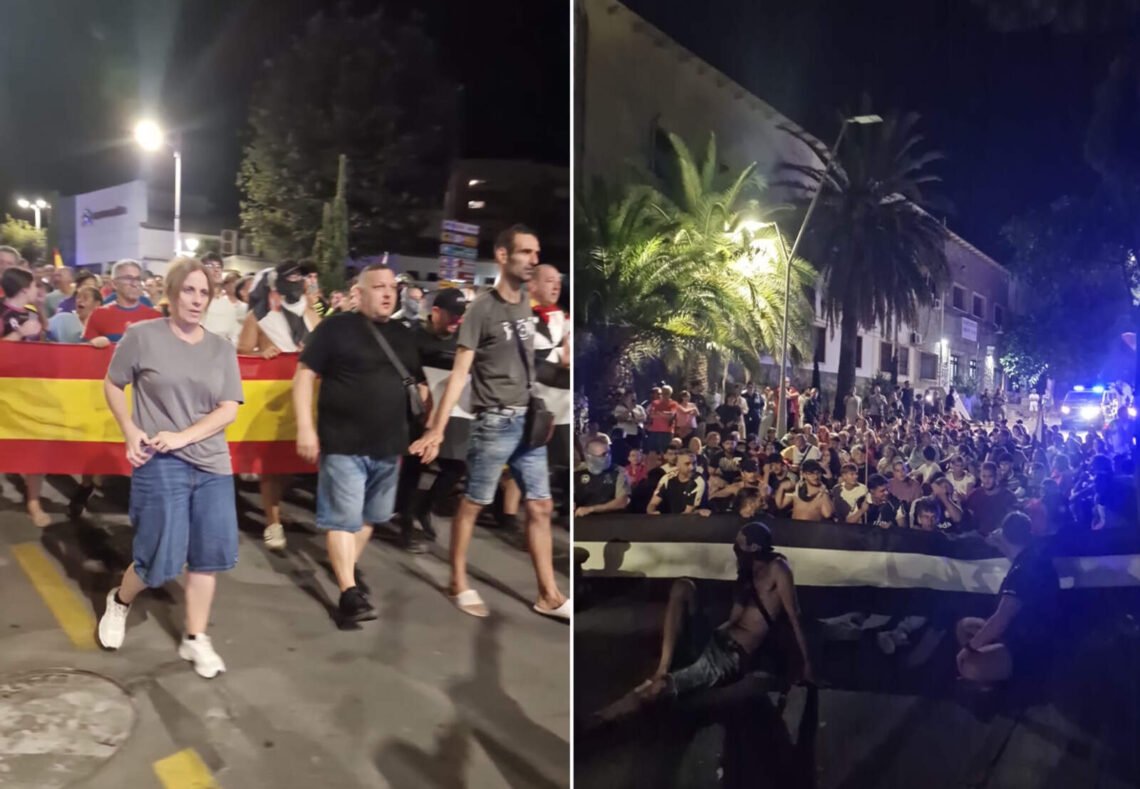
In Ceuta, the dispute is no longer only about where the migrants who remained in the city after the mass arrivals at the end of July will be housed. Over the past two days, the situation has crossed into more troubling territory: demonstrations demanding the departure of migrants, clashes in streets and on beaches, vandalism and the burning of temporary shelters, and attempts to block a Red Cross vehicle carrying food supplies.
Against this backdrop, Moroccans living in Ceuta have begun reporting that they themselves are being targeted, simply because they are suspected of being among those who entered the city during the recent migration crisis.
That is where the paradox lies.
What began as a migration shock has gradually turned into a crisis of trust, security and coexistence. The question is no longer simply how Spanish authorities will deal with the thousands of people still in the city. It is also how they will prevent migration from becoming a pretext for collective discrimination against Moroccans, regardless of their legal status.
On Thursday, August 27, tensions escalated around Benítez beach and the Trampolín area. Protesters entered areas where temporary facilities for migrants had been set up. Vandalism and the burning of belongings were reported, while some demonstrators attempted to prevent a Red Cross vehicle carrying food aid from reaching the migrants. Police intervened to prevent the confrontation from developing into a broader clash.
The same day, authorities reported a separate incident in the opposite direction: twelve Moroccan migrants were detained on suspicion of taking part in a stone-throwing attack against a military vehicle in the Benzú area, after a group of between 30 and 40 people reportedly surrounded it. Four soldiers were injured.
Taken together, these incidents reveal something important: Ceuta has entered a zone where it is becoming increasingly difficult to separate the migration crisis from the security crisis — and where security itself can no longer be separated from the rise of anger in the streets.
From opposition to migrant housing to demands for expulsion
On Wednesday evening, large demonstrations took place across the city. Slogans such as “Ceuta defends itself” and calls to “expel the migrants” were heard.
Part of the anger was directed at the decision to use certain sites to accommodate migrants, but it also reflected a broader sense among some residents that the authorities have failed to restore normal daily life.
That anger exists. It cannot simply be reduced to the far right.
A section of Ceuta’s population has genuine concerns about the prolonged crisis, the presence of migrants in streets and on beaches, and the pressure placed on public spaces and local infrastructure. Those concerns are legitimate subjects for political debate.
The problem begins when that anger stops targeting government decisions and starts targeting people.
That appears to be what happened when some groups sought to reach areas where migrants were staying. Once police had to establish barriers to separate the two sides, and once demonstrations began to involve vandalism and fires, it became clear that the crisis had entered another phase.
The issue was no longer simply what migration policy should be.
It was becoming a question of who has the right to occupy public space — and who can be defined as an outsider to the city.
This is where the accounts from some Moroccans living in Ceuta become particularly significant. Through videos, messages circulating on WhatsApp and social media posts, some have alleged that they were insulted, harassed or attacked because they were mistaken for migrants.
Those accounts must be treated carefully. Each alleged incident requires independent verification before it can be presented as established fact.
But their emergence at precisely this moment, alongside incidents reported by Spanish media and the repeated intervention of police, points to something broader: the tension is no longer necessarily confined to those who entered the city on July 30 and 31.
That distinction matters.
Because once the “migrant” becomes an identity supposedly recognizable through appearance, language or origin, a Moroccan who has lived legally in Ceuta for years, a worker who crosses the border every day, a woman who has built her life there, or a child born in the city may suddenly find themselves in the absurd position of having to prove that they are not among those being targeted.
Digital hate came before the street
What is happening today in Ceuta did not emerge from nowhere.
According to Spain’s Observatory on Racism and Xenophobia, the FARO monitoring system detected 57,406 items of hate speech or discriminatory narratives on social networks in July, compared with around 40,800 in June. On July 30 and 31 alone, the two days associated with the mass arrival of migrants in Ceuta, 9,590 hate-related messages were detected.
People from North Africa were the main target, accounting for 68 percent of the content analysed.
The numbers become more revealing when the nature of the messages is examined.
The report identifies threats, calls for expulsion, insults and content aimed at dehumanising those being targeted. Some messages directly encouraged violence. Others relied on images, videos, emojis or coded language to circulate discriminatory content.
In other words, a process of digital escalation had already begun before tensions moved onto the beaches and into the streets.
That does not mean everyone taking part in the demonstrations shares this discourse. Such a conclusion would be another form of simplification.
But it does suggest that the digital sphere has helped create an environment in which the migrant is no longer presented simply as an administrative or social challenge. The migrant is increasingly portrayed as a threat.
And once that representation moves from screens into the streets, the risk changes scale.
The Spanish state faces a problem more complicated than simply sending people back
The Spanish government now knows that the crisis cannot be resolved through a single measure.
Minister for Territorial Policy Ángel Víctor Torres told Parliament that migrants cannot simply be sent back immediately outside the procedures established by law. Identifying those present and examining their individual circumstances remains an essential part of the process.
Madrid has also announced 400 additional places at the Temporary Stay Centre for Immigrants, bringing its capacity to 1,183.
Torres also explained that some of the sites proposed by Ceuta’s authorities for migrant accommodation would require months before they could be used, partly because of infrastructure and utility problems.
This is where the real difficulty lies.
The authorities are under pressure to restore normal life in the city, but they do not have an immediate solution for everyone who remains there. The migrants cannot simply disappear from public spaces, while residents who believe the crisis has lasted too long are becoming increasingly frustrated.
Every additional day spent in this administrative and political vacuum increases the possibility of confrontation.
The police presence around beaches and areas where migrants gather is therefore no longer simply a matter of maintaining public order. It is becoming evidence that the state must prevent a dispute over migration policy from turning into an open social conflict.
Police have already had to intervene to stop groups of protesters from reaching migrants directly. During separate nighttime incidents, security forces fired warning shots into the air to prevent an attack on migrants.
This is no longer simply a housing crisis.
And Morocco cannot stand outside this crisis
For Morocco, the issue concerns more than those who entered Ceuta during the July episode.
If the equation between “Moroccan” and “irregular migrant” becomes entrenched, the Moroccan community in the city could itself become trapped in a logic of collective suspicion.
That is perhaps the aspect that deserves the closest attention from Rabat.
This is not about interfering in Spain’s internal affairs, nor about defending anyone who may have committed a crime. It is about protecting Moroccan citizens and ensuring that no person becomes a target simply because their appearance, language or origin makes them appear foreign.
Demonstrating is a right. Challenging migration policy is a right. Demanding that the Spanish government resolve the crisis is also a right.
But turning the street into a place where a Moroccan has to prove that he or she is “not a migrant” belongs to an entirely different logic.
And that may now be where the real dividing line lies.
The government of Ceuta itself has called for calm, stressing that the city belongs to everyone and that violence is not a solution. Ángel Víctor Torres has condemned attacks targeting migrants, Muslims, Red Cross volunteers and journalists. He also said that some residents of Ceuta had themselves been attacked after being mistakenly identified as recently arrived migrants.
That last point may be the most revealing.
When suspicion about someone’s identity becomes sufficient reason to attack them, the crisis has already moved beyond migration.
Ceuta is now facing another test: whether the state can regain control of public space before collective anger becomes an accepted method of dealing with an entire category of people.
The distance between political protest and collective violence is no longer as great as it was only a few days ago.
What is happening today on Ceuta’s beaches is therefore no longer simply another consequence of the July migration crisis. It is a test of Spain’s institutions and their ability to prevent an exceptional migration crisis from becoming a crisis of coexistence.
It is also a test for Morocco, which faces the responsibility of protecting its citizens when their identity itself begins to become a source of suspicion.
At this stage, it is not enough for the authorities to return migrants to a legal framework.
They must also return the streets to the rule of law.


