

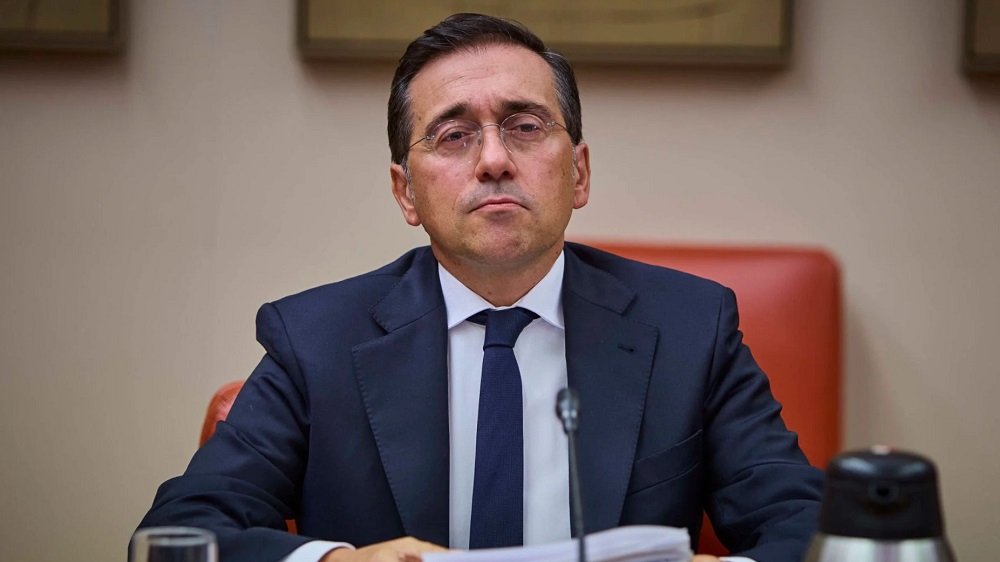
Some words in a political speech are never chosen by accident. When Spanish Foreign Minister José Manuel Albares says that his country is committed to defending “every centimetre” of Spanish territory and that the moment requires “unity,” “responsibility” and “a sense of state,” he is not simply addressing the people of occupied Ceuta and Melilla. He is reaffirming Madrid’s political position at a particularly sensitive moment, weeks after a migration crisis whose consequences have moved beyond the border and into the city itself.
In a message addressed on August 28 to the people of Ceuta and Melilla, Albares said that Spain’s Foreign Ministry was “firmly committed” to the territorial integrity of “every centimetre” of Spanish territory, including, of course, Ceuta and Melilla. He added that the government was also committed to their prosperity, coexistence in both cities and throughout Spain, and respect for diversity.
A los ceutíes y melillenses les reitero que el @MAECgob está firmemente comprometido con la integridad territorial de cada centímetro de España, también de Ceuta y Melilla, con su prosperidad y convivencia.
Es tiempo de unidad, responsabilidad y altura de Estado.@Congreso_Es pic.twitter.com/imqtyMoQnn
— José Manuel Albares (@jmalbares) August 28, 2026
Then came the words with which he chose to close his message: “unity,” “responsibility” and “a sense of state.”
It is difficult to separate that message from its timing.
Nearly a month after the mass-entry crisis in Ceuta, Madrid’s challenge is no longer simply one of protecting a border. Thousands of migrants remain in the city, tensions with part of the local population have intensified, clashes and acts of violence have occurred, and the central government is trying to contain a crisis that has become simultaneously a security, social and humanitarian issue.
That is precisely why Albares’s reference to “a sense of state” deserves to be examined beyond the question of sovereignty alone.
Because if the state is truly to rise to the occasion, its strength cannot be measured only by its ability to protect its borders or reaffirm its commitment to every centimetre of its territory. It must also be measured by what it does when the most vulnerable people within that territory are exposed to fear, violence or incitement.
This is where the most sensitive part of the Ceuta story begins.
No one has the right to justify an attack against residents of the city, its soldiers or its police. Nor can a migration crisis become a pretext for disorder or violence. But the same principle must apply to migrants.
The law cannot change according to the identity of the person standing before it.
That principle is particularly important when children, minors and young Moroccans are involved — people who found themselves at the centre of a crisis they did not create on their own. Some arrived without families, without adequate social protection and sometimes without even knowing what awaited them.
Recent developments make the issue even more serious.
On August 27, Spanish prosecutors announced 16 reports of sexual assaults in Ceuta involving 17 victims, 16 of them women and most of them minors, in the context of the crisis that followed the mass entries at the end of July.
Such allegations must be treated with the rigour required by any judicial process. An accusation is not a conviction. But allegations do not simply disappear from the story of the crisis.
This is precisely where the state’s role becomes essential: distinguishing the migrant from the offender, the victim from the suspect, irregular entry from criminal conduct, legitimate concern from incitement to hatred.
Criminal responsibility is individual.
It cannot become collective condemnation of thousands of people.
But there is another dimension to the problem.
In recent days, violence has no longer been confined to the border or to confrontations involving security forces. Tensions between sections of the local population and migrants have intensified, with clashes, property damage and incidents reported in different parts of the city.
In such an atmosphere, the words of political leaders carry particular weight.
When Albares speaks of “unity” and the “general interest,” he is addressing the city’s residents, political opponents and, beyond them, Europe. When he insists that Ceuta and Melilla form part of “every centimetre” of Spanish territory, he also closes the door to any interpretation that the migration crisis could become a debate about sovereignty.
That is Spain’s official position.
Morocco, for its part, maintains its well-known position on Ceuta and Melilla, regarding them as Moroccan cities under occupation.
But the dispute between the two states should not become a reason to erase the human being caught in the middle of it.
This is where another phrase used by Albares — “respect for diversity” — acquires particular significance.
If Ceuta and Melilla are to be presented as spaces of coexistence, protecting that coexistence means more than preventing another mass entry. It also means preventing Moroccan migrants from being reduced to an indistinguishable mass, preventing every young person who arrives in the city from being portrayed as a threat, and preventing words such as “invasion” from becoming fuel for street violence.
The Spanish government itself has warned, in the context of the crisis, about disinformation and narratives portraying the arrival of migrants as an “invasion” or a form of “cultural replacement.”
At the same time, it has continued to defend cooperation with Rabat as essential to managing the border and preventing further attempts to cross.
That juxtaposition is what makes Albares’s latest message particularly revealing.
Madrid wants the crisis to be understood as a matter of sovereignty, security and European-Moroccan cooperation.
That is understandable from the perspective of the state.
But the crisis has produced other questions that a border alone cannot answer.
What happens to the minor who arrives in the city without knowing where to go?
Who protects the girl who says she has been assaulted?
Who protects the migrant who is attacked in the street?
And who protects Ceuta’s residents from fear, disorder and hate speech at the same time?
These questions are not directed against Spain. Nor do they constitute a justification for any crime committed by a migrant.
At their core, they are a test of the very “sense of state” invoked by Albares.
Because if a sense of state means anything, it means that the law does not need an enemy in order to demonstrate its strength.
A state can protect its borders, defend its position on sovereignty, return those who entered unlawfully according to the law and, at the same time, prevent a child, a woman or a young person from being attacked, regardless of nationality.
Turning every border crisis into a battle in the streets may strengthen a sovereignty narrative for a while.
It does not necessarily protect the society the state is supposed to serve.
Perhaps that is the real meaning of Albares’s message.
“Every centimetre” of territory can become the subject of political and diplomatic defence.
But the value of a state is not measured only by the territory it says it will never surrender.
It is also measured by whom it protects on that territory.
And when those people include children, minors and young people, a “sense of state” begins with something much simpler: making the street a place governed by law, not a place of collective punishment.


