

The episode should have ended when the flow stopped.
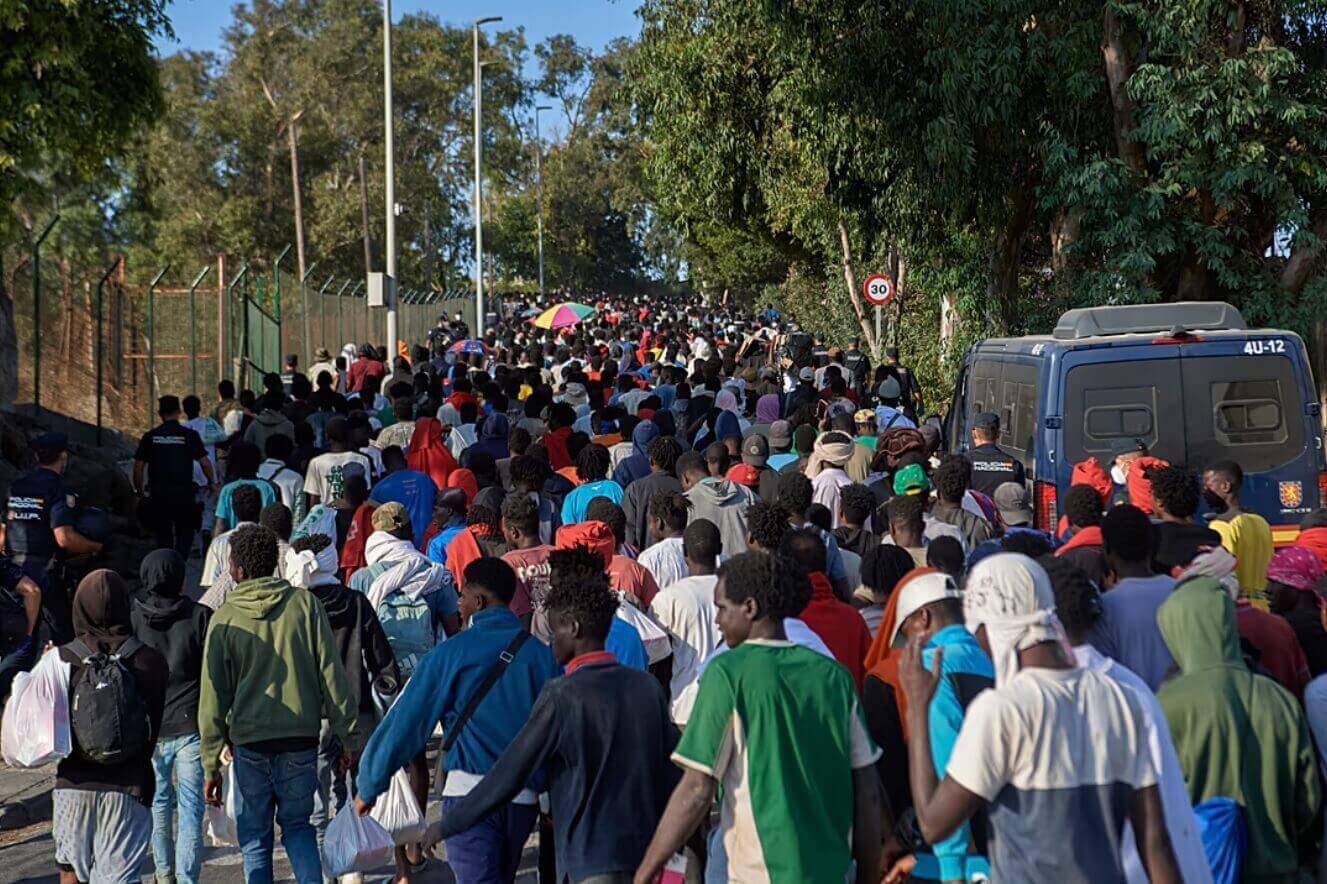
Tens of thousands of people crossed from Morocco into occupied Ceuta on July 30 and 31, before most of them returned in the hours and days that followed. On the surface, that might have been enough to conclude that the worst of the crisis was over.
But what happened afterwards tells a different story.
Nearly a month later, Spain is still dealing with thousands of people who remain in the city, identification procedures and legal files that have yet to be resolved, minors requiring special protection, and protests by residents that have, in some cases, turned into confrontations with police.
On August 28, Madrid formally requested stronger European assistance, including support from Frontex, Europol and the European Union Agency for Asylum, to help process the remaining cases.
That is where the nature of the story begins to change.
Ceuta is no longer facing only a mass arrival of migrants. It is now dealing with the internal consequences of that arrival, in a city covering just 18.5 square kilometres and home to roughly 80,000 people.
From 72,000 arrivals to several thousand remaining
The most frequently cited official figure is 72,000 people who entered Ceuta during the surge of July 30 and 31. The Spanish government later confirmed that figure after earlier statements had referred to around 80,000.
But the more significant number may not be the total number of people who entered.
It is the number who stayed.
Spain’s Interior Ministry estimates that around 5,000 people are still in Ceuta, including approximately 1,500 minors. Opposition forces have cited higher estimates, while some rights organisations have, at different stages, referred to figures of up to 10,000.
That discrepancy is not simply a statistical detail.
It reflects one of the crisis’s central problems: the state is trying to manage thousands of individual cases while the number of people actually present remains contested.
This is the context in which Spanish Interior Minister Fernando Grande-Marlaska asked the European Commission to reinforce the identification and screening process, with the participation of Frontex, Europol and the EU asylum agency.
The objective is to establish the identity and legal status of each person, conduct the necessary interviews and provide interpreters, in order to distinguish those who may be returned from those who could have grounds to seek asylum or international protection.
Madrid has also requested an extension, until September 2, of the “Minerva” operation involving Frontex, while announcing additional measures to reinforce the border: extending the Tarajal and Benzú breakwaters, establishing a permanent maritime buoy system, expanding aerial surveillance through drones and increasing the use of maritime intervention assets.
The message is clear.
Madrid is no longer dealing only with an exceptional episode. It is beginning to redesign the way it controls and manages the border in light of what has happened.
But that alone does not explain why Ceuta has become more tense several weeks after the migrant surge subsided.
The city that began speaking for itself
On August 28, Ceuta’s local assembly unanimously adopted a resolution calling on the central government to intervene “immediately and without further delay,” arguing that the city was facing an exceptional situation and was close to breaking point.
Juan Vivas, president of the Ceuta government, said the city had “lost its way of life and tranquillity” and warned that the time available to prevent further deterioration was becoming increasingly limited.
But he also insisted on another point: defending residents’ interests could not mean acting outside the law.
That distinction matters.
Because the protests are no longer simply political expressions of opposition to immigration.
In recent days, clashes have taken place between protesters and police in areas where migrants were staying. Personal belongings and temporary shelters were set on fire. In a separate incident, a soldier was injured after being hit by stones.
At the same time, Spain’s right wing and far right have hardened their position, demanding the return of all migrants still in the city.
But the central government cannot simply gather them together and send them back as a group.
Every individual must be identified and have their legal situation assessed. Some may wish to seek asylum. Unaccompanied minors are subject to specific protection rules.
That is precisely why screening is necessary before return decisions can be made.
The problem is not simply a few thousand people
This is where the paradox becomes visible.
Spain has extensive experience managing migration and deals every year with far larger volumes of cases than those currently concentrated in Ceuta. Saying that five thousand, or even ten thousand people, are by themselves enough to explain the state’s difficulties does not tell the whole story.
Ceuta’s particular vulnerability lies elsewhere.
A small city. A land border with Morocco that is also an external border of the European Union. Limited territory. A sensitive social configuration. And, above all, the memory of the shock caused by the arrival of tens of thousands of people within a matter of hours.
By mid-August, Human Rights Watch had already described a difficult humanitarian situation, with thousands of people living in the streets or in precarious conditions, particularly in terms of accommodation, food and sanitation. It also stressed the need to ensure access to asylum procedures for those wishing to seek protection.
Madrid is therefore facing two problems that can no longer be separated:
How does it preserve security and prevent tensions from escalating while at the same time protecting the rights of those still inside the city?
A mistake on either front risks worsening the other.
If migrants remain for a prolonged period, public anger may increase. If that anger turns into violence, the security dimension becomes more complicated. And if migrants are treated outside legal procedures, another crisis emerges, this time involving asylum and fundamental rights.
That is what makes the European request easier to understand.
Why Europe now?
The European Commission had already offered Spain, on August 21, assistance from European agencies to help deal with the consequences of the crisis. Madrid subsequently made a formal request for that support to be strengthened.
The timing is revealing.
The request came precisely as the crisis began moving from border control to the management of its consequences inside the city.
European involvement can therefore be understood as an attempt to ease the pressure on Spanish institutions while giving the management of the crisis a stronger European dimension.
But Frontex is not simply a force designed to push migrants back. Europol is not an expulsion agency. And the EU asylum agency does not decide on Spain’s behalf who should be returned.
Each has a specific role.
In other words, Europe is not arriving in Ceuta to do what Spain is unwilling to do. It is being brought in to help Madrid manage the complexity created by the crisis.
That distinction is essential.
The problem is no longer simply how to prevent someone from crossing the border.
It is now what to do with the person who crossed it, stayed behind and can no longer be treated simply as a number in a collective surge.
That is the purpose of screening.
A mass arrival must now be transformed into thousands of individual cases: this person is a minor, that person an adult; one wants to seek asylum, another may not qualify; one can be returned, another requires a different procedure.
A process that is inevitably slow, in a city demanding a rapid solution.
What remains outside the frame?
There is another aspect that deserves caution.
Spanish authorities have referred to disinformation and the impact of calls circulating online to explain how quickly the migrant surge took shape. Reports indicated that rumours about the border being open may have contributed to drawing thousands of people towards Ceuta.
But explaining how tens of thousands of people could move almost simultaneously requires more than simply referring to a “rumour.”
Who started it? How did it spread? Why was it believed? And, above all, what allowed unverified information to generate movement on such a scale?
These are different questions from those surrounding the management of migrants after they entered.
Confusing the two risks obscuring an essential part of the story.
The crisis did not begin when migrants appeared on the streets or beaches. It began earlier, at the moment when the belief that the border could be crossed became strong enough to outweigh, for thousands of people, the fear normally associated with that border.
The aftermath of Ceuta
Madrid may succeed, with European assistance, in reducing the number of people still present and bringing the most acute phase of the crisis under control. Strengthening the border may also make a repeat of the scenario more difficult in the short term.
But that will not erase what happened.
Ceuta has revealed, within a matter of weeks, the vulnerability of a territory carrying a function far greater than its size: a city, a Spanish border, an external frontier of the European Union and, at the same time, a permanent point of friction with Morocco.
When tens of thousands of people entered within hours, the crisis did not simply test the strength of the border.
It tested the city’s capacity to absorb a shock, the state’s ability to manage its aftermath and society’s ability to prevent fear from turning into violence.
That is why the arrival of Frontex, Europol and the European asylum structures is more than a story about external assistance.
In practical terms, it amounts to an acknowledgement that the Ceuta crisis is no longer simply a border-crossing crisis, but a crisis over how to manage what that crossing left behind.
And the next phase may prove more difficult than the day of the crossing itself.
If Madrid succeeds in accelerating the examination of cases and return procedures where legally possible, tensions may gradually subside. But if thousands remain and anger in the streets continues to rise, Ceuta could move from a migration crisis to a prolonged social and political crisis, in which confrontation between residents and migrants becomes part of the problem rather than simply a consequence of it.
In that case, the real question would no longer be how many people entered Ceuta that day.
It would be why, nearly a month later, Spain had to call on Europe to manage the consequences of what happened on that day.
That may ultimately be the most important story — well beyond the number of people who crossed.


