

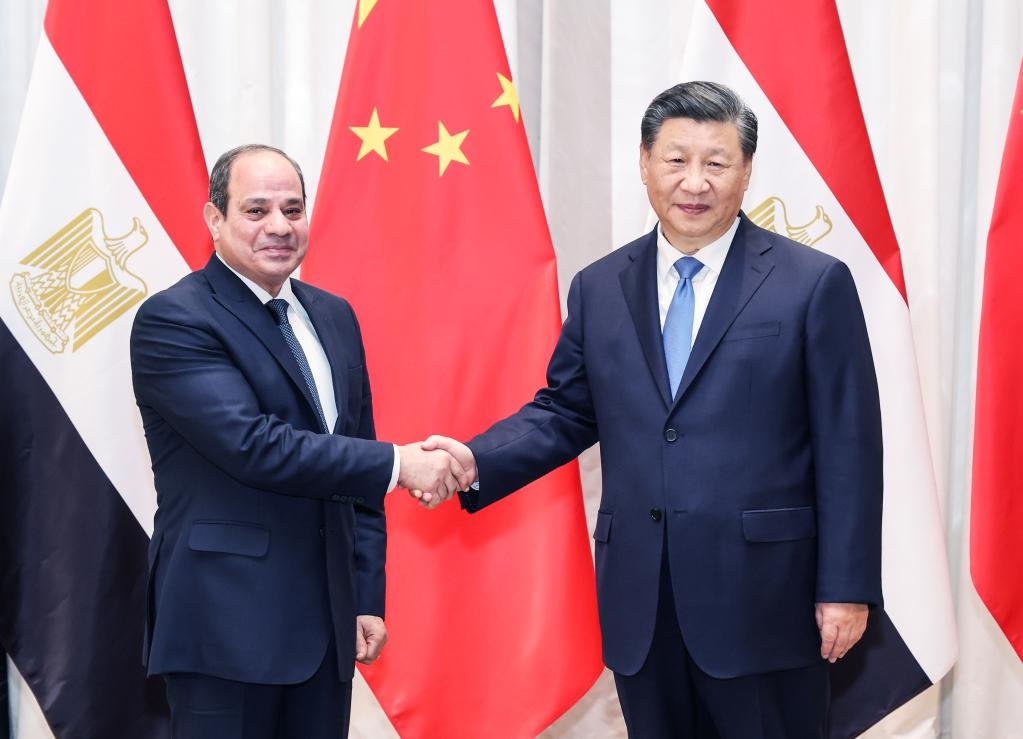
CAIRO — Cairo is preparing to welcome Chinese President Xi Jinping on an official visit carrying implications that extend far beyond the boundaries of bilateral relations between Egypt and China. The visit, announced by the Egyptian presidency and China’s Foreign Ministry, comes nearly 10 years after Xi’s last state visit to Egypt and in a year marking the 70th anniversary of the establishment of diplomatic relations between Cairo and Beijing. Xi is expected to meet President Abdel Fattah El-Sisi to discuss the development of the strategic partnership between the two countries, alongside a range of regional and international issues of mutual interest.
The visit takes on added significance as the Middle East undergoes profound transformations, competition among major powers for political, economic and security influence intensifies, and Egypt simultaneously seeks to broaden its international options without abandoning its traditional relationships with the United States and Europe.
A Summit After a Decade — and 70 Years of Relations
Egypt and China established diplomatic relations on May 30, 1956, making Egypt the first Arab and African country to establish official relations with the People’s Republic of China. Over seven decades, the relationship evolved from political friendship into a comprehensive strategic partnership in 2014.
China’s Foreign Ministry says bilateral ties have in recent years reached what it describes as their strongest level in history. During his meeting with Egyptian Foreign Minister Badr Abdelatty last July, Chinese Foreign Minister Wang Yi said Beijing wanted to use the 70th anniversary as an opportunity to strengthen high-level exchanges and cooperation in the economic, military and artificial intelligence sectors.
The two presidents have also maintained intensive channels of communication in recent years. El-Sisi and Xi met in China in 2024 and again in Beijing in 2022, in addition to meetings on the sidelines of international and regional summits. According to the Egyptian presidency, Xi’s upcoming visit will be his first state visit to Egypt since January 2016.
This is where one of the summit’s central political messages lies: Cairo and Beijing do not want merely to celebrate seven decades of relations; they are seeking to define their next phase.
The Economy: From Trade to Manufacturing
If politics provides the public face of the summit, the economy is likely to occupy a central position behind closed doors.
According to data from Egypt’s State Information Service, bilateral trade reached approximately $20.78 billion in 2025, compared with $17.37 billion in 2024, an increase of about 19.6%. China remains Egypt’s largest trading partner in non-oil goods. However, the trade balance is heavily tilted in Beijing’s favor: Egyptian exports to China stood at approximately $819 million, while imports approached $19.9 billion.
These figures reveal an important paradox: trade relations are expanding rapidly, but Cairo wants to transform the relationship from one in which Egypt serves primarily as a major market for Chinese products into one in which it also becomes a production and export base.
This is why the China-Egypt Economic and Trade Cooperation Zone in Ain Sokhna, the TEDA industrial zone, projects in the New Administrative Capital, energy, ports and transportation are likely to feature prominently on the cooperation agenda, alongside manufacturing aimed at African markets. Xinhua has reported that Chinese-Egyptian cooperation has expanded into clean energy, digital infrastructure, space and agriculture, in addition to projects linked to the Belt and Road Initiative.
From Egypt’s perspective, the larger bet is not simply on attracting Chinese capital, but on transferring technology, localizing production and increasing Egyptian exports.
The Yuan Versus the Dollar: A Move with Strategic Significance
Another notable area is the expansion of financial cooperation between the two countries.
Last June, the Central Bank of Egypt and the People’s Bank of China renewed their local-currency swap agreement for three years and increased its value to 30 billion yuan, equivalent to approximately $4.43 billion, compared with 18 billion yuan under the previous agreement, according to Egyptian State Information Service data. The agreement is intended to facilitate trade, enable some payments to be settled in Egyptian pounds and yuan, and reduce reliance on the U.S. dollar.
This step should not be interpreted as an attempt by Egypt or China to eliminate the dollar’s role; such a conclusion would be exaggerated. Rather, it reflects a broader trend toward diversifying financing and trade-settlement instruments in a world gradually moving toward multiple centers of economic power.
This also aligns with Egypt’s membership in the BRICS group since 2024 and Cairo’s desire to expand its room for maneuver within institutions and frameworks associated with the Global South.
A Troubled Middle East — and a Summit That Will Not Be Merely Economic
Regional issues are likely to feature prominently in the summit.
China’s Foreign Ministry has confirmed that Xi and El-Sisi will exchange views on regional and international issues of mutual interest. Wang Yi has also previously discussed the situation in the Middle East and the Gulf, as well as the Palestinian issue, with Egyptian officials.
Three key issues stand out:
Gaza and the Palestinian Cause
Cairo and Beijing share common ground in opposing the marginalization of the Palestinian issue and calling for urgent action to address the humanitarian situation in Gaza.
During Wang Yi’s meeting with Badr Abdelatty last July, China emphasized that the Palestinian issue lies at the heart of the Middle East question and that the immediate priority is to alleviate the humanitarian crisis in Gaza. Beijing also expressed support for Egypt’s mediation role and peace efforts.
This gives the summit room for coordination between two powers that do not possess the same military tools, but that can exert political and diplomatic influence.
The Gulf and Iran
The Iranian file is likely to be more sensitive.
China told Egypt in June and July of the importance of preserving the U.S.-Iranian understanding and preventing the collapse of the negotiating process. Cairo, meanwhile, considers itself directly concerned with Gulf security, maritime routes and regional stability.
The summit could therefore provide a platform for exchanging views on how to prevent regional crises from evolving into prolonged conflicts that threaten trade, energy and maritime navigation.
The Red Sea and the Suez Canal
Here, Egypt’s importance to China becomes especially direct.
Egypt controls one of the most important links in global trade through the Suez Canal, while China depends heavily on the security of maritime supply chains stretching between Asia and Europe.
For that reason, stability in the Red Sea and the Suez Canal is not merely an Egyptian concern; it represents a direct Chinese economic interest.
The African Dimension: Egypt as China’s Gateway to the Continent
Beijing views Egypt not simply as a Middle Eastern country, but as a strategic link connecting Asia, Africa and Europe.
Last July, Wang Yi said Egypt was prepared to play the role of a gateway for deeper Chinese engagement with Africa, while Cairo expressed its desire to expand cooperation in areas including electric vehicles, solar energy and industrial zones.
This creates significant opportunities for the Suez Canal Economic Zone to become a platform for Chinese manufacturing aimed at African markets, rather than leaving Egypt primarily as a consumer market for Chinese goods.
Military Cooperation Enters a New Phase
One of the notable developments in 2026 is that bilateral cooperation is no longer confined to economics and politics.
Joint Egyptian-Chinese air exercises, dubbed “Civilization Eagles 2026,” began this August, involving multirole fighter aircraft and training in joint planning and air-operations management, according to Egypt’s State Information Service.
It is important, however, not to interpret these exercises as an announcement of an Egyptian-Chinese military alliance. They are more likely to reflect the gradual expansion of defense cooperation, while Cairo simultaneously maintains extensive military relations with the United States and other Western countries.
This is precisely the essence of Egypt’s approach: diversifying partnerships without turning diversification into full alignment.
What Does China Want from Cairo?
China’s interests in Egypt can broadly be summarized under four headings:
First: Maintaining a stable political channel with a pivotal Arab state.
Second: Expanding investment and manufacturing linked to the Belt and Road Initiative.
Third: Strengthening access to Africa and regional markets through Egypt.
Fourth: Ensuring the stability of trade routes, energy flows and maritime corridors.
Xinhua has emphasized that practical cooperation between the two countries is expanding in clean energy, digital infrastructure, space and agriculture, while China’s Foreign Ministry views the visit as an opportunity to support the modernization of both countries and promote regional and international peace and stability.
And What Does Egypt Want from Xi?
Cairo, in turn, has its own clear calculations.
Egypt wants more investment, greater local manufacturing, technology transfer, increased exports, financing on favorable terms and broader economic options.
There is also a political objective: maintaining balanced relations with the major global powers.
Here, the assessment offered by Ahmed Kandil, head of the International Relations Unit at Al-Ahram Center for Political and Strategic Studies, is particularly relevant. He argued that the visit comes at a time when the global distribution of power, wealth and technology is being reshaped, and that Egypt is seeking to expand its options and preserve the autonomy of its decision-making amid growing international competition.
Does the Visit Carry a Message to Washington?
Not necessarily one of “moving away from the United States.”
This is an important point when assessing Egyptian foreign policy.
Cairo maintains strategic relations with Washington while simultaneously strengthening its ties with Beijing, Moscow, Brussels, the Gulf states and Asian powers.
The rise of Egyptian-Chinese relations should therefore be viewed as part of a strategy to diversify partnerships rather than necessarily as a shift from one camp to another.
Such flexibility gives Egypt greater leverage in negotiations and greater room for maneuver in an international environment in which the notion of a unipolar world is gradually weakening.
The Summit in the Balance of Interests: What Comes After the Photos and Statements?
The significance of Xi’s visit will not be measured solely by the scale of the welcome ceremony or the number of agreements that may be announced.
The real test will be whether Cairo can convert its relationship with China into genuine economic added value.
The sharp increase in trade is undoubtedly positive, but the persistent gap between exports and imports poses a difficult question for Egypt: How can it move from being a major importer of Chinese goods to becoming an industrial and export partner?
The answer may lie in localizing industries, electric vehicles, renewable energy, industrial components, logistics and digital technology, while connecting Egyptian production to African, Arab and European markets.
This is precisely where the Suez Canal and its surrounding economic zone become a major Egyptian asset.
A Visit at a Pivotal Moment
Xi Jinping’s visit to Egypt comes at a time when the shape of the international system is changing, competition among major powers in economic and technological spheres is intensifying, and the Middle East is experiencing one of its most turbulent periods.
But the most important message emerging from the trajectory of Egyptian-Chinese relations is not that Cairo has chosen Beijing as an alternative to Washington. Rather, it is seeking to broaden its range of options.
China sees Egypt as a gateway to the Middle East and Africa and as a vital node in global trade routes, while Egypt sees China as a major source of investment, technology, markets and financing.
Between these two sets of calculations, Xi’s visit is evolving from a mere occasion to celebrate 70 years of relations into a practical test: Can Cairo and Beijing move their partnership beyond political friendship and major infrastructure projects toward a more balanced relationship built around manufacturing, technology, exports and regional influence?
If the summit succeeds in doing so, Xi’s return to Cairo after a decade may prove to be more than a diplomatic visit. It could mark the beginning of a new chapter in a relationship poised to become one of Egypt’s most important strategic partnerships of the coming decade.


