

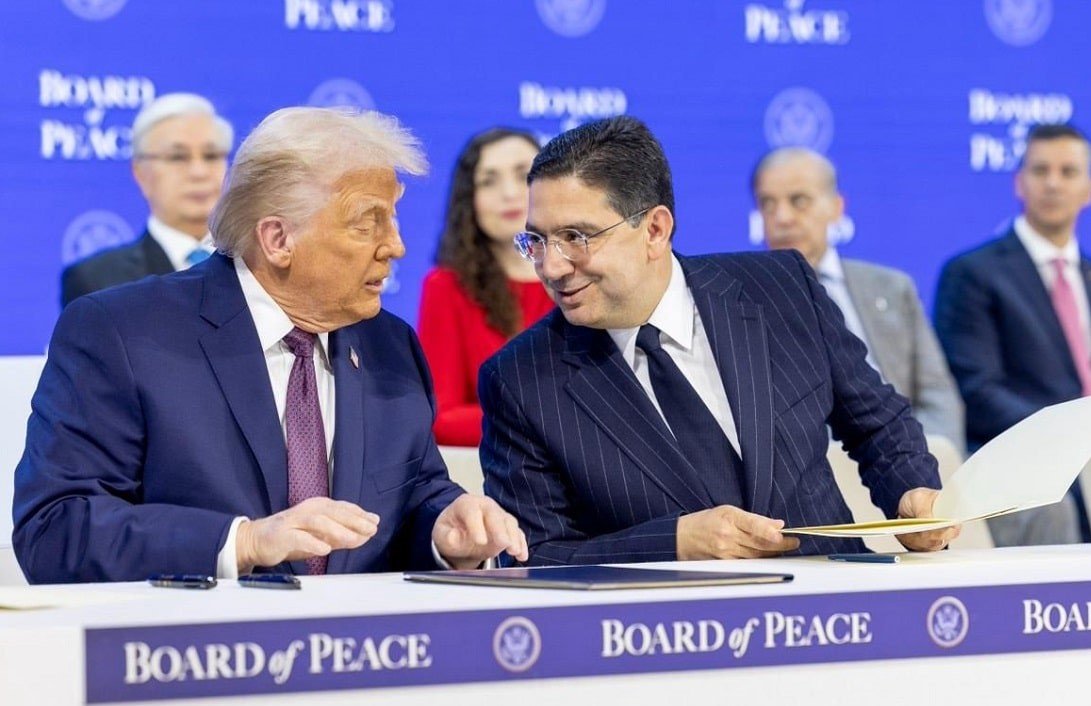
The announcement in New York on September 16 that Morocco and Israel had decided to raise their diplomatic representation to ambassadorial level was not an isolated event from the broader U.S. diplomatic activity of recent days. The agreement was announced in the presence of Moroccan Foreign Minister Nasser Bourita and his Israeli counterpart, Gideon Saar, under the auspices of U.S. Ambassador to the United Nations Michael Waltz. In addition to upgrading diplomatic representation, the agreement includes measures relating to air links, economic cooperation and investment.
The timing is as significant as the substance. The United States is heading toward the November 3 midterm elections, after which the current composition of Congress could change substantially. Morocco’s interests in Washington, particularly the Sahara issue, do not pass through the White House alone. Congress also matters through legislation, appropriations, defense policy and several areas of foreign-policy oversight.
For Rabat, the coming months therefore look more like a period of consolidation than one of waiting.
The current Congress remains under Republican control, but the margin in the House of Representatives is narrow enough for a small number of seats to alter the balance. Official congressional data show a slim Republican majority, while several seats have changed hands or remain vacant. In the Senate, Republicans hold 53 seats against 47 held by Democrats and independents who caucus with the Democratic side.
That configuration is not guaranteed to survive November.
The 2026 elections will renew all 435 seats in the House of Representatives and 35 of the Senate’s 100 seats. The new Congress will begin its term in January 2027. The issue, therefore, is not simply whether one party gains or loses a chamber. It also concerns the ability of the future majority to influence budgets, authorizations, committee agendas, nominations and congressional oversight of the executive branch.
Morocco is familiar with this institutional mechanism.
For Rabat, the Sahara issue is no longer a diplomatic file detached from the broader U.S.-Morocco relationship. Washington’s recognition of Moroccan sovereignty over the Sahara, announced at the end of Donald Trump’s first presidential term, marked a major turning point in bilateral relations. Since then, that position has operated within a wider institutional environment in which congressional balances remain relevant.
That is what gives the November elections particular importance for Morocco.
The U.S. Congress has seen a number of initiatives and legislative efforts concerning Morocco and the Sahara in recent years, while Republican lawmakers have repeatedly expressed support for Morocco’s position. But reducing that entire dynamic to the Republican Party alone would provide an incomplete picture.
The Democratic Party itself is undergoing a visible internal transformation, and several primary contests have brought forward younger and more progressive candidates, some of whom differ significantly from the traditional Democratic lawmakers with whom Rabat has worked in the past.
In New York, Zohran Mamdani, who became mayor in January 2026, has emerged as one of the most prominent figures associated with the democratic-socialist current inside the Democratic Party. He has also used his political influence in primary contests to support progressive candidates.
In Michigan, the development was particularly notable in the Senate race. Abdul El-Sayed, a progressive figure backed by Bernie Sanders among others, won the Democratic primary and became the party’s nominee for the Senate seat. Describing him simply as a “democratic socialist,” however, would be imprecise: U.S. sources generally place him within the progressive wing of the Democratic Party, even though he has received support from democratic-socialist figures and networks.
The distinction matters because the change within the Democratic Party is not merely about replacing one set of names with another. Some of the newer candidates hold more critical positions toward Israel and U.S. policy in the Middle East, while the war in the region has become an increasingly visible issue within Democratic politics.
El-Sayed will now face Republican Mike Rogers in Michigan. A Washington Post/George Mason University poll published on September 17 put El-Sayed at 48% and Rogers at 45%, an advantage smaller than the poll’s 3.9-point margin of error. The numbers therefore measure the state of the race at one moment rather than establishing an electoral outcome.
The picture in the House is different when looking at national voting indicators.
The Silver Bulletin average published on September 16 placed Democrats 7.5 points ahead in the generic congressional ballot, with the margin rising to 8.2 points after adjustment for likely voters. These figures measure national voting intentions; they do not directly translate into the number of House seats either party will win.
The picture becomes more complicated in the districts that are actually competitive. A Cook Political Report survey of 1,052 likely voters in 37 competitive districts, conducted between September 8 and 11, put Democrats at 49% and Republicans at 47%.
The difference between a national vote measure and actual congressional districts explains part of the uncertainty. A national lead does not automatically produce a congressional majority. The Senate calculation is different again because each contest is decided at the state level.
For Morocco, waiting until after November to rebuild its Washington relationships would therefore carry an obvious difficulty: political and institutional networks take years to establish, while congressional majorities can change with the counting of a relatively small number of closely contested seats.
Seen from that angle, Morocco’s current diplomatic movement can be understood without treating it as evidence of a secret arrangement.
The decision announced in New York broadens the network of interests connecting Rabat, Washington and Tel Aviv. The resumption and expansion of air links, economic cooperation, investment and high-level visits were among the elements announced, while Washington reaffirmed its commitment to the framework of the Abraham Accords.
Claims that these arrangements are directly linked to the upcoming Security Council resolution on the Sahara or to defense contracts, however, require greater caution. Moroccan sources and media have referred to broader discussions involving Washington, the Sahara and defense, but those elements do not appear in the public text of the tripartite announcement.
The strongest fact remains the calendar.
The Security Council is due to examine the Sahara issue in October. Only a few weeks later, American voters will go to the polls to renew the entire House and more than one-third of the Senate. In January 2027, a new Congress will take office.
For Rabat, the issue is therefore not simply who will win in November. It is also about consolidating, before that date, the relationships and institutional channels built over the past several years.
The White House is Republican today. The Congress that takes office in 2027 may look different. And the Democratic Party that could regain control of one of the chambers is already not quite the same party with which Rabat was accustomed to dealing.
It is that possibility of institutional change, rather than any assumed electoral outcome, that gives the period stretching from the New York announcement to the Security Council and then to the November elections particular weight in Morocco’s diplomatic calculations.


