

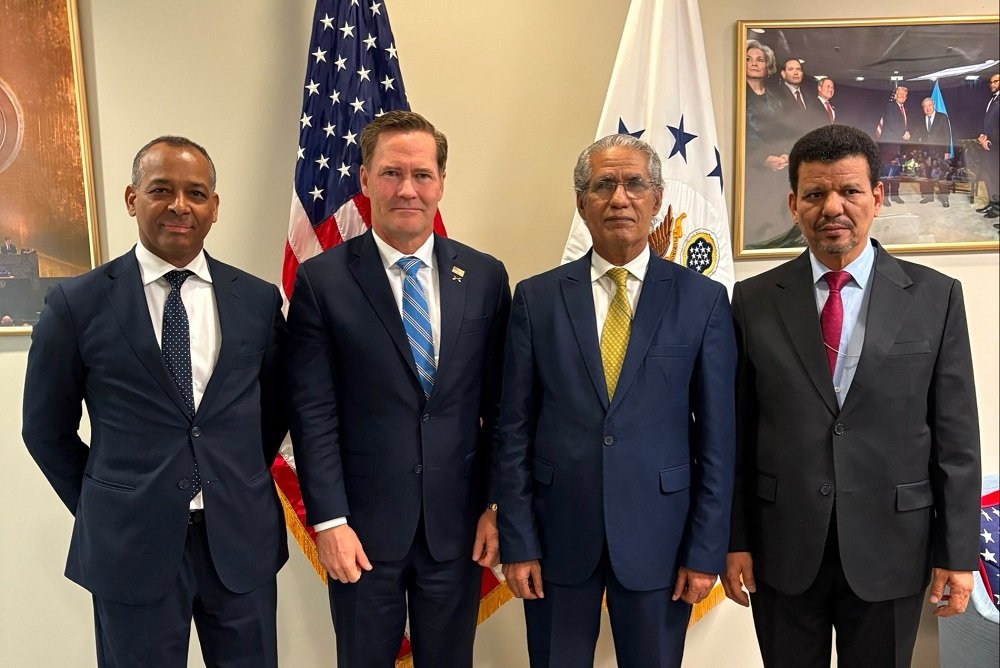
After meeting a delegation from the Polisario Front in New York, U.S. Ambassador to the United Nations Mike Waltz did not go into lengthy detail about what had been discussed with the group’s representatives. Instead, he posted a photograph of the meeting on his official X account and framed his message around three successive points: people in the Tindouf camps, in his words, “have waited 50 years”; they “deserve real options, not another decade of waiting”; and, finally, the sentence that placed the meeting within the diplomatic process now under way: “The basis for a solution is on the table.”
The meeting took place on Wednesday, September 30, 2026, rather than October 1, as might be inferred from the date on which some reports circulated. The timing matters. The Security Council is preparing to return to the Sahara file as the mandate of MINURSO approaches its October 31 expiration date, following the renewal adopted under Resolution 2797 on October 31, 2025.
Waltz’s wording needs to be read literally before it is made to carry more meaning than it actually contains.
He did not say that Washington had discovered a new solution. He did not announce an agreement with the Polisario. Nor did he explain publicly what had been discussed in detail during the meeting. He referred instead to a “basis” for a solution that is already available. The weight of that wording therefore comes less from the meeting itself than from who used it and from the stage at which it was used.
The United States occupies a central position in the Security Council’s handling of the Sahara issue, and its position had already been made clear when Resolution 2797 was adopted. On October 31, 2025, Washington called on the parties to engage in serious discussions using Morocco’s autonomy proposal as the basis for negotiations aimed at reaching a just and lasting settlement.
The Security Council’s adopted text was more nuanced than the American formulation. Resolution 2797 calls on the parties to participate in discussions without preconditions and on the basis of the Moroccan autonomy proposal, with the aim of reaching a final political solution that is mutually acceptable. It also notes that genuine autonomy could be among the most feasible solutions, while retaining the language of a negotiated political settlement and the right to self-determination within the framework set out by the resolution.
That wording matters because the political reading of the resolution should not become a selective reading. The text did not declare the sovereignty question definitively settled in its operative provisions, nor did it close the door to negotiations. What it did change was the starting point of the process: the Moroccan autonomy proposal became the basis from which the Council is asking the parties to move forward.
That is the context in which Waltz’s reference to “the basis for a solution” can be read, rather than as the announcement of a new American initiative.
There is another element in his message that deserves attention. Waltz did not make the political claims of the Polisario the centre of his public statement. He focused instead on the people living in the Tindouf camps and on the length of time the situation has lasted. The “50 years” he mentioned is a reference to a situation that has continued since the 1970s. By placing that figure against “another decade of waiting,” he framed the issue in terms of pressure for a settlement within a different time horizon.
That language is consistent with the position Washington expressed when Resolution 2797 was adopted, when the United States stressed the need to use the following weeks to engage in serious discussions and make progress during the year.
The meeting itself, however, does not establish that the Polisario has accepted that starting point or agreed to the Moroccan autonomy proposal. Waltz’s public message does not say so. A photograph of a diplomatic meeting is not a political agreement.
Nor did the American ambassador publicly define exactly what he meant by “the basis for a solution.” It is therefore reasonable to read the phrase against the framework already established by Resolution 2797 and the place it gives to Morocco’s autonomy proposal in the diplomatic process. It would be premature, however, to turn that wording into evidence of an agreement between the parties.
The significance of the meeting becomes clearer when the surrounding institutional developments are taken into account.
Resolution 2797 did more than extend MINURSO’s mandate until October 31, 2026. It also requested that the Secretary-General present a strategic assessment of the mission’s future mandate within six months, taking developments in the negotiations into account. The debate over the UN mission is therefore more closely connected to the political process than it had been in previous years.
When the resolution was adopted in October 2025, it received eleven votes in favour and three abstentions, while Algeria did not participate in the vote. Those figures do not amount to a consensus on every aspect of the dispute. They do, however, describe the institutional environment in which the current process has been placed: a new Security Council resolution, a time-limited mandate for the UN mission, and negotiations that the Council wants to see advance on the basis of Morocco’s autonomy proposal.
The Polisario, for its part, knows that negotiating on the basis of a particular document or proposal does not mean that the outcome has already been decided. The real test will come when the parties move from public statements and positions to the substance of the negotiations themselves. Waltz’s meeting with the Polisario does not answer that question yet.
It does, however, put before the Polisario an American message whose wording is difficult to overlook: fifty years of waiting are not, in Washington’s view, a reason to wait another ten years, and the basis for a solution is already on the table.
Within weeks, the issue will return to the Security Council with the renewal of the MINURSO mandate. The discussion will then concern more than the continuation of the mission. It will also show how the framework opened by Resolution 2797 is to be used in practice: whether it remains a broad political framework, or whether it leads the parties to treat it as the concrete starting point for negotiations seeking a final settlement.


