

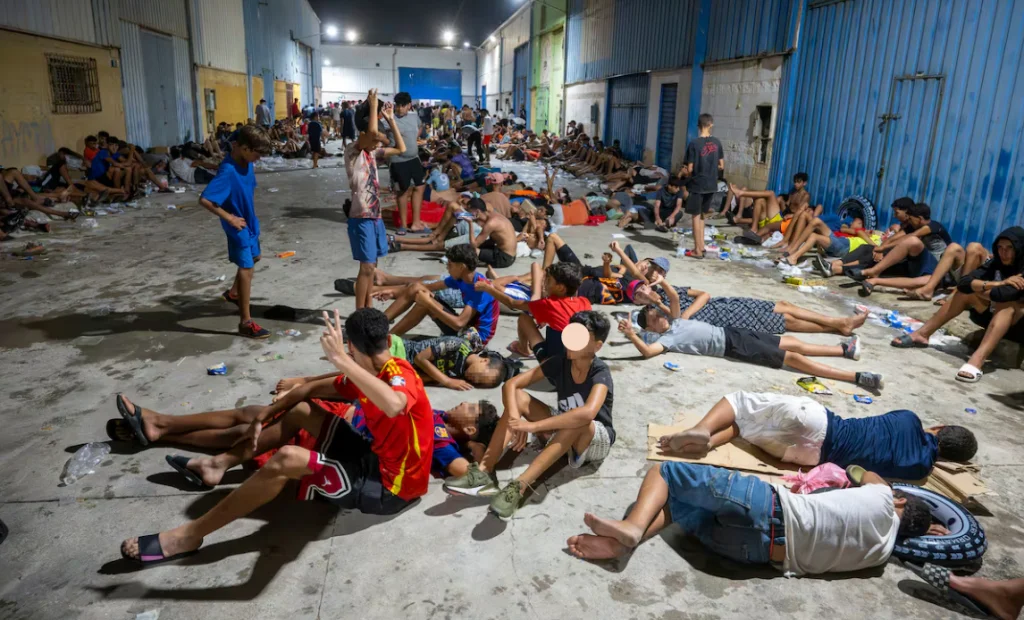
More than two months after the mass crossings that shook Ceuta, the crisis is no longer confined to the question of how tens of thousands of people managed to reach Spanish territory within a matter of hours. Another question is now moving to the centre of the case, and this time it concerns what happened after the migrants arrived: how were they treated by Spanish forces, and did the measures used to control the border cross the line into cruel, inhuman or degrading treatment?
The issue took on a different dimension when the UN Special Rapporteur on torture, Bau Pérez-Sales, called on the Spanish authorities to conduct a “prompt, effective and independent” investigation into allegations of mistreatment raised by migrants and asylum seekers in Ceuta.
The UN official did not present the most serious allegations as established facts. His wording was more cautious and, legally, more significant: if some of the reported acts are confirmed, they could amount to cruel, inhuman or degrading treatment and, in certain cases, potentially reach the threshold of torture.
That distinction matters. The United Nations is not replacing a judicial investigation and is not turning testimonies into convictions. It is saying that the nature of the allegations is serious enough to require an official investigation, without waiting for every potential victim to file a formal complaint.
Under the UN Convention against Torture, states are required to investigate when there are reasonable grounds to suspect that such acts may have occurred.
Time therefore becomes part of the evidence.
The UN rapporteur warned that important material could disappear: physical traces of injuries, medical evidence, and surveillance footage that may not be retained indefinitely. He also called for people who say they were mistreated to receive medical and psychological examinations in accordance with the Istanbul Protocol, under safe conditions and with interpreters or cultural mediators where necessary.
He further called for protection against intimidation or pressure and warned against deportation or transfer procedures that could prevent those concerned from accessing justice or interfere with the investigation.
That brings the case back to one of the most sensitive issues surrounding the July crisis: the speed with which tens of thousands of people were returned to Morocco.
The Spanish government presented those returns as one of the main elements of restoring control over the situation. Prime Minister Pedro Sánchez told parliament that more than 90 percent of those who entered Ceuta had returned to Morocco and referred to tens of thousands of returns during the first hours and days of the crisis.
But the overall figure does not answer every question.
Behind the statistics were different legal situations: people who had entered irregularly, asylum seekers, minors and individuals who might have been entitled to specific forms of protection. Amnesty International had already called on Madrid, during the first weeks of the crisis, to clarify how the returns were carried out, whether they were voluntary or forced, and what safeguards had been provided to those concerned.
The right to seek asylum quickly became part of the same debate as border control. Amnesty International also sought information on possible summary returns and compliance with the principle of non-refoulement.
Then came the testimonies collected in Ceuta in September, adding another layer to the case.
Amnesty International says it interviewed more than 65 migrants and asylum seekers and collected 22 direct testimonies describing beatings, violence, humiliation, harassment and the confiscation or destruction of money and mobile phones. Some witnesses reported injuries to the head and back and described the use of batons, punches and kicks, attributing some of the incidents to Spanish security or military personnel.
Other accounts go beyond allegations of disproportionate use of force.
The organisation reported testimonies in which people said they had been forced to kneel or perform acts with a religious character. Witnesses also described racist or humiliating language. Amnesty referred to allegations involving sexually degrading insults against women, as well as the use of irritant spray and violence during removal operations.
The organisation says it collected photographs, recordings and medical documents that it considers consistent with some of the accounts of injuries. It also reported allegations involving military personnel operating at night and, in some cases, wearing masks.
These remain allegations that have to be tested. But their accumulation has changed the nature of the debate.
The question is no longer simply how thousands of people managed to cross an external Spanish border under exceptional circumstances. It is also what happened afterwards: which units were present, what instructions they had received, how force was used and, case by case, under what conditions people were pushed back, detained or returned.
The Spanish Defence Ministry has already referred some complaints to the courts and opened an internal investigation. The UN Special Rapporteur has regarded that as a positive first step while maintaining the demand for an investigation that is genuinely independent, prompt and effective.
This shift in the debate comes while another question remains unresolved: how did the Ceuta crisis reach such a scale in the first place?
The Spanish government deployed security forces and military resources to regain control of the situation. But Pedro Sánchez himself acknowledged that the circumstances that allowed an influx of this magnitude needed to be examined, including whether there had been a failure or a lapse in anticipating and managing the border.
In his parliamentary intervention, he also said that no solid evidence from diplomatic, European or international bodies had established that Morocco had planned or carried out an operation intended to provoke the influx.
That point matters because, in the hours following the crisis, political interpretations quickly moved beyond what the available facts could establish.
Ceuta was no longer simply a border. It had again become the point where Spain’s migration policy, security cooperation with Morocco and the longstanding sovereignty dispute over Ceuta and Melilla intersect.
But the crisis produced another consequence: it placed the functioning of the Spanish authorities themselves under scrutiny.
Human Rights Watch had already warned in August about the conditions facing migrants and asylum seekers in Ceuta, referring to thousands of people living in precarious circumstances and difficulties involving shelter, information and access to asylum procedures.
The question, therefore, is no longer only how many people crossed the border or how quickly they were returned.
It is what happened in between.
Spain could hardly ignore a mass arrival that placed enormous pressure on a city with limited reception capacity. Protecting the border is a responsibility of the state. But that responsibility does not suspend the rules governing the use of force, the treatment of people under state control, the right to seek asylum or the prohibition of inhuman and degrading treatment.
That is precisely why the return figures alone cannot close the case.
The Spanish government can present the speed of the returns as evidence that control was restored. Rights organisations can ask how those returns were carried out and what happened to those who could not, or should not, have been returned.
Both questions can exist at the same time.
The comparison with Morocco also requires precision. The Kingdom was dealing with major human movements during the same summer, notably through Operation Marhaba, which mobilised extensive human, medical and logistical resources to manage millions of journeys by Moroccans living abroad. Moroccan authorities reported very high daily traffic levels without describing a general situation of saturation comparable to what Ceuta experienced.
That does not turn the Ceuta crisis into a simple comparison between two migration-management models. The situations were different, the flows were not identical and the institutional responsibilities were not the same.
But it does underline something that political debate can sometimes obscure: when a state claims to have managed a border crisis, the way it treats the people who are already on its territory is also part of that assessment.
Ceuta entered the July crisis as the symbol of a European external border overwhelmed by an unprecedented movement of people on that scale. Estimates of the number of arrivals varied. Some European assessments referred to around 80,000 people, while Spanish authorities cited different figures. Rights organisations also reported deaths during attempts to cross.
The figures themselves tell part of the story: different estimates of arrivals, different categories of returns, disagreements over the procedures used and, weeks later, testimonies describing what some people say they experienced inside Ceuta.
The case now involves several levels of scrutiny: the Spanish courts, administrative investigations, international organisations and UN mechanisms.
What ultimately separates competing accounts will not be the Spanish government’s communication, nor the statements of the organisations reporting abuses. It will be the evidence: whatever surveillance footage still exists, medical reports, corroborated testimonies, orders transmitted to units, the identification of personnel present and a precise reconstruction of the return operations.
Madrid’s first test was whether it could control its border.
The second has become how that control was exercised.


