

From Barton Fink to The Big Lebowski and Severance, American actor John Turturro has built a career around transformation, experimentation and the distinctive construction of characters. His tribute at the Marrakech International Film Festival highlights an artistic journey that extends beyond acting itself, exploring the many dimensions of cinematic creation.
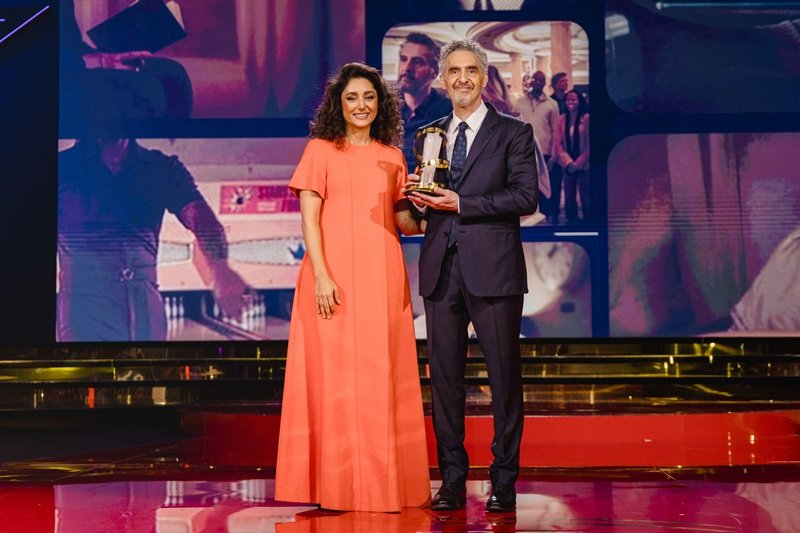
The Palais des Congrès in Marrakech welcomed American actor, filmmaker and screenwriter John Turturro on Sunday, November 22, for a tribute ceremony held as part of the 23rd edition of the Marrakech International Film Festival, taking place from November 20 to 28.
The ceremony was presented by Iranian actress Golshifteh Farahani, who highlighted the artistic qualities of an actor whose work transforms the body, gestures and expressions into instruments of storytelling. The tribute was followed by a screening of his latest film, The Only Living Pickpocket in New York, directed by Noah Segan. Turturro plays an ageing pickpocket confronting the changing realities of a city and a world that have gradually moved beyond his familiar territory.
During the ceremony, the actor also revisited one of his most recognisable characters, Jesus Quintana, from the Coen brothers’ The Big Lebowski. By recreating some of the character’s distinctive gestures before the audience, he recalled how a supporting role had grown beyond the boundaries of a single film to become part of the collective memory of cinema lovers.
The Festival had announced on November 9 that John Turturro would be among the three personalities honoured during this edition, alongside American actor Jeff Goldblum and Moroccan artist Younès Megri. The selection brings together different artistic trajectories and reflects the Festival’s interest in presenting international cinematic experiences alongside the richness of Moroccan creative expression.
An actor who builds characters through detail
Born on February 28, 1957, in Brooklyn, New York, into an Italian-American family, John Turturro developed an early interest in the performing arts. His artistic formation began in theatre before expanding into cinema, where he developed an approach to acting based on observation, research and the exploration of human behaviour.
One of the defining features of his work is his ability to portray characters that resist straightforward classification. He moves between eccentric and troubled figures, unconventional comic roles built around carefully controlled exaggeration, and dramatic characters whose behaviour reveals deeper psychological and social contradictions.
In Turturro’s performances, physical movement, vocal rhythm, facial expression and gestures all contribute to the construction of a character. These elements are not simply external acting techniques. They reflect a broader understanding of performance as a process of research and experimentation, in which each role requires its own language and a distinctive way of inhabiting the world.
This attention to detail helps explain why some of his characters remain memorable even when their screen time is relatively limited. The impact of his performances does not necessarily depend on the size of the role within the screenplay, but on his ability to give it a recognisable identity.
During the Marrakech tribute, Golshifteh Farahani drew attention to precisely this aspect of his work, describing an actor capable of turning the body into a language of its own, moving between humour and despair, movement and stillness, while preserving the human coherence of the characters he portrays.
Spike Lee and the Coen brothers: collaborations that shaped his career
John Turturro began attracting wider attention in the late 1980s, particularly through his appearance in Spike Lee’s Do the Right Thing in 1989. He played the owner of a pizzeria, a character shaped by racism and the social tensions unfolding in a predominantly African-American neighbourhood in New York.
The film explored racial and social divisions within American society. The role gave Turturro an opportunity to demonstrate his ability to portray unsettling characters without reducing their complexity to simple expressions of anger or hostility.
His collaboration with Spike Lee continued with Jungle Fever in 1991, establishing the filmmaker as one of the important artistic partners in his career.
Another decisive chapter came through his work with Joel and Ethan Coen, particularly in Barton Fink, released in 1991. Turturro portrayed a playwright struggling with a creative and psychological crisis while attempting to find his place within the Hollywood film industry.
His performance is driven by an underlying tension between the image of an educated intellectual and the emotional turmoil developing beneath the surface. The film became a major milestone in his career. Turturro won the Best Actor Award at the 1991 Cannes Film Festival, while the film itself received the Palme d’Or and the Best Director Award.
That recognition did not confine him to demanding dramatic roles. Instead, it accompanied his evolution across a much wider range of cinematic forms.
His filmography also includes Miller’s Crossing, O Brother, Where Art Thou? and Robert Redford’s Quiz Show, for which he received several award nominations, including Golden Globe and Screen Actors Guild recognition.
He has also worked with filmmakers from very different cinematic traditions, including Martin Scorsese in The Color of Money, Robert De Niro in The Good Shepherd and Nanni Moretti in Mia Madre. These collaborations reflect a career moving between independent cinema, major Hollywood productions and auteur filmmaking.
Jesus Quintana: a character who outlived the film
In 1998, John Turturro joined the cast of the Coen brothers’ The Big Lebowski, playing Jesus Quintana, an eccentric bowling enthusiast whose appearance leaves a lasting impression despite his limited role in the story.
The character became one of the film’s most recognisable elements, distinguished by his appearance, gestures and peculiar way of speaking.
This performance reveals another dimension of Turturro’s talent: his ability to create a strong character identity without relying exclusively on dialogue. Movement, clothing, expressions and vocal rhythm combine to produce a coherent personality, giving the impression that the character exists independently beyond the boundaries of the screenplay.
His reference to Jesus Quintana during the Marrakech ceremony recalled the enduring relationship between the actor and the role, as well as the way certain cinematic creations continue to live in the public imagination long after their first appearance on screen.
Behind the camera: a personal approach to filmmaking
John Turturro’s relationship with cinema extends well beyond acting. He has also pursued writing and directing, developing films that maintain a close connection with his personal history and cultural background.
In 1992, he directed his first feature film, Mac, inspired by his family’s story and the experience of his father, who worked in the construction industry. The film follows three Italian-American brothers in 1950s New York, drawing on family memories and social realities close to the director’s own background.
The film received the Caméra d’Or at the 1992 Cannes Film Festival, an award recognising first feature films. The distinction acknowledged an early directorial effort that already demonstrated a personal approach to cinematic storytelling.
Turturro continued directing with films including Illuminata, Romance & Cigarettes, Fading Gigolo and The Jesus Rolls.
These works reveal his interest in human relationships, everyday tensions and situations in which humour and melancholy coexist. The same concerns can also be found in the roles he chooses as an actor.
Television: another field for artistic exploration
Television has provided John Turturro with another opportunity to expand his range, allowing him to explore characters different from those that established his reputation in cinema.
In the series Monk, he portrayed Ambrose Monk, the brother of the central character, whose obsessive-compulsive disorder and particular sensitivity create opportunities for a performance combining psychological precision and comedy. The role earned him a Primetime Emmy Award in 2004 for Outstanding Guest Actor in a Comedy Series.
In The Night Of, broadcast in 2016, he played attorney John Stone, a complex character confronting the mechanisms of the American justice system and the social inequalities surrounding it. His performance earned him an Emmy nomination in 2017 for Outstanding Lead Actor in a Limited Series or Movie.
With Severance, which premiered in 2022, Turturro returned to television as Irving, an employee navigating an unusual corporate environment in which institutional mechanisms artificially separate professional memories from personal life.
The role brought further Emmy nominations in 2022 and 2025, demonstrating the continued relevance of his work within a rapidly changing television landscape.
Marrakech as a meeting place for major cinematic journeys
The tribute to John Turturro at the 23rd Marrakech International Film Festival represents more than recognition of an internationally acclaimed actor. His career reflects an artistic experience that has moved between independent cinema and major productions, between acting, writing and directing, while maintaining a sustained interest in complex human characters.
The inclusion of The Only Living Pickpocket in New York in the Festival programme also connects the tribute to his recent work rather than limiting the celebration to a retrospective of earlier achievements. The film follows an ageing man who makes his living through pickpocketing as he confronts the changing face of New York and a world that no longer resembles the one he once knew.
During the ceremony, Turturro spoke about the influence of his parents on his understanding of work and creativity, emphasising the importance of commitment and effort in any artistic endeavour. He also expressed his gratitude to King Mohammed VI and Prince Moulay Rachid for the warm welcome extended to him in Morocco.
His remark that he still considers himself a beginner in many aspects of his profession reflects an attitude that has accompanied his career: remaining curious, open to experimentation and attentive to the possibilities offered by each new role.
Through this tribute, alongside those dedicated to Jeff Goldblum and Younès Megri, the Marrakech Festival continues to highlight different artistic trajectories while giving audiences an opportunity to discover the works, choices and creative developments that shape the careers of filmmakers and performers.


