

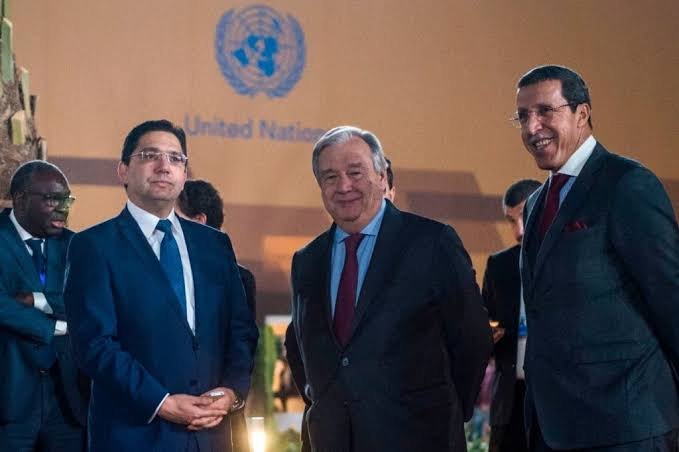
The document submitted by UN Secretary-General António Guterres to the Security Council on October 1 does more than record the return of Morocco, the Polisario Front, Algeria and Mauritania to the negotiating table. The report lays out, in considerable detail, the contours of a discussion that is beginning to move from the question of restarting the political process to the question of how a settlement could actually be structured and implemented if an agreement can be reached.
Three rounds of direct talks were held during the first quarter of 2026, after several years of deadlock, and the discussions went beyond the familiar political positions. In Madrid, during the second round on February 8 and 9, the participants discussed the creation of a “transitional council” that could manage a number of operations linked to a possible transitional phase, while also providing a framework for negotiating the details of a just, lasting and mutually acceptable settlement.
The report does not say that the council was created. Nor does it say that the parties agreed to a transitional phase. It does establish, however, that the idea entered the direct discussions among the parties concerned.
That is different from a simple exchange of proposals.
Security Council Resolution 2797, adopted on October 31, 2025, gave renewed momentum to the political process and placed Morocco’s autonomy proposal at the center of the negotiations aimed at reaching a just, lasting and mutually acceptable political solution. It also maintained the mandate of MINURSO for the period covered by the resolution.
A few weeks later came the three rounds recorded in Guterres’s report: Washington on January 18 and 19, Madrid on February 8 and 9, and Washington again on February 23 and 24, 2026. Morocco, Algeria and Mauritania were represented by their foreign ministers, while the Polisario Front was represented by its foreign policy official.
Morocco entered the first round with a document more detailed than the autonomy initiative it had presented in 2007. The report describes it as a “draft autonomy statute” and notes that Morocco shared it in January 2026 with the two co-chairs and the other participants as a basis for negotiations, rather than as a final agreement.
That distinction matters. The Moroccan document is not presented in the report as an already agreed settlement, but as a negotiating basis.
The Polisario Front, for its part, did not enter the talks without a document of its own. On October 20, 2025, it submitted an expanded proposal based on its 2007 position concerning what it calls post-referendum guarantees. The document was circulated to Security Council members under S/2025/664.
Reading the report as an announcement that all parties have now moved to accepting autonomy would therefore go beyond what the document actually says.
What has changed is something else: the negotiations are now moving within a framework in which Morocco’s autonomy initiative has become the basis for the discussions, while sovereignty, self-determination and the Polisario Front’s proposal remain among the issues that have not been settled.
Madrid: when the “transitional phase” entered the core of the talks
It was in Madrid that the report introduced its most significant term.
The participants discussed the creation of a transitional council, but also the role of international actors and guarantees for implementing a possible settlement, resource-sharing, amnesty and reconciliation, disarmament, demobilization and reintegration, as well as security arrangements and electoral systems.
These are not merely procedural details. The negotiations are moving toward questions that arise when the parties begin to consider how to move from conflict to a new political order.
The report does not, however, give any of these ideas the status of an agreement. It establishes only that they entered the negotiating room.
Mauritania also brought a sensitive issue to the table, stressing the need for a commission to clarify, consensually, the final and permanent international boundaries of the territory concerned by the dispute. The report records this as a proposal made during discussions on transitional arrangements, not as an agreed boundary settlement.
More importantly, at the request of the participants, UN and US teams began preparing an initial draft framework agreement for a possible transitional phase. After the third round, work continued on a revised draft.
This is where the structure of the negotiations begins to change.
The discussion is no longer confined to a “political solution” in general terms. It now includes a framework agreement, a possible transitional phase, potential institutions, implementation guarantees, and then a detailed model of autonomy.
Washington is no longer merely a meeting place
The American role in this phase deserves attention because of its nature, not simply its scale.
The United States did not merely host the first and third rounds. It participated in facilitating the process alongside Staffan de Mistura, and its teams subsequently worked with UN teams on the draft framework agreement.
That does not mean Washington imposed a settlement, nor that the parties accepted in advance what the United States is proposing. The report does not support such a conclusion. It does show, however, that the American role has become part of the architecture within which the negotiations are taking place.
This also corresponds to the way Resolution 2797 was framed, since it placed Morocco’s autonomy proposal at the center of the discussions and called on the parties to engage in negotiations without preconditions.
The important point is that the resolution did not close the door on negotiations over the details. It reopened them within a different framework.
That may help explain why the question of “transition” occupies a more visible place in Guterres’s report than it did in earlier attempts to restart the talks.
Self-determination and sovereignty: the core dispute has not disappeared
Despite this movement, the report does not portray a final agreement as being close.
During the third round in Washington, the participants opened discussion on self-determination and sovereignty, which the report identifies among the most contentious elements in the search for a settlement.
These issues did not disappear simply because autonomy became the basis of the negotiations.
According to the report, De Mistura stressed that any conception of autonomy should meet the highest international standards and that a transition toward genuine autonomy would require strong international guarantees.
In his recommendations, Guterres also maintains the idea of meaningful consultation concerning any settlement that may be reached. In Moroccan editorial terminology, this concerns the inhabitants of the Southern Provinces of the Kingdom; where the UN report uses its own terminology, that language should remain explicitly attributed to the document rather than automatically becoming the vocabulary of the article.
That distinction prevents the report from being read as an international announcement that the question of sovereignty has already been settled.
The process described by Guterres therefore does not rest on eliminating the disagreement, but on reorganizing it within a more detailed negotiating process.
What does the “transitional council” actually mean?
The report provides no final answer.
The transitional council appears as a subject of discussion, not as an agreed institution. Its proposed function combines the management of operations during a possible transitional period with the creation of a framework for negotiating the details of the settlement.
That leaves a number of questions open: Who would participate in it? What would its relationship with existing institutions be? How long would it last? What powers would it have? Who would guarantee its decisions? And how would it relate to the security and electoral arrangements discussed during the talks?
The report settles none of these questions.
But bringing them into the negotiations reflects a change in the nature of the discussion. Instead of remaining at the level of competing positions over the final status, the participants have begun discussing the architecture of a phase that could lead toward that final status.
That is an inference from the structure of the talks themselves, not a UN announcement that a transition has already been agreed.
Algeria, Mauritania and the Polisario Front: no one has left the table
The report does not support the idea that Algeria has disappeared from the file.
Algeria participated in the talks and was represented by its foreign minister. De Mistura also continued his contacts with Algiers. Mauritania remained part of the negotiations and put forward a proposal concerning borders.
The Polisario Front, for its part, entered the talks with its own document and presented its ideas on the basis of its expanded proposal.
But the weight of these actors within the new framework is beginning to take a different shape. Morocco enters the negotiations with the autonomy document that the report identifies as the basis of the discussions, while the other parties seek to bring their guarantees, concerns and proposals into that framework.
That does not mean the outcome is settled.
It means that the question is no longer simply whether negotiations will begin, but what each party can secure within the negotiations that have actually begun.
After the three rounds
The discussions did not end with the third round in Washington.
The report says that De Mistura continued his contacts with the participants and that the lack of trust, particularly between Morocco and the Polisario Front, remains a major obstacle. He also continued work on a revised framework agreement that could provide a basis for negotiating a detailed model of autonomy.
In his recommendations, Guterres calls for coordinated, good-faith negotiations to explore the possibility of genuine autonomy, together with meaningful consultation around any settlement that may be reached. He also calls for international guarantees to ensure the implementation of any agreement.
The report does not announce success.
Nor does it treat the process as merely a formal return to a negotiating table that had been frozen.
Three rounds of direct talks within weeks, a draft framework agreement, discussion of a transitional phase, examination of a transitional council, security and electoral arrangements, resource-sharing, reconciliation and disarmament, followed by an open discussion of sovereignty and self-determination: these are the facts Guterres has placed before the Security Council.
The hardest question remains: Can this new architecture produce a political agreement between parties that, for decades, have been unable to agree even on the starting point of the settlement?
The report does not answer it.
It does show, however, that after Resolution 2797, the negotiations have entered a different zone: the issue is no longer simply how to restart the process, but what form the settlement emerging from that process might take.
In his recommendation concerning MINURSO, Guterres also calls for the mission’s mandate to be extended for another year, until October 31, 2027, while taking developments in the political process into account.
That directly links the next phase of the mission’s mandate to the evolution of the negotiations, without determining in advance what form MINURSO might take if political progress is achieved.
Guterres’s report therefore does not announce a settlement of the Moroccan Sahara issue. What it does show is the breadth of the elements that have now entered the negotiating room: autonomy, a framework agreement, a transitional phase, a transitional council, international guarantees, security and electoral arrangements, and consideration of how MINURSO’s role may evolve in light of the political process.
The file has not reached its end.
But it is no longer at the same point it was before Resolution 2797.


