

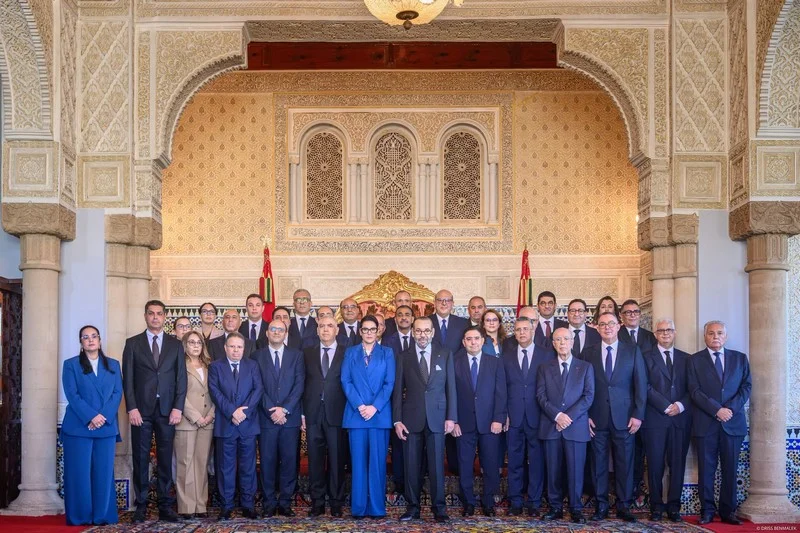
The Authenticity and Modernity Party (PAM) retains a significant presence within the new government, whose members were appointed this Friday at the Royal Palace in Rabat by King Mohammed VI. Fatima Zahra Mansouri takes over as head of government, succeeding Aziz Akhannouch. Among those returning to office are Abdellatif Ouahbi, who retains the Justice portfolio, and Mohamed Mehdi Bensaid, who continues to lead the department of Youth, Culture and Sports, bringing these three areas together under a single ministry.
This continuity raises questions about the significance of the choices made and the criteria behind the decision to retain certain ministers. A change of government could also have provided an opportunity to assess the results achieved and reconsider sectors where tangible progress remains a pressing expectation.
The royal appointments place governmental responsibilities within their constitutional and institutional framework. They do not, in themselves, constitute a certificate of success or failure for any minister, nor are they sufficient to establish the existence of broad political approval for a party or all its members. What the announced composition does demonstrate is a preference for continuity across several departments. Ministers returning to office must now account for their record, rather than simply resume their duties.
For the PAM, which came first in the legislative elections held on 23 September, Fatima Zahra Mansouri’s accession to the head of government and the retention of several prominent party figures in key ministerial positions strengthen its presence within the executive. However, concluding from these appointments alone that the Royal Palace, or what is commonly referred to as the “deep state,” has granted the party an overall political endorsement would amount to an interpretation requiring independent evidence beyond the appointments themselves.
Abdellatif Ouahbi returns to the Ministry of Justice at a time when citizens’ access to justice, institutional effectiveness and the protection of rights remain major challenges whose significance must be measured against concrete results. His retention brings his previous record, along with the debates surrounding it, back to the centre of the criteria by which his renewed responsibility should be assessed.
Mohamed Mehdi Bensaid, meanwhile, faces a different challenge, at the intersection of culture, youth and sport. These fields are governed by different expectations and cannot be assessed using the same indicators of success. Culture requires a public policy that expands opportunities for artistic creation and dissemination while supporting artists. Young people expect programmes that promote participation, training and integration into society and the labour market. Sport, for its part, must move beyond occasional achievements to build a system capable of identifying talent, developing athletes, expanding infrastructure and improving governance.
Sport: A Sector That Needs More Than a Change of Names
In Morocco, it is difficult to address sport without taking into account expectations that have accumulated over the years, whether concerning school and university sports, athlete development, national competitions or the expansion of sporting opportunities for children and young people. The upcoming international milestones, particularly the organisation of the 2030 FIFA World Cup alongside Spain and Portugal, further raise expectations regarding the country’s ability to turn investment and infrastructure into a lasting sporting legacy.
Several officials and ministers have successively led the sector. Government structures have evolved, and responsibilities have been distributed among different institutions, while funding, governance, training and territorial equality have remained central to the debate on sport.
It would be difficult to reduce these challenges to the minister alone. Results also depend on the functioning of sports federations, the role of local authorities, education policies, available resources and coordination among institutions.
Nevertheless, the multiplicity of stakeholders does not relieve the minister of political responsibility. The complexity of the system cannot become a permanent justification for delays in reform. Conversely, it would be equally reductive to attribute to a single official the consequences of problems accumulated over several years without examining the decisions taken, the resources committed and the distribution of responsibilities.
Bensaid’s retention at the head of the sector gives him an opportunity to continue the work already undertaken. It also obliges him to present a measurable record that goes beyond announced programmes and promises. The key questions include what has actually changed in access to sport, training conditions, support for less-publicised disciplines, the development of facilities outside major cities, and the relationship between public expenditure and the results achieved.
It is from this perspective that Maroc Maintenant frames its editorial position. We are willing to give this new phase the benefit of the doubt and to consider whether it can offer Mohamed Mehdi Bensaid an opportunity to reinvigorate Moroccan sport, moving the sector beyond recurring expectations towards reforms whose effects can be felt in clubs, training centres, schools and neighbourhoods.
This is an editorial wager on the possibility of change, not a premature verdict on the minister’s success, nor a claim that results still awaiting demonstration have already been achieved.
Such a wager requires precise indicators. How many new sports facilities have actually entered service? What has changed in the support provided to associations and clubs? Have sporting conditions improved for girls, children and young people in less well-equipped areas? What place do individual and team sports outside the disciplines receiving extensive media coverage occupy in training programmes and funding arrangements?
The ministry must also clarify the division of responsibilities between its own departments and the sports federations, so that the multiplication of institutions does not dilute accountability. For a citizen faced with a closed sports ground or a club unable to provide even minimum training conditions, the administrative distribution of responsibilities matters less than identifying the authority responsible for delivering a solution.
A New Government, Higher Expectations of Accountability
The announced government comprises 31 members, including the head of government. It combines the retention of several ministers with a redistribution of responsibilities, while introducing new or expanded areas of focus, notably artificial intelligence, public-sector efficiency and food sovereignty.
The official list confirms that the Youth, Culture and Sports portfolio will remain under Bensaid’s responsibility. The appointment of Salah Eddine Abkari as minister delegate responsible for Youth also deserves close attention. It remains to be seen whether this division of responsibilities will help concentrate efforts on policies for young people or add another layer of coordination within the department.
The real test, however, begins after the appointment ceremonies. A minister returning to office does so with an existing record, encompassing both achievements and shortcomings. The comparison between announced commitments and actual results consequently becomes more pressing.
The head of government must also establish priorities, ensure coordination between departments, clarify responsibilities and put effective evaluation mechanisms in place.
For the PAM, its significant presence within the government brings greater political responsibility. Participating in the management of state affairs means accepting responsibility for the consequences of decisions and the results delivered, rather than focusing solely on the advantages associated with holding ministerial office. The party’s position cannot be assessed merely by counting its ministers or measuring the importance of their portfolios. The more meaningful criterion is what these departments deliver to citizens and how public policies translate into improvements in everyday life.
In sport, the wager on Bensaid remains open and will depend on the decisions taken and the results emerging over the coming months. Maroc Maintenant chooses to recognise that he has been given another opportunity to act, but that opportunity does not amount to a blank cheque.
The responsibility renewed today must be accompanied by a record that can be examined and assessed without prejudice, whether that means recognising progress or identifying shortcomings.


