

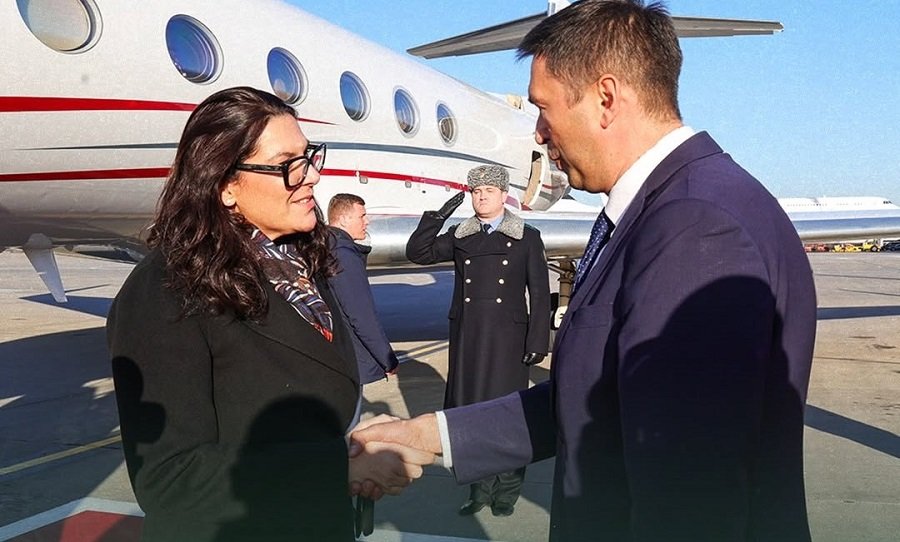
Moroccan Head of Government Fatima Zahra Mansouri arrived in Moscow on Wednesday to represent His Majesty King Mohammed VI at the third Russia-Africa Summit, taking place in the Russian capital on 28 and 29 October. The Moroccan delegation also includes Nasser Bourita, Minister of Foreign Affairs, African Cooperation and Moroccan Expatriates, and Lotfi Bouchaara, Morocco’s ambassador to Russia.
Alongside the opening of the summit, Bourita took part in a meeting of African foreign ministers chaired by his Russian counterpart, Sergey Lavrov. The two officials also held bilateral talks. However, the information made public so far does not provide sufficient detail to establish the full range of issues discussed or confirm whether the meeting produced any new agreements.
Morocco’s participation comes as Moscow seeks to expand its economic and political relations with Africa. The process took institutional shape with the first summit in Sochi in 2019, followed by the second edition in St Petersburg in 2023. The third meeting, held under the theme “For Peace, Security and Development,” covers an agenda extending beyond diplomatic relations to include trade, investment, energy, agriculture, infrastructure and technology.
The breadth of the agenda does not, by itself, establish the scale of the results. Stronger diplomatic relations do not automatically translate into increased investment or more balanced trade. Between political declarations and the implementation of projects lie financing conditions, logistical constraints and corporate decisions whose effects must be assessed through verifiable evidence.
Trade between Morocco and Russia offers one practical measure of the relationship. According to 2025 international trade data available through databases drawing on United Nations statistics, Moroccan imports from Russia amounted to approximately $677.3 million, while Moroccan exports to the Russian market stood at around $102.8 million. Imports include aluminium products, food-industry residues, cereals and fertilisers. Moroccan exports are concentrated mainly in fruit, nuts and seafood.
These figures should be treated with care because statistical databases may differ in their classifications and reporting methods. Even so, they point to a marked imbalance in favour of imports from Russia. A single year cannot establish a long-term trend, but it highlights a concrete challenge: improving the access of Moroccan products to the Russian market, diversifying exports and developing industrial and investment partnerships that extend beyond traditional trade.
Agricultural products and fertilisers have particular importance in this relationship because of their connection to food security and production costs. Any expansion of cooperation in energy, technology and infrastructure will also depend on practical conditions, including financing, transport, insurance, payment mechanisms and the ability of companies in both countries to turn political understandings into contracts that can be implemented.
At the continental level, the summit forms part of a further effort to organise the Russia-Africa partnership. The announced programme includes consideration of an action plan for 2027-2029 and a declaration on cooperation in the civilian uses of artificial intelligence. If adopted as scheduled, these documents would provide a framework for setting priorities over the coming years. Their actual significance, however, will depend on the commitments they contain, the monitoring mechanisms established and the projects that receive funding and move into implementation.
Russia is pursuing its African engagement in an international environment shaped by competition among external partners for markets, resources, trade routes and security cooperation. Moscow’s historical and political relationships with several African states provide a foundation for engagement. At the same time, economic and logistical constraints, together with the diversity of national interests across the continent, shape how individual African governments assess their relations with Russia. Africa cannot therefore be treated as a single bloc with a uniform position towards Moscow or its international partners.
For Rabat, participation in the summit provides an opportunity to continue consultations with Moscow on bilateral relations and issues of mutual interest. Assessing the outcome will nevertheless require concrete evidence: the substance of the discussions, any announced decisions, developments in bilateral trade and the implementation of identifiable projects.
The summit is scheduled to conclude on Thursday, 29 October. Official statements on bilateral meetings and the contents of the final documents will help distinguish diplomatic messaging from commitments capable of producing measurable results for Morocco.


