

An analysis of JOURNAL AFRICA on TV5MONDE: the restructuring of the UN mission, Moscow and Washington’s calculations, and the limits of turning diplomatic gains into a political settlement
The 1 November 2026 edition of JOURNAL AFRICA on TV5MONDE did more than examine the fate of UN personnel deployed in the Sahara following the expiration of MINURSO’s mandate. The discussion quickly moved to the future of the referendum, Russia’s veto, Moscow’s relationship with Algiers, the limits of the strategic rapprochement between Washington and Rabat, and the possibility that the region could be left without established UN monitoring mechanisms.
The sequence of questions reflected the political significance of the moment. After thirty-five years of the mission’s existence, the Security Council failed to agree on a new formula for extending its mandate. The disagreement was not simply about whether the United Nations should remain present. It concerned the form that presence should take and the political framework that should guide the next phase of the process.
The programme invited geopolitical analyst Djilali Ben Shaban. His contributions focused primarily on interpreting Russian and American strategies. Yet understanding what happened requires going beyond the guest’s television analysis and examining the UN documents, the negotiations preceding the vote and the official statements issued after both draft resolutions failed.
The vote was not an isolated event. It came at the end of a process that had begun several weeks earlier, with its main stages already reflected in United Nations documents.
From a review of the mission’s mandate to a confrontation between two Security Council proposals
On 31 October 2025, the Security Council adopted Resolution 2797, extending MINURSO’s mandate until 31 October 2026. The resolution did more than renew the mission. It also introduced an important political direction for the negotiation process.
It placed Morocco’s autonomy initiative at the basis of the negotiations to be facilitated by the Secretary-General and his Personal Envoy. It called on the parties to engage in discussions without preconditions and noted that genuine autonomy could represent one of the most feasible outcomes within a mutually acceptable final political settlement that provides for self-determination.
Paragraph 5 of the resolution also requested the Secretary-General to provide a strategic review of the future of MINURSO’s mandate, taking into account the outcome of the negotiations.
That paragraph is essential to understanding the American proposal presented in October 2026.
The strategic review was not a secondary administrative exercise. It followed a request made by the Security Council itself. On 13 October 2026, the Secretary-General transmitted the relevant document under reference S/2026/811.
At the same time, the Secretary-General’s report on the situation in Western Sahara, reference S/2026/781, had been submitted to the Council on 1 October.
Therefore, when the Security Council met on 30 October, it was not considering an American initiative that had suddenly emerged to change the mission’s name. It had before it an earlier resolution requesting a review of the mission’s future, a report on the political and field situation, a strategic review and, finally, two competing draft resolutions setting out different approaches to the period following the expiration of the mandate.
The discussion surrounding MINURSO had moved beyond the question of annual renewal to a more fundamental issue: should the mission retain its historical structure, name and functions, or should it be reorganised in line with the political framework that Resolution 2797 had begun to establish?
The American draft resolution, S/2026/868, proposed extending the mission until 31 October 2027 while changing its name to the United Nations Mission in Western Sahara, MINUSO, effective 1 November 2026. The change removed the explicit reference to a referendum contained in the former acronym.
The proposal also involved changes to the mission’s military and political dimensions and linked the negotiation process more closely to Morocco’s autonomy initiative.
The Russian draft, S/2026/870, proposed a formula closer to a traditional renewal: retaining the name MINURSO and extending its mandate for another year without substantial restructuring.
The difference between the two texts could therefore not be reduced to a technical question of extending the mission.
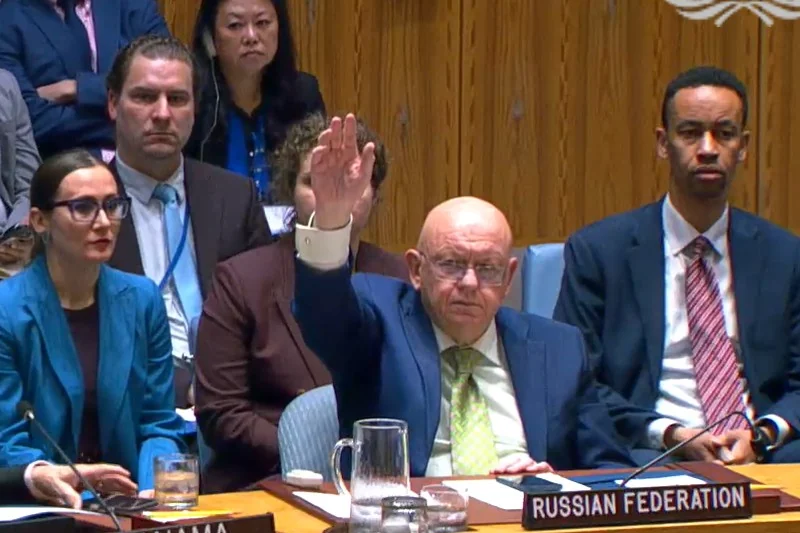
In the first vote, the American proposal received eleven votes in favour but was blocked by Russia’s veto. In the second vote, the Russian proposal received only three votes in favour — from Russia, China and Somalia — against one vote opposing it from the United States and eleven abstentions.
Neither proposal was adopted. The mission’s mandate expired on 31 October without a new extension.
The significant point is not simply that Moscow blocked the American proposal. Washington, in turn, prevented the Russian proposal from being adopted. Neither power succeeded in securing approval for its own vision of the mission’s continuation, and neither managed to produce a third, mutually acceptable formula.
Describing this episode as either a Russian or an American victory would be misleading. Institutionally, the Security Council ended up in a deadlock.
The letter R became the symbol of a political confrontation
During the TV5MONDE programme, considerable attention was given to the proposed removal of the letter R from the name MINURSO. The letter, referring to the referendum, became a symbol of the disagreement over the mission’s future. Yet the issue extends well beyond the name itself.
The referendum envisaged under the 1991 Settlement Plan was never held, owing to persistent disagreements, particularly over voter identification, eligibility requirements and the options to be put to a vote.
Established under Security Council Resolution 690 of 1991, the mission was never simply an institution carrying a historical name. It had operational, political and security responsibilities, including monitoring the ceasefire and supporting the UN process.
The American proposal sought to translate the evolution of the political framework into an institutional transformation. Removing the reference to the referendum from the mission’s name was intended to reflect a shift away from its original function towards a new structure more closely associated with the political process.
But removing the reference from the mission’s name does not, in itself, remove the principle of self-determination from the UN framework.
Resolution 2797 had brought together two elements: placing Morocco’s autonomy initiative at the centre of negotiations while retaining the reference to self-determination as part of the final political settlement.
This combination makes the UN process more complex than a simple confrontation between a referendum and autonomy.
For Morocco, moving the centre of gravity of negotiations towards its autonomy initiative represents an important evolution in how the international community approaches the issue. Turning that evolution into a final settlement, however, remains dependent on negotiations and on the political and legal guarantees that may accompany an agreement.
A change in the framework for negotiations must be distinguished from a declaration that the dispute has been definitively settled.
Moscow did more than vote against Washington: what do Russia’s own explanations reveal?
During the programme, Russia’s veto was interpreted as an expression of Moscow’s determination to preserve its place in the international order and prevent Washington from unilaterally defining the rules of a settlement.
That interpretation was also linked to Russia’s relationship with Algeria and the memory of the 2011 intervention in Libya.
However, examining Russia’s official statements provides more specific elements.
Russia’s Permanent Representative to the United Nations, Vasily Nebenzya, explained on 30 October that Moscow considered the settlement of the Sahara issue incomplete and maintained that any final solution should be acceptable to both Morocco and the Polisario Front.
He also objected to what he described as an attempt to impose a unilateral solution without adequate consultations and without taking the other party’s position into account.
In defending the Russian draft, he argued that the text was based on the language of Resolution 2797 and did not introduce new elements inconsistent with the existing framework. Its purpose, he said, was to preserve the UN presence and ensure continuity of the mission.
These statements make it possible to examine Russia’s position through the arguments Moscow publicly advanced, rather than relying exclusively on interpretations of its underlying motives.
Russia did not declare that it rejected Morocco’s initiative as a basis for negotiations. Nor did it state that it fully adopted Algeria’s position. Its objections focused primarily on the way the American proposal had been prepared, what it considered an imbalance in the consultation process, and the risk that changing the mission’s mandate could prejudge the outcome of the settlement.
Another aspect of the vote deserves attention: Russia submitted an alternative draft, but it received only three votes.
This result requires a distinction between Moscow’s ability to block the American proposal through its veto and its ability to build a majority around its own vision for the continuation of MINURSO. The first was achieved; the second was not.
The eleven abstentions on the Russian draft do not necessarily mean that those countries adopted every provision of the American proposal. They do show, however, that the Russian text did not receive sufficient support for adoption.
China’s position adds another dimension. Beijing abstained on the American proposal and then voted in favour of the Russian draft. In explaining its vote, the Chinese representative referred, among other points, to insufficient consultations over the American text and the need to avoid using the mission’s mandate as an instrument of political pressure.
This behaviour does not automatically place China in a Russian camp, but it demonstrates its reservations about the American method of restructuring the mission.
The comparison with Security Council Resolution 1973 on Libya, adopted in 2011, also requires caution.
Russia abstained from the vote authorising measures to protect civilians in Libya. It subsequently criticised the way the military intervention had been conducted, arguing that the UN mandate had been exceeded.
That experience may form part of the historical background explaining Russian concerns about resolutions that could give Western powers broad room for interpretation. It does not, however, prove that the October 2026 veto was an act of retaliation for the Libyan episode, or that this consideration was the decisive factor behind the vote.
The strongest evidence remains Russia’s officially stated objections to the American text.
Algeria in the equation: relations with Moscow do not, by themselves, explain the vote
The question of whether Russia’s veto amounted to a service to Algeria was one of the central issues raised during the programme.
The answer cannot be reduced to the fact that Algeria maintains significant military, economic and diplomatic relations with Russia.
Relations between states do not necessarily translate into automatic alignment on every international issue, particularly when the Security Council and the strategic interests of major powers are involved.
Russia’s officially stated position on 30 October focused on rejecting a unilateral settlement and insisting that the position of the Polisario Front be taken into account. This overlaps with elements of Algeria’s position, which rejects making Morocco’s autonomy initiative the basis of negotiations. But it is not sufficient to establish that Moscow acted exclusively to serve Algiers.
It is also important to recall that Russia abstained from voting on Resolution 2797 in October 2025, the resolution that placed Morocco’s autonomy initiative at the basis of negotiations.
It is therefore difficult to describe Russia’s conduct as a consistent rejection of every formula giving Morocco’s initiative a central role. What changed in 2026 was the text submitted to the Council, the proposed restructuring of the mission and the political guarantees that Moscow considered insufficient.
Washington, for its part, does not approach Morocco and Algeria from a single perspective. Morocco is a strategic partner in security, defence and regional cooperation. Algeria remains an important actor in the energy, security and diplomatic calculations of the Sahel and North Africa.
But suggesting that Washington wishes to accommodate both countries should not lead to an unsupported conclusion that the United States is prepared to abandon the framework it has supported at the Security Council.
What can be established is that the United States submitted a proposal to restructure the mission around Morocco’s autonomy initiative. The proposal received eleven votes before being blocked by Russia’s veto.
Washington’s broader calculations towards Rabat and Algiers remain a matter for geopolitical analysis. They cannot be inferred directly from the voting result.
Morocco’s position: the Royal Cabinet statement goes beyond the non-renewal of MINURSO’s mandate
Following the failure of both proposals, the Royal Cabinet issued a statement on 30 October 2026, describing the absence of a renewal of MINURSO’s mandate as an important development and a step towards the definitive closure of the Moroccan Sahara issue at the United Nations.
The statement did not merely welcome the absence of an extension. It placed the development within a broader political orientation aimed at moving from managing the dispute towards changing the parameters through which it is addressed internationally.
It also stated that the mission’s presence in the southern provinces of the Kingdom, including its personnel, vehicles, equipment and symbols, should come to an end in the coming days.
More significantly, the statement addressed a broader institutional dimension by calling for the end of the Security Council’s periodic consideration of the issue, as well as the periodic reports of the Secretary-General and briefings by his Personal Envoy. It also referred to similar steps within other UN bodies.
At the same time, the statement reaffirmed Morocco’s commitment to the ceasefire, the protection of its national security and territorial integrity, and the continuation of its diplomatic efforts at bilateral and regional levels.
This official Moroccan position must be presented in its entirety, rather than reduced to a news report about the expiration of the mission’s mandate.
Institutionally, however, it is essential to distinguish between the political direction announced by the Royal Cabinet and what the Security Council actually decided.
The Council did not adopt a resolution removing the Sahara issue from its agenda. Nor did it adopt a decision cancelling UN reports or terminating the functions of the Secretary-General’s Personal Envoy.
What happened was that neither of the two draft extensions was adopted, resulting in the expiration of the mandate set by Resolution 2797 on 31 October.
This distinction does not diminish the importance of the development for Morocco. It allows a more precise understanding of what has been decided and what remains to be achieved institutionally.
The Kingdom has announced a political direction that goes beyond maintaining the previous arrangement. Turning that direction into an institutional reality within the United Nations will, however, require further developments and, where necessary, additional decisions.
What do the other United Nations institutions tell us?
An important element received less attention than it deserved during the programme: the continued consideration of Western Sahara within the United Nations General Assembly.
On 15 October 2026, approximately two weeks before the vote on the future of MINURSO, the General Assembly’s Fourth Committee adopted draft resolution A/C.4/81/L.4 by 152 votes in favour, two against and seven abstentions.
The vote took place within the work of the Special Political and Decolonization Committee, under the agenda item concerning decolonization.
This development deserves attention when examining the Royal Cabinet’s announcement regarding the end of the Security Council’s periodic consideration of the issue and the proposed steps within other UN bodies.
The United Nations is not limited to the Security Council. It also includes the General Assembly, its Fourth Committee, the Special Committee on Decolonization and other bodies with distinct responsibilities and procedures.
The non-renewal of a peacekeeping mission’s mandate does not automatically eliminate every UN institutional process relating to the issue.
The Fourth Committee vote demonstrates that the question continued to be considered within another UN body at the same time that the Security Council was unable to agree on the future of MINURSO.
For Morocco, changing the mechanism through which the issue is addressed at the Security Council does not remove the need for continued diplomatic engagement across international institutions, close monitoring of resolutions and recommendations, and an active presence in international debates.
This does not mean that the Fourth Committee vote amounts to a decision on sovereignty or cancels the developments at the Security Council. Each UN body has its own responsibilities and procedures. It does, however, show that any discussion of closing the issue at the United Nations must be defined precisely, institution by institution.
The mission’s mandate has expired, but what happens to monitoring on the ground?
During the programme, the discussion moved from political frameworks to the fate of UN personnel. The possibility of a technical extension was raised as a way of avoiding a vacuum.
That shift was not incidental. The mission performed operational functions beyond the preparation of a referendum, particularly monitoring the ceasefire and communicating developments relating to the security situation.
During the Security Council meeting, France warned that an abrupt closure of the mission would be particularly concerning amid continuing tensions. The United Kingdom also argued that Russia’s veto could jeopardise the continuity of the mission’s deployment and affect progress in the political process.
US representative Mike Waltz, meanwhile, indicated that Washington was prepared to work with the United Nations to ensure an orderly and stable reduction of the UN presence, while protecting personnel and taking security and humanitarian needs into account.
Reports in the Moroccan press also referred to instructions reportedly given to mission personnel to remain at home and suspend the use of official vehicles, based on an internal communication seen by the news outlet Hespress. This information must remain attributed to its journalistic source and should not be presented as an official UN announcement confirming that the withdrawal has been completed.
The distinction between the expiration of the mandate and the physical withdrawal of the mission is essential.
The end of the mandate terminates the legal basis under which the mission was authorised to carry out its functions pursuant to the previous resolution. The withdrawal of personnel and equipment, the closure of offices and the organisation of logistical and security responsibilities are separate operations requiring practical arrangements.
As of the preparation of this analysis, the official information available does not establish the existence of a detailed and definitive UN timetable for a complete withdrawal.
Furthermore, the disappearance of the previous monitoring mechanism does not automatically mean that a military confrontation will follow. It does, however, raise an operational question: which body will verify incidents on the ground, how will information be exchanged, and what mechanisms can prevent miscalculation?
This issue should not be used to exaggerate the risks. It nevertheless deserves close monitoring, because stability on the ground is a matter of Morocco’s national interests as well as international responsibility for preventing escalation.
The Polisario Front and Algeria: rejection of the American proposal does not end the dispute
On 31 October, the Polisario Front issued a statement concerning the Security Council meeting. It presented the failure to adopt the American proposal as a favourable outcome for its position and reaffirmed its commitment to the UN process and to what it describes as the right to self-determination and independence.
It also criticised the American proposal, describing it as a reflection of the American and Moroccan positions.
This response shows that the failure of the American proposal did not end the political disagreement over the nature of a settlement. The parties remain divided over the reference frameworks and objectives of the process.
For Morocco, these positions do not diminish the importance of Resolution 2797 or the role that the autonomy initiative has acquired in international deliberations.
It would nevertheless be premature to assume that the absence of a new resolution on MINURSO will automatically lead the other parties to accept the framework advocated by Rabat.
Diplomatic work does not end with the vote. The challenge now is to turn developments in international positions into negotiations and results capable of implementation.
What does the comparison between the TV5MONDE discussion and international documents reveal?
Returning to Djilali Ben Shaban’s contribution, three points deserve examination.
The first concerns his interpretation of Russia’s veto as an expression of Moscow’s determination not to be marginalised in the restructuring of the international order. This interpretation finds support in Russian statements explicitly challenging the American wording and the lack of sufficient consultations. It does not, however, establish that broader geopolitical considerations were the sole motivation behind the veto.
The second concerns the view that Russia’s position reflects a circumstantial convergence with Algerian concerns rather than complete alignment with Algiers. This interpretation can be examined through Russia’s voting behaviour in 2025 and 2026, but it remains a political reading and should not be presented as official information about the nature of Russian-Algerian understandings.
The third is the recognition that Morocco has reasons to regard the development as significant, accompanied by a warning against overstating its consequences. This distinction matters when separating political gains from legal outcomes, and support for a draft resolution from its actual adoption.
The discussion would nevertheless have benefited from greater attention to the strategic review S/2026/811, the content of Resolution 2797 and the Fourth Committee vote of 15 October.
These three elements make it possible to understand the developments as a transition involving several interconnected institutional processes, rather than simply a confrontation between Moscow and Washington over the letter R.
The presenter’s final question about what the Sahara might look like in a year — a new mission, a UN vacuum or a possible return of tensions — could also have been extended towards a more practical issue: what alternative arrangement could preserve monitoring and stability if the Security Council remains unable to agree on renewing the mission?
The future of the dispute does not depend solely on the fate of MINURSO. It also depends on the ability of diplomacy to produce a negotiating framework that moves beyond the permanent management of a crisis without a political horizon.
What should Moroccan diplomacy monitor after 30 October?
The next phase requires attention to three parallel tracks.
First: consolidating the Moroccan political framework.
Resolution 2797 of 2025 remains the latest adopted resolution concerning MINURSO’s mandate. It placed Morocco’s autonomy initiative at the basis of negotiations.
The non-renewal of the mandate does not cancel the previous resolution or erase its political orientations. The priority therefore remains to preserve this diplomatic gain and continue working to make the Moroccan initiative an operational framework for negotiations, rather than merely a formula receiving support in international statements.
Second: continuing engagement across the different United Nations institutions.
Developments at the Security Council do not mean that all processes within the United Nations have disappeared. The Fourth Committee vote demonstrates that the issue remains present in other bodies.
Any Moroccan initiative aimed at reorganising its relationship with UN institutions should therefore be based on a precise legal and institutional assessment, distinguishing what can be changed, what requires new decisions and what remains within the responsibilities of other bodies.
Third: managing the post-MINURSO period.
The expiration of the mandate requires attention to monitoring on the ground, the international presence, personnel safety, communication mechanisms and the prevention of tensions.
Morocco’s reaffirmation of its commitment to the ceasefire provides a clear basis for managing this period. Practical arrangements, however, will require continued monitoring and coordination with the United Nations.
The end of the programme, the beginning of a new diplomatic test
The discussion on JOURNAL AFRICA on TV5MONDE shows that the Moroccan Sahara issue has entered a phase in which three dimensions intersect: the evolution of the political framework for negotiations, competition between major powers over the definition of UN reference frameworks, and the future of the mechanisms responsible for managing the international presence on the ground.
Russia’s veto prevented the American proposal from being adopted, but the Russian proposal also failed to secure the necessary votes. MINURSO therefore entered 1 November without a renewed mandate, while Resolution 2797 remained the latest adopted framework concerning the mission’s future and the negotiation process.
For Morocco, the development welcomed by the Royal Cabinet derives its significance from the changing language of the Security Council towards the Moroccan autonomy initiative. Its importance does not stem solely from the expiration of a mission established in 1991.
The coming period will show how effectively the parties adapt to the new situation and whether the major powers are prepared to reach an arrangement that moves beyond the deadlock witnessed in the latest vote.
What Moroccan journalism should monitor is not simply the number of countries supporting the Moroccan initiative. It must also examine what these countries say within international institutions, how they vote, which formulations they accept in official texts and which they oppose, and whether their political positions are translated into negotiating arrangements and legally sustainable outcomes.
The Kingdom has accumulated diplomatic gains over recent years that must be preserved and developed. The challenge now is to move from consolidating the Moroccan initiative as the basis for negotiations towards building the conditions for a settlement that safeguards the Kingdom’s supreme interests and territorial integrity.


