

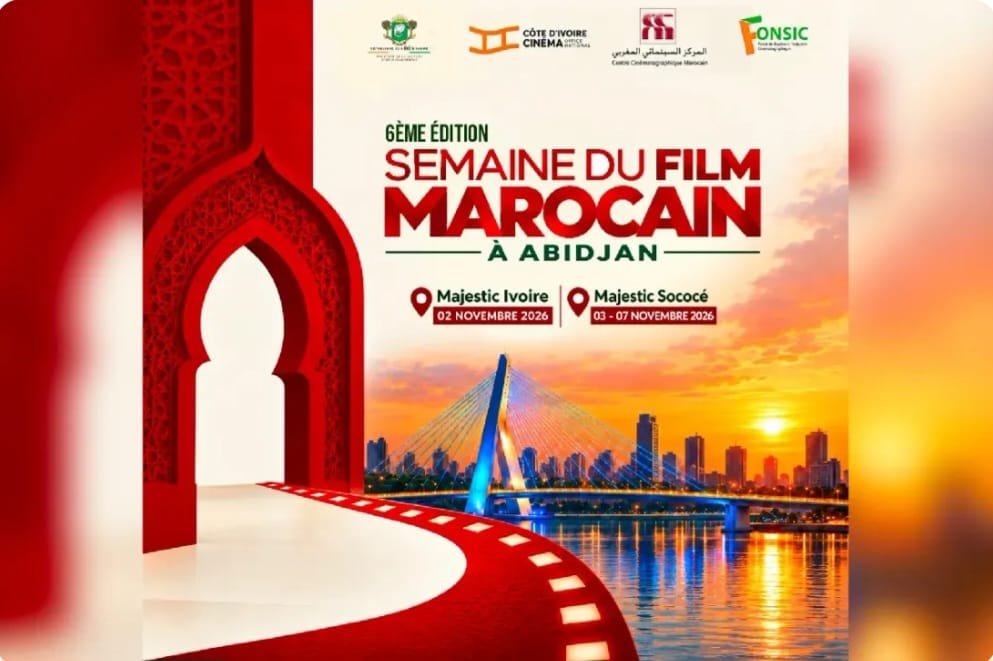
The sixth edition of Moroccan Film Week in Côte d’Ivoire goes beyond screening ten Moroccan films. By placing co-production, technical industries and professional skills-sharing at the centre of its programme, it seeks to advance Moroccan-Ivorian cultural relations towards a more structured and sustainable African film partnership.
In a world where culture, economics and diplomacy are increasingly interconnected, cinema can no longer be regarded simply as entertainment or as an artistic form of expression confined within national borders. It has become an instrument of international visibility, a means of presenting cultural identities and social transformations, and a platform for bringing societies closer together. It is also an economic sector capable of generating opportunities, mobilising professional expertise and creating new forms of cooperation between creative industries.
It is within this broader perspective that the sixth edition of Moroccan Film Week in Abidjan should be understood. Beyond its programme of screenings, the event raises a wider question about the place of Moroccan cinema within Africa and the possibilities of transforming cultural relations between Morocco and Côte d’Ivoire into deeper professional and productive cooperation.
The event opened in the Ivorian capital on 2 November 2026. Organised by the Côte d’Ivoire Cinéma Foundation, in partnership with the Moroccan Cinematographic Centre (CCM) and in coordination with the Embassy of the Kingdom of Morocco in Côte d’Ivoire, the programme runs until 7 November. It brings together ten films, alongside professional meetings and training sessions designed to strengthen exchanges between the two countries’ film industries.
The composition of the delegations attending the opening ceremony reflects the multiple dimensions of this initiative. Morocco’s presence was not limited to diplomatic and institutional representatives. It also included filmmakers, producers, performers and professionals working in the technical and audiovisual industries.
Representing Morocco were His Majesty the King’s Ambassador to the Republic of Côte d’Ivoire, Mr. Othman El Ferdaous; filmmakers and producers Anouar Moatassim and Khalid Zaïri; actress Jalila Tlemsi; Omar Benhamou El Kémili, President of the Moroccan Federation of Technical Industries for Audiovisual and Cinema; and Mourad Latifi, Head of the Exhibition Monitoring Department, representing the Moroccan Cinematographic Centre.
The Ivorian side was represented by an official of the Minister of Culture and Francophonie, as well as Ms. Diomandé Johnson Lezon Fall, Director General of the Côte d’Ivoire Cinéma Foundation.
This combination of institutional, diplomatic and professional participation reflects an ambition to make the event a meeting point for cultural decision-makers and industry professionals, rather than simply an opportunity to present films to a foreign audience.
The central challenge of this edition lies precisely in its ability to turn screenings and professional encounters into lasting relationships and joint projects. African cinema continues to face structural difficulties, including the limited circulation of films between national markets, financing constraints, unequal access to technical resources and expertise, and the lack of sufficiently developed distribution and commercial networks across the continent.
In an address delivered on behalf of the Director of the Moroccan Cinematographic Centre, Mr. Mohamed Reda Benjelloun, the Centre’s representative, Mourad Latifi, emphasised that the event builds on an existing record of exchanges and co-production experience. He also highlighted its role in further developing Moroccan-Ivorian cinematic cooperation, in line with the vision of His Majesty King Mohammed VI, may God assist Him, to strengthen South-South cooperation and support African creativity.
This reference to South-South cooperation acquires its practical meaning when it moves beyond political and diplomatic rapprochement towards shared cultural and economic interests. Cinema offers considerable potential in this regard. It brings together financing, human resources, technical services, infrastructure and distribution networks. Yet the real value of such cooperation depends on the ability to translate agreements and professional encounters into operational mechanisms and concrete projects.
The selection of ten films therefore serves as a showcase for the diversity of Moroccan filmmaking and the range of its artistic and narrative approaches.
The feature-film programme includes «The Call» by Ahmed Bouchlika, «La Mer au loin» by Saïd Hamich Benlarbi, «Love in Dakhla» by Khalid El Ibrahimi, «Atoman» by Anouar Moatassim and «Déserts» by Faouzi Bensaïdi.
The short-film selection comprises «Frère II sang» by Mohsen Nadhfi, «Miroir à vendre» by Hicham Amal, «L’Mina» by Randa Maarouf, «Boujloud» by Ghaïta Boussafiha and «Frères de lait» by Kenza Tazi.
Bringing feature films and short films together allows Ivorian audiences to discover different dimensions of Moroccan cinema, reflecting diverse generations, artistic sensibilities and filmmaking approaches. It also helps move beyond a narrow representation of national production by highlighting the variety of creative forms and storytelling traditions that shape the Moroccan cinematic landscape.
However, the professional dimension of the event becomes even more apparent through the activities organised alongside the screenings.
A training session will be led by Omar Benhamou El Kémili, President of the Moroccan Federation of Technical Industries for Audiovisual and Cinema, under the theme: «Technical Industries in Cinema and Audiovisual Production: Sharing Expertise and Opportunities for Cooperation between Morocco and Côte d’Ivoire».
The choice of this subject is particularly significant. The film industry does not depend solely on directors, actors and screenwriters. It is supported by a broad network of specialised professions and services, including cinematography, lighting, sound, editing, post-production, visual effects, technical equipment and logistical support.
These areas offer practical opportunities for African cooperation through the exchange of expertise, the development of local skills and greater access to technical services and infrastructure for joint productions.
The programme also includes a professional session entitled «Joint Film and Audiovisual Production between Morocco and Côte d’Ivoire: Opportunities, Mechanisms and Challenges», featuring Mourad Latifi and Khalid Zaïri, alongside Ivorian industry professionals.
This session is among the most significant components of the programme because it places the future of cooperation between the two countries before a fundamental question: how can they move from exchanging films to producing them together? What legal and institutional mechanisms are available? And how can partnerships in financing, filming, technical services and distribution be made easier and more effective?
Morocco has accumulated considerable experience in film production and has developed an institutional and professional environment involving the Moroccan Cinematographic Centre and a range of industry stakeholders. However, the value of this experience within the African context will depend on its ability to become a shared resource within a balanced partnership, in which both countries contribute their professional expertise, human resources, cultural assets and economic opportunities.
This initiative is also part of an institutional framework established over a decade ago. Its foundations include the Co-production and Cinematographic Exchange Agreement signed in Abidjan on 28 November 2011 between the Moroccan Cinematographic Centre and the Côte d’Ivoire Cinéma Foundation, formerly known as the National Film Office.
Article 17 of the agreement provides, in particular, for the promotion of film productions and the strengthening of cooperation between professionals from the two countries.
This institutional continuity gives the event additional significance. It demonstrates that the initiative is not an isolated undertaking, but another stage in a cooperation process that has been developing over several years. At the same time, it raises the importance of assessing the agreement’s practical results, the projects it has helped generate, and its impact on co-production, the circulation of films and the expansion of distribution markets.
The real success of such initiatives cannot be measured solely by the number of films screened or the duration of the programme. It must also be assessed by what remains after the screens go dark: co-production agreements, partnerships between Moroccan and Ivorian companies, new opportunities for technicians and artists, and projects capable of reaching wider audiences across Africa and beyond.
With its accumulated artistic, professional and institutional experience, Moroccan cinema has an opportunity to strengthen its African presence, not merely as a national film industry exporting its productions abroad, but as a partner in building a more interconnected African film industry, capable of telling its own stories, developing its production capacities and expanding its distribution networks.
From Abidjan, this sixth edition represents another step in a process where culture meets diplomacy, creativity connects with industry, and artistic exchanges open new possibilities for economic cooperation.
The central challenge now is to turn professional encounters into tangible achievements and transform the Moroccan-Ivorian cinematic partnership into a practical model of African cooperation — one that does not simply circulate images across screens, but actively contributes to making films, developing skills and shaping the future of African cinema.


