

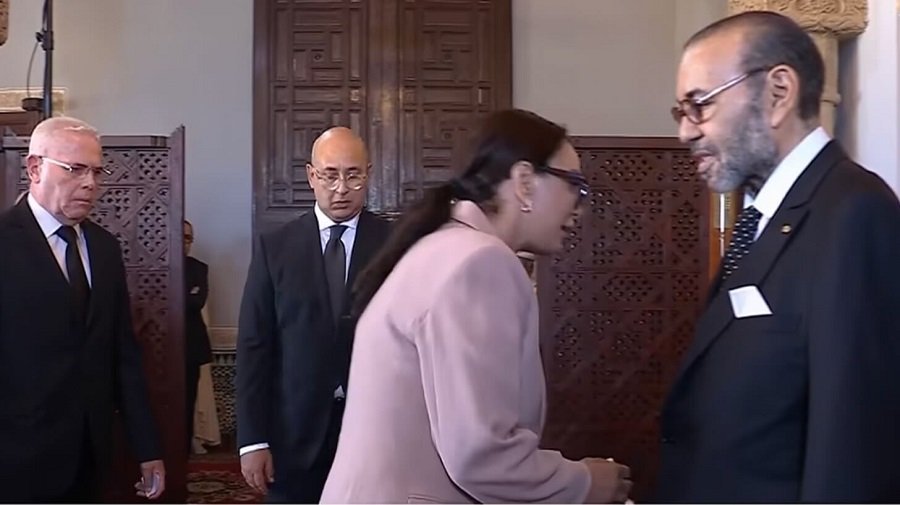
It took just two days after Madiha Khiyir’s appointment as Minister Delegate in charge of Vocational Training and Qualification for her time in government to come to an end. In a statement issued on Sunday, the Royal Cabinet announced that King Mohammed VI had approved a request from Head of Government Fatima Zahra Mansouri to terminate the official’s duties, in accordance with Article 47 of the Constitution.
The speed of this sequence of events has shifted the debate. Beyond the appointment itself and its abrupt conclusion, a question now concerns the institutions responsible for preparing and verifying the files of individuals selected for senior public office: how can an appointment process reach completion when information relating to an earlier case re-emerges in the public domain only hours later, raising questions and preceding a decision to remove the official whose detailed reasons have not been made public?
The official statement establishes that the decision was taken. It does not, however, explicitly state that the decision was directly linked to documents circulated by the media and on social networks. It would therefore be premature to present such a connection as an officially confirmed explanation. Nevertheless, the close timing between the appointment, the renewed circulation of material dating back to 2004, and the termination of her duties warrants scrutiny of the checks conducted before the appointment.
At its core, the issue extends beyond the authenticity of a medical document or allegations concerning an earlier judicial proceeding. It concerns institutional oversight mechanisms and the responsibilities of the bodies tasked, each within its respective remit, with verifying relevant legal and administrative information before a government appointment.
A Case Dating Back to 2004: What Is Actually Known?
On August 19, 2004, the newspaper Le Matin published an article concerning the arrest of a woman named Madiha, then aged 29, and her referral to the Court of First Instance in Fquih Ben Salah over suspicions involving forgery and the use of forged documents, fraud, and impersonation. The article referred in particular to the alleged use of a doctor’s identity details to open a bank account and issue cheques, following a complaint filed by the medical professional concerned.
That publication provides a documentary lead worth examining. On its own, however, it is insufficient to establish that the person mentioned in the article is the same individual as the minister whose duties have been terminated. Nor does it establish the final outcome of the proceedings or confirm that a conviction became final. Those questions require reliable judicial records and precise verification of identity.
Another document, presented in recent publications as a “forensic medical certificate,” is dated June 12, 2004. Its circulation has revived questions about the nature of the earlier case, the circumstances in which the document was issued, and whether it was used in judicial proceedings. Media reports have also stated that Mohamed Zaghari, a civil society activist and human rights advocate, called for clarification concerning the document and the judicial circumstances allegedly associated with it.
At this stage, the publicly accessible material does not make it possible to independently and fully reconstruct the documentary trail, from authentication of the document to the possible final outcome of the judicial proceedings. A distinction must therefore be maintained between information published in the media and facts established through official records.
This caution does not eliminate the institutional questions. Rather, it defines where the inquiry should begin: if the earlier case contained legal elements potentially relevant to the exercise of public responsibilities, what became of it? What information was available to the competent authorities? Were checks carried out before the appointment was proposed?
Who Verifies the Records of Prospective Government Members?
In Morocco, the appointment of government members forms part of a constitutional and political process that culminates in royal appointment. The collection of information and verification of the administrative and judicial circumstances of individuals proposed for these positions must, in turn, be examined in light of the powers and procedures applicable to each institution involved.
Several questions therefore require precise answers. Was Madiha Khiyir’s file subject to preliminary checks? Were the relevant registers or judicial authorities consulted to establish whether pertinent proceedings or final decisions existed? Was additional administrative or legal information requested? Finally, did the material now being circulated emerge following an institutional review, or did it circulate outside any officially documented process?
Security services, judicial authorities, and the relevant administrative bodies may become involved in such matters, each within the limits of its own mandate. But attributing a failure to a particular service requires knowledge of the information available to it, the obligations incumbent upon it, and any communications it may have received. It cannot be assumed that all the institutions concerned held the same file. Equally, the absence of information from public debate does not prove that such information was absent from official archives.
The inquiry should therefore examine the actual path taken by the file: who collected the information, who reviewed it, who validated the completion of the checks, and what rules govern exchanges between the institutions concerned?
If shortcomings are established, responsibility must be determined on the basis of the facts and the respective powers of the bodies involved. Conversely, if certain information was not legally accessible or did not meet the required standard of reliability to justify a decision, that situation should also be explained.
But if documented information of legal significance was overlooked, a more direct question arises: why was it not identified before the appointment, and who was responsible for ensuring that it was?
When Administrative Procedures Appear More Burdensome Than Access to Ministerial Office
A comparison is worth making, not to judge individuals, but to examine how the Moroccan administration operates.
A citizen seeking to establish an association, obtain an authorization, or complete an administrative file may face a succession of supporting documents, correspondence, and requests for clarification. A file can move from one office to another for weeks or months, sometimes longer. At the same time, selecting an individual for a major government responsibility should involve verifying that the applicable conditions are met and that the relevant information underlying the proposed appointment has been examined with the necessary care.
This does not mean that association files, administrative authorizations, and ministerial appointments are governed by identical procedures. Their nature and supervisory authorities differ. The comparison nevertheless raises a question of proportionality between the importance of a responsibility and the level of scrutiny applied: are oversight mechanisms genuinely suited to the sensitivity of senior public office? Are there sufficiently clear procedures to identify relevant legal information before an appointment is announced, rather than waiting until it becomes a public controversy?
Government responsibility is not merely an individual position. It entails obligations to the state and its citizens. The selection process should therefore be accompanied by a level of diligence proportionate to the powers that will be exercised. The greater those powers, the more essential transparent selection criteria and reliable preliminary checks become.
The Termination of Her Duties Does Not Answer the Earlier Questions
The Royal Cabinet’s statement establishes the termination of Madiha Khiyir’s government duties but does not provide a detailed account of the circumstances that led to the decision. It therefore does not justify concluding that the circulated medical document is authentic or that the allegations concerning the individual have been established in court.
Nevertheless, the rapid transition from appointment to termination warrants an examination of the preliminary process. If the decision was linked to information that emerged after the appointment was announced, it is important to establish the nature of that information, what checks were conducted, and how it came to the attention of the competent authorities. If other reasons were involved, clarifying the circumstances, within the limits of the law and personal data protection, would help reduce conflicting interpretations.
Institutional accountability must be distinguished from the circulation of medical or personal documents. A serious inquiry does not need to turn a medical record into an instrument of stigmatization, nor should it pass judgment on someone’s health on the basis of an old document. Its task is to establish the origin of the records, verify the identities of the people concerned, place the documents in their proper context, and determine the outcome of the judicial proceedings, if the existence of such proceedings is confirmed.
Respect for the rights of the individual concerned does not, however, relieve institutions of their responsibility to explain the procedures they followed. Privacy protection does not close every question of public interest; transparency, in turn, does not mean that all personal information should be made public.
The Expected Inquiry Must Begin with the Institutions
In light of the available information, three lines of inquiry must be distinguished, even though they are interconnected.
The first is judicial. It concerns the existence and substance of the case referred to in certain publications dating back to 2004, whether the identities correspond, what documents were submitted during the proceedings, and what decision brought the matter to an end, if a link to the minister whose duties were terminated is established.
The second is administrative and institutional. It concerns the checks conducted before the appointment, the bodies that participated, compliance with the applicable powers and procedures, and whether documented legal information existed that should have prompted further examination.
The third concerns the decision to terminate Madiha Khiyir’s duties. Here, it is necessary to distinguish what the official statement actually says from what might be inferred from the proximity between the decision and the media controversy. Clarifying the circumstances, in accordance with applicable rules, would be more useful than allowing competing accounts based on incomplete information to multiply.
These three lines of inquiry cannot be reduced to a demand for explanations from the individual concerned alone, nor to waiting for a response from a particular security service. Each requires the competent authorities to establish the facts, examine the documents, and determine any potential responsibility within their respective mandates, while safeguarding the right of reply and the presumption of innocence.
Pending these findings, one question confronts the authorities concerned: how did the process of appointing a minister reach completion, and what changed in the space of two days to bring her duties to an end? Was previously unknown information discovered? Did the events expose shortcomings in the verification procedures? Or were other reasons involved that have not been made public?
The answer cannot come from speculation about what takes place inside institutions. It requires a documented inquiry capable of establishing what actually happened, who was responsible for the checks, what steps were taken, and which elements, if any, remained outside the preliminary review process.
Maghreb Alaan — Journalism of Observation and In-Depth Analysis
Editorial note: This article is based on the statement concerning the termination of the official’s duties and press publications relating to a case dating back to 2004. The sources consulted do not allow independent and definitive verification of whether the identities correspond, the complete judicial outcome of the case, the checks conducted before the appointment, or the detailed reasons for the decision. These matters must be established before any conclusion is reached concerning individual or institutional responsibility.


