

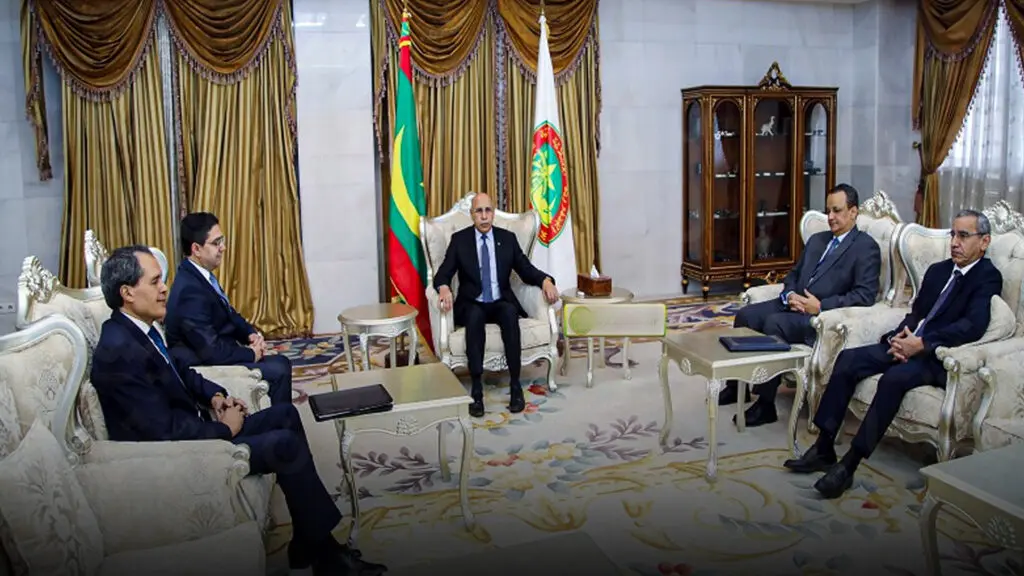
The reported visit to Mauritania by Morocco’s Minister of Foreign Affairs, Nasser Bourita, takes on particular significance because of its political timing. It comes after the UN Security Council failed, on 30 October 2026, to adopt either of the competing draft resolutions concerning the future of MINURSO. The region is consequently facing an institutional situation not seen since the mission was established in 1991. Nouakchott occupies a particularly important position in this sequence of developments, given its geographical location, its involvement in the political process concerning the Moroccan Sahara, and its stated commitment to what it calls “positive neutrality.”
The information circulated by Mauritanian media, notably the independent Al-Akhbar News Agency, citing special sources, reports that Nasser Bourita made an unannounced visit to Nouakchott on Friday, 6 November, where he reportedly met Mauritanian officials. However, the details of those meetings, the identities of all the officials involved and the substance of the discussions have not yet been established through a detailed official announcement. The distinction between media reporting and formally confirmed diplomatic information therefore remains important.
The Moroccan media outlet Yabiladi also reported the visit, referring in particular to a meeting between the Moroccan minister and Mauritanian President Mohamed Ould Cheikh El Ghazouani, as well as Bourita’s departure from Nouakchott on Friday evening. In the absence of an official Moroccan or Mauritanian statement explaining the nature and outcome of the visit, it would be premature to treat all the reported objectives as confirmed facts.
The Security Council Failed to Renew the Mandate: More Than a Question of the Mission’s Withdrawal
Understanding the timing of this visit requires going back to the Security Council meeting of 30 October. The Council failed to adopt the US draft resolution S/2026/868, which proposed extending MINURSO’s mandate until 31 October 2027 while changing its name to the “United Nations Mission in the Sahara”, effective 1 November 2026.
The American draft received eleven votes in favour, but Russia’s veto prevented its adoption. China, Pakistan and Somalia abstained. The alternative Russian draft, which proposed a further one-year extension without substantially changing the mission’s existing mandate, subsequently received only three votes in favour. The United States voted against it, while the remaining eleven members abstained.
The official records of the Security Council meeting make clear that this was not a collective decision to definitively terminate MINURSO. Rather, the Council failed to agree on a proposal capable of securing the required support, amid a fundamental disagreement between Washington and Moscow over the direction of the next phase.
The differences between the two drafts are significant. The American proposal introduced political and institutional changes that went beyond a routine technical renewal, including a change in the mission’s name and a reassessment of its future role. Russia, meanwhile, defended the continuation of the existing arrangement. The disagreement was therefore not simply about extending the mission’s mandate for another year, but also about the political framework that should govern the next stage.
Following the expiry of the mandate on 31 October, the United Nations began, on 1 November, the process of winding down the mission, withdrawing its personnel and equipment and closing its facilities, while retaining a reduced team to oversee the withdrawal process.
Morocco’s official position was set out in the Royal Cabinet statement issued on 30 October. The Kingdom described the non-renewal of MINURSO’s mandate as an important development in the management of the Moroccan Sahara issue, placing it within a broader transition from managing the dispute towards a different political approach. Morocco also reaffirmed its commitment to the ceasefire, the continuation of international diplomatic engagement at both bilateral and regional levels, and the Moroccan Autonomy Initiative under Moroccan sovereignty as the framework for a settlement.
Nevertheless, Morocco’s political assessment of this development must be distinguished from the institutional reality within the United Nations. The failure to renew MINURSO’s mandate does not, in itself, constitute an international decision establishing a definitive settlement of the dispute. The Security Council did not adopt a new resolution determining a final political solution.
That distinction remains essential when assessing what may follow.
Mauritania Is More Than a Neighbouring Country: Its Position in the Negotiations Matters
Mauritania’s importance becomes clearer when examining its role in the political discussions held during 2026. Nouakchott has not remained outside the diplomatic exchanges concerning the future of the Moroccan Sahara issue. It participated alongside Morocco, Algeria and the Polisario Front in the meetings held in Madrid on 8 and 9 February, under the auspices of the UN Secretary-General’s Personal Envoy, Staffan de Mistura, with US support.
Spanish authorities confirmed that these discussions took place in coordination with the United Nations and the United States, as part of efforts to implement Security Council Resolution 2797 of 2025 and establish the foundations of a political roadmap.
Mauritania’s participation was therefore not merely a matter of diplomatic protocol. The country shares a direct border with the area concerned and has a concrete interest in the security and political consequences of any developments. Its position also forms part of the regional balance surrounding the process.
Among the elements discussed in connection with the UN Secretary-General’s report was a Mauritanian proposal to establish a committee tasked with clarifying the definitive international boundaries of the territory concerned by the political settlement.
This issue requires careful interpretation. Raising the question of borders within the framework of a possible political agreement does not, by itself, establish that Mauritania has made a new territorial claim. Nouakchott’s historical position, particularly its withdrawal from the conflict in 1979, must also be taken into account.
The issue has additional significance because of the economic and security interests surrounding Nouadhibou and the border areas, as well as strategic development projects in the region, particularly the Atlantic port of Dakhla.
“Positive Neutrality”: What Does Nouakchott Want from the Next Phase?
On 4 November 2026, two days before the visit attributed to Nasser Bourita, Mauritania’s government spokesperson, Mohamed Ould Babbana, Minister of Culture, Arts, Communication and Relations with Parliament, reaffirmed his country’s position, describing it as “complete positive neutrality”.
He stated that Mauritania wanted to be “part of the solution, not part of the problem”. The remarks were made during a press conference following a cabinet meeting and were reported by Mauritanian media.
This position is not new. Prime Minister Mokhtar Ould Diay had already reaffirmed it in February 2026 during an interview with Sky News Arabia. He explained that Mauritania supported any solution accepted by the parties and would continue contributing to efforts aimed at reaching a consensual settlement.
However, positive neutrality does not mean that Nouakchott has no interests or strategic calculations of its own. Border stability, the continuity of commercial exchanges and cross-border movements, and preventing any military tensions from spilling onto Mauritanian territory are practical priorities.
Its geographical position between Morocco and the Sahel also encourages it to avoid political alignments that could expose the country to additional security and diplomatic consequences.
This concern became more visible after MINURSO’s mandate expired. Mauritanian and Spanish media reported warnings issued by local authorities to residents of border areas, herders and gold prospectors, urging them to avoid sensitive zones and verify that they were operating within Mauritania’s national territory.
These warnings, also reported by Spain’s EFE news agency, reflect security concerns that go beyond the diplomatic debate over the future of the UN mission. Since 1991, MINURSO’s presence had constituted part of the international monitoring and liaison arrangements on the ground, even though its ability to enforce the ceasefire or resolve disputes remained limited.
Why Does the Visit Follow the Royal Meeting in Rabat?
Another Moroccan development deserves to be placed within the chronology of events.
On 4 November, His Majesty King Mohammed VI chaired a working meeting at the Royal Palace in Rabat to review the next phase following the end of MINURSO’s mandate.
The meeting was attended by Head of Government Fatima-Zahra Mansouri, Royal Adviser Fouad Ali El Himma, Minister of the Interior Abdelouafi Laftit, and Lieutenant General Mohammed Berrid, Inspector General of the Royal Armed Forces and Commander of the Southern Zone.
According to the Royal Cabinet statement, the directives focused on safeguarding territorial integrity, national security and the tranquillity of citizens in the Kingdom’s southern provinces, while continuing development projects. The meeting also decided to establish a coordination office within the Ministry of the Interior to work with MINURSO and follow the procedures associated with the mission’s winding down and withdrawal, in cooperation with the United Nations.
Morocco also reaffirmed its commitment to the ceasefire, regardless of the end of the mission’s mandate.
When the Rabat meeting on 4 November is considered alongside the Mauritanian government’s statement on the same date and the visit attributed to Bourita on 6 November, a sequence of developments emerges within a relatively short period. However, their chronological proximity does not, by itself, prove that a prior agreement or coordination existed concerning the precise content of the discussions.
It does, nevertheless, place relations between Rabat and Nouakchott within a phase in which political and security coordination becomes particularly relevant. The end of MINURSO’s mandate does not eliminate geographical realities, security responsibilities or the shared interests of the two countries.
Morocco, having announced a new phase in its management of the Moroccan Sahara issue, has an interest in maintaining communication with its regional environment, particularly Mauritania, given its position in any future political or security arrangements.
This development must also be considered alongside the American diplomatic efforts accompanying the Madrid meetings and Washington’s attempt to promote a new negotiating framework involving the parties concerned. That process, however, remains ongoing and has not yet produced a definitive settlement.
What Is Known About the Visit, and What Remains Unconfirmed?
As of the preparation of this analysis, Mauritanian media have reported that Nasser Bourita travelled to Nouakchott and met Mauritanian officials. Moroccan media have also referred to a meeting with President Mohamed Ould Cheikh El Ghazouani.
However, no available joint Moroccan-Mauritanian statement has officially detailed the visit’s programme, the nature of the discussions or their outcome. Nor is there a published document establishing that the meetings produced a new understanding concerning the Sahara, borders or future security arrangements.
The independent Al-Akhbar News Agency attributed its report to “special sources”, without publishing documented details about the identity of all participants or the substance of the exchanges. It would therefore be inappropriate to turn the timing of the visit, following the end of MINURSO’s mandate, into certainty about the meeting’s agenda.
Several practical issues are likely to remain central to relations between the two countries in the coming months: border stability, security coordination, engagement with any new negotiating initiative and the management of potential consequences arising from the withdrawal of the UN presence.
For Morocco, Mauritania remains a regional partner whose position cannot be overlooked when assessing developments concerning the Kingdom’s southern provinces. For Nouakchott, maintaining positive neutrality does not remove the need to monitor developments along its borders or to participate in any political process that could lead to a durable settlement.
As for the visit attributed to Nasser Bourita, its actual implications will need to be assessed in light of the information that the diplomatic institutions of both countries choose to make public, rather than solely through the timing in which it took place.


