

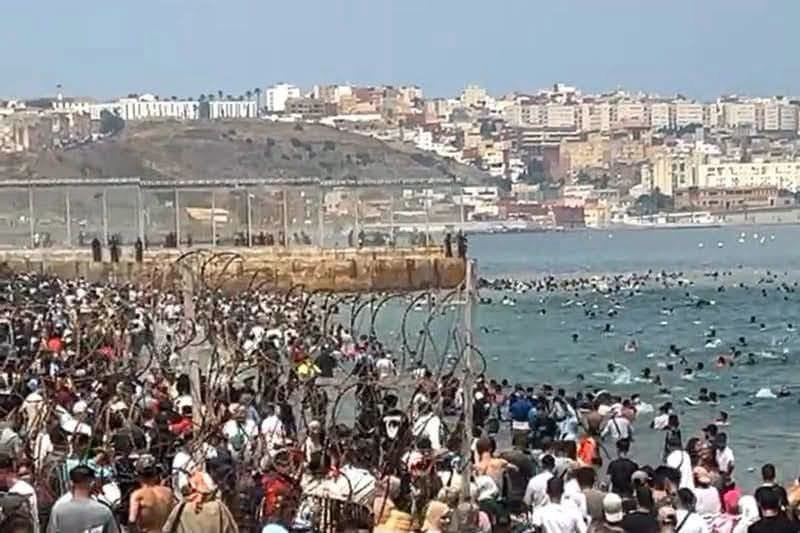
50,000 Moroccans Cross into Ceuta… When Escape Becomes a Silent Referendum on the Nation
Some figures merely pass through the news cycle.
Others shake a nation’s conscience.
The fifty thousand people who crossed into the Spanish enclave of Ceuta within a matter of hours are not simply another episode of irregular migration. They represent an extraordinary historical moment, one that exposes a crisis extending far beyond border security. What unfolded was not merely a movement of people across a frontier; it was a powerful expression of a growing fracture between citizens and their own country.
When tens of thousands of people—children, women, elderly citizens, unemployed youth, persons with disabilities and entire families—simultaneously decide to leave, the central question is no longer “How did they cross?”
The real question is:
“Why did they feel compelled to leave in the first place?”
According to Spain’s Ministry of the Interior, nearly 50,000 migrants entered Ceuta irregularly during the latest mass crossing, including at least 7,000 minors. Yet within hours, almost half of them voluntarily returned to Morocco after discovering a reality dramatically different from the one they had imagined. Reception facilities collapsed under the pressure, food and drinking water became scarce, military deployment intensified across the city, and dozens lost their lives attempting to swim across the sea.
These figures are unprecedented.
Yet to describe this event simply as a migration crisis would be to misunderstand its true nature.
What occurred in Ceuta was, above all else, a silent social explosion.
Human beings do not willingly entrust their lives to the sea for the sake of adventure.
Parents do not expose their children to mortal danger on a whim.
Such decisions are made only when people become convinced—or are made to believe—that the uncertainty awaiting them abroad is somehow less frightening than the certainty they face at home.
This is where the deeper reading begins.
Over the past decade, Morocco has undeniably achieved remarkable economic progress.
Major infrastructure projects have transformed the country’s landscape.
Industrial investment has accelerated.
Renewable energy projects have expanded.
Ports, highways and logistics hubs have become symbols of national ambition.
These achievements are real.
They deserve recognition.
Yet they also give rise to a far more fundamental question.
Has the ordinary citizen truly felt the benefits of these achievements in everyday life?
Because citizens do not measure development through investment reports or international conferences.
They measure it differently.
Development means finding a stable job.
Receiving decent healthcare.
Being able to educate one’s children.
Paying monthly expenses without watching an entire salary disappear before the middle of the month.
It is precisely here that Morocco’s deepest contradiction begins to emerge.
The State speaks the language of macroeconomic indicators.
Citizens speak the language of daily survival.
The State points to GDP growth.
Citizens look at rising food prices.
The State celebrates foreign investment.
Citizens see unemployment.
The State inaugurates large-scale projects.
Citizens open increasingly empty wallets.
When these two languages cease to meet, the sea gradually becomes the bridge between despair and hope.
Perhaps the most heartbreaking aspect of this migration wave is not its scale.
It is the identity of those who took part.
Seven thousand minors.
That number alone should provoke a profound national reckoning.
Children do not abandon their homeland after studying economic forecasts.
They do not analyse development models.
If a child leaves, it is because, somehow, he or she has stopped believing that tomorrow exists where they were born.
Then comes the second tragedy.
Nearly half of those who crossed returned voluntarily only hours later.
Not because they suddenly rediscovered confidence in Morocco.
But because they realised that the other side was not the paradise promised by rumours, social media narratives or smuggling networks.
Instead, they encountered overcrowded streets, overwhelmed reception centres, nights spent sleeping outdoors, shortages of food and water, and an overwhelming security presence.
In that moment, the tragedy became complete.
They fled one unbearable reality.
Only to encounter another.
The greatest losers were therefore not only those who remained stranded in Ceuta.
Those who returned carried back something equally devastating.
Not hope.
But another broken illusion.
Under these circumstances, responsibility cannot be reduced solely to human smuggling networks, however dangerous and influential they may be. Nor can the crisis be explained simply by rumors circulating on social media, or by legal loopholes and judicial decisions in Spain that may have created what Madrid describes as a “pull factor.”
These elements may explain what triggered the mass movement.
They do not explain why tens of thousands of people were prepared to risk their lives.
Because the willingness to leave is not born at the border.
It is born long before that—within society itself.
It grows gradually as economic frustrations accumulate, as opportunities for social mobility diminish, as perceptions of inequality deepen, and as an entire generation begins to feel that tomorrow offers fewer possibilities than yesterday.
This is where the most painful question emerges.
What drives a twenty-year-old young man, an eighteen-year-old young woman, a child, or even a person living with a disability to conclude that the possibility of drowning at sea is less frightening than remaining where they are?
That question cannot be answered by security agencies alone.
Neither can it be addressed through official communiqués.
It reaches far beyond administrative responses.
It challenges public policy, economic priorities, the development model itself, and ultimately the State’s ability to generate hope.
No border, regardless of how heavily guarded it may be, can indefinitely contain a population that is gradually losing faith in its own future.
At this point, a comparison frequently arises in public debate. It is not intended to equate two fundamentally different realities, but rather to illuminate a profoundly human question.
Look at Gaza.
Its territory is smaller than many rural communes in Morocco.
Large parts of it have been devastated by war.
Entire neighborhoods have been reduced to rubble.
Thousands have lost their lives.
Yet countless Palestinians continue to cling to their homeland with extraordinary determination, choosing to endure unimaginable hardship rather than abandon the land they consider their own.
Morocco’s reality is entirely different.
There is no war.
There are no bombs reducing cities to ruins.
The political, military and humanitarian contexts are incomparable.
And yet, tens of thousands of Moroccans willingly place themselves in mortal danger in search of a future elsewhere.
The comparison is therefore not political.
It is existential.
It asks a universal question:
At what point does a citizen stop believing that his or her future can still be built in the country of birth?
That is the question that should concern every public official.
Because the greatest danger confronting any nation is not that some of its citizens choose to leave.
The real danger begins when leaving becomes more believable than staying.
When exile ceases to be an exception and gradually becomes a shared life project.
When the border no longer represents a geographical line, but instead symbolizes hope itself.
During this crisis, Moroccan and Spanish authorities coordinated the return of thousands of migrants while working to restore order under exceptionally difficult circumstances.
From an operational standpoint, that cooperation was necessary.
It prevented an even greater humanitarian emergency.
But security responses alone cannot resolve a crisis whose deepest roots are social, economic and psychological.
Security forces can protect borders.
They cannot manufacture hope.
And hope is ultimately what persuades young people to remain in their homeland.
History repeatedly demonstrates that major migration waves are never merely demographic events.
They are often silent indicators of deeper structural transformations.
They reveal fractures that official statistics sometimes fail to capture.
They expose expectations that public policies have not yet fulfilled.
They signal widening gaps between national narratives and individual realities.
In Ceuta, it was not simply fifty thousand people who crossed an international border.
It was fifty thousand individual stories expressing a common uncertainty.
Uncertainty about the future.
Uncertainty about opportunity.
Uncertainty about whether their own country is still capable of fulfilling their aspirations.
For that reason, this episode should not be remembered solely as another migration crisis.
It deserves to be understood as a political, social and human signal of exceptional significance.
Because, ultimately, the central issue is not how many people crossed into Ceuta.
The real issue is why so many believed that their future might begin somewhere else rather than in the country they call home.
In the end, this story is not merely about Ceuta.
It is not merely about borders.
Nor is it simply about migration.
It is about the relationship between a nation and its citizens.
A country’s true strength is measured not only by the scale of its infrastructure, the size of its investments, or the performance of its economy.
It is measured by something far more fundamental:
Its ability to convince its own people that their future still belongs within it.
When fifty thousand people leave at the same moment, they do not issue a political manifesto.
Yet their footsteps speak with remarkable clarity.
And that message cannot be understood through the lens of security alone.
It demands a deeper reading—one capable of confronting the social, economic and human challenges that Morocco now faces, before today’s silent exodus becomes tomorrow’s irreversible reality.


