

Spain, Migration and the U.S. Elections… How Donald Trump Turned a European Crisis into an American Political Argument
At the heart of Spain’s migration crisis, Donald Trump did more than comment on unfolding events. He transformed the Spanish case into a domestic political narrative. In his view, what is happening on Spain’s borders is not merely a European challenge; it is an early warning of what the United States could face if, as he argues, current immigration policies continue. Spain thus becomes more than a country confronting a border crisis—it becomes a political case study through which Trump invites American voters to imagine their own future.
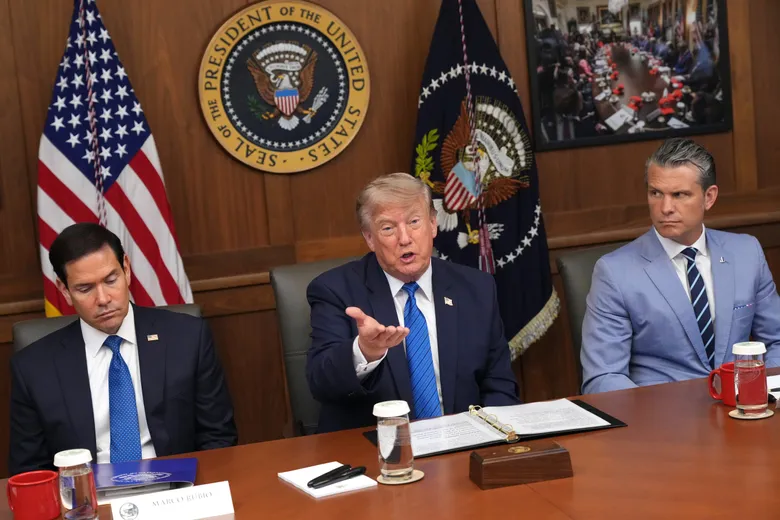
His choice of Spain was far from accidental. Trump stated that he intended to raise the issue during his meeting at Camp David because he believes it will become one of the defining themes of the upcoming elections. Behind this remark lies a carefully crafted political strategy. The true audience of his message is not Madrid but the American electorate. Spain’s migration crisis is presented not as a foreign policy issue, but as evidence in a broader domestic debate over border security, immigration, and national sovereignty.
From a rhetorical perspective, Trump’s argument follows a familiar political pattern: transforming an external event into a domestic warning. Rather than treating Spain’s situation as the product of its unique geographic, European, and political circumstances, he portrays it as proof of what inevitably happens when immigration policies become, in his view, overly permissive. In doing so, the Spanish experience is reframed as a predictive model rather than an isolated national crisis.
The language he employs reinforces this political framing. Expressions such as “invasion,” “weak laws,” and “bad management” do more than describe a situation—they establish a specific interpretive framework. Migration is no longer discussed primarily as a humanitarian, economic, or geopolitical phenomenon; instead, it is repositioned as a matter of national security and state authority. The central political question shifts from how migration should be managed to whether governments are capable of protecting their borders.
Another important layer of Trump’s argument concerns the behavior of migrants themselves. He suggests that people closely observe immigration policies across different countries and adjust their decisions accordingly. Beneath this statement lies a broader political message: immigration laws do not affect only those already living within a country’s borders; they also send signals far beyond them. Within this logic, legislation becomes more than a legal instrument—it becomes either a magnet or a deterrent.
Yet what Trump chooses not to discuss is just as revealing as what he emphasizes. His remarks largely bypass the structural causes that drive migration—armed conflicts, economic hardship, political instability, and widening global inequalities. Nor do they explore the human realities that compel thousands of people to risk dangerous sea crossings. Instead, the focus remains firmly on the visible consequences of migration rather than its underlying causes, a framing that serves the political narrative he seeks to advance.
The speech reaches its rhetorical climax when Trump compares Spain’s experience with the future of the United States. After describing the Spanish situation as unprecedented, he argues that America could face an even greater challenge if current policies remain unchanged. At that moment, Spain ceases to be the subject of the discussion. It becomes a cautionary tale designed to persuade voters that preventive political action is preferable to managing a crisis after it unfolds.
Trump concludes by returning to one of the central themes of his political discourse: criticism of former President Joe Biden. He argues that Biden’s greatest mistake was allowing, according to Trump’s own estimate, approximately 25 million people to enter the United States. Regardless of the debate surrounding that figure, its political significance lies less in its statistical accuracy than in its rhetorical function. It reinforces Trump’s broader narrative that the previous administration lost control of America’s borders and that restoring that control should become a defining priority in the upcoming elections.
Beyond the American political debate, however, Spain’s migration crisis reflects a broader transformation taking place across Europe. Large-scale arrivals at Ceuta have reignited discussions about the protection of the European Union’s external borders, cooperation with neighboring countries, and the difficult balance between security obligations and humanitarian responsibilities. The crisis has become part of a wider European conversation about migration governance in an era of increasing geopolitical instability.
Ultimately, Donald Trump’s remarks should not be understood simply as commentary on Spain. They represent a broader political strategy in which an international event is reinterpreted through the lens of domestic electoral competition. Where Madrid sees a complex border crisis requiring diplomatic, humanitarian, and security responses, Trump sees confirmation of his long-standing immigration narrative. The same event therefore generates two distinct political readings: one focused on managing a crisis, the other on shaping electoral opinion.
Perhaps this illustrates one of the defining characteristics of contemporary politics. Crises no longer remain confined to the countries where they originate. They rapidly evolve into political symbols, campaign narratives, and strategic arguments capable of influencing public debate thousands of miles away from the borders where they first began.


