

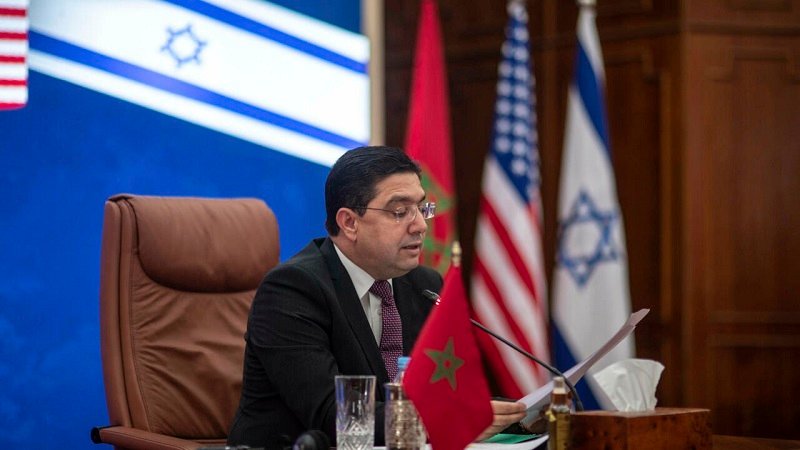
Unlike the period of the war in Gaza, when relations between Rabat and Tel Aviv experienced a noticeable diplomatic freeze, recent Israeli indicators suggest a different trend: relations are reportedly improving despite the ongoing confrontation involving Israel, the United States, and Iran.
According to a report published by the English-language Israeli newspaper The Jerusalem Post, Israeli sources indicate that relations between Israel and several Arab states have strengthened during the confrontation with Tehran. The report highlights Morocco, the United Arab Emirates, and Bahrain among the countries that have continued to expand their military cooperation with Israel, reinforcing emerging regional alliances.
The same sources claim that several states associated with the Abraham Accords have directly cooperated with Israel militarily at certain stages. Even countries that have not formally joined the agreements have reportedly coordinated with Israel through the American military structure known as United States Central Command.
From the Israeli strategic perspective presented in the report, the confrontation with Iran has had a more immediate impact on several Arab states than on Israel itself. This observation is widely interpreted as referring to countries such as Saudi Arabia, Qatar, and Kuwait.
Recent ballistic missile and large-scale drone attacks attributed to Iran across the region have also contributed to bringing a number of Arab states closer to Israel and the United States. According to the data cited, these attacks have affected or targeted up to eight Arab countries: Saudi Arabia, the United Arab Emirates, Qatar, Bahrain, Kuwait, Oman, Jordan, and Iraq.
Regarding Morocco, the report emphasizes that Rabat has increased its level of military cooperation with Israel since 2020, similarly to the UAE and Bahrain. It also notes that Morocco has been listed, since February 16, 2026, among the countries expected to participate in an international stabilization force in Gaza tasked with supervising the implementation of a ceasefire agreement between Israel and Hamas.
Israeli military sources quoted in the report indicate that around 130 foreign military officials visited Israeli defense facilities in November 2025 to receive classified briefings on Israeli military tactics. Moroccan officers were reportedly among them. The report also mentions publicly announced joint exercises between Israel and Morocco in 2023 and 2025.
In addition, it recalls that Eyal Zamir, during his tenure as Director-General of Israel’s Ministry of Defense, facilitated arms exports to Morocco and the United Arab Emirates before later becoming Chief of Staff of the Israeli military.
This renewed diplomatic momentum follows a ceasefire agreement mediated by the United States last year, which came after two years of devastating war in the Gaza Strip. The conflict resulted in massive destruction and a heavy human toll, provoking widespread international condemnation.
In Morocco, the war triggered a strong popular reaction. Hundreds of demonstrations were organized across the country demanding the suspension of diplomatic, economic, and military ties with Israel. At the official level, government visits and high-level exchanges between the two countries had largely been frozen during the height of the conflict.
The diplomatic stalemate began to ease when the Israeli president Isaac Herzog sent a message of congratulations to King Mohammed VI on November 6, 2025, marking the fiftieth anniversary of the Green March. In the same message, he welcomed the adoption of UN Security Council Resolution 2797 on the Sahara issue, describing it as an important step toward a lasting political solution.
However, despite the gradual revival of diplomatic interaction, Moroccan public opinion remains largely skeptical about normalization. A survey published in mid-2024 by Arab Barometer revealed that public support for maintaining relations with Israel had dropped to just 13 percent, compared to 31 percent in 2022, largely due to the political and emotional impact of the war in Gaza.


