

Imbroda Responds to El Ouahbi: When a Statement on Immigration Risks Turning Against Morocco
Moroccan Justice Minister Abdellatif Ouahbi’s statement to the Spanish news agency EFE came at a particularly sensitive moment in relations between Rabat and Madrid, following the wave of mass entries into Ceuta at the end of July and while Spain was still dealing with the political and security consequences of the crisis. Ouahbi did not limit himself to explaining Morocco’s position. He placed Spain’s policy of receiving and regularising migrants at the centre of the problem, arguing that Morocco prevents migrants—both Moroccans and foreigners—from leaving, while once they reach Spain, they are received and regularised. He then posed the question: if Spain is prepared to receive them, why should Morocco prevent their departure?
On the surface, Ouahbi’s reasoning rests on a contradiction that he attributes to the policies of the two countries: Morocco bears the cost of controlling departures, while Spain, on the other side, opens regularisation channels for some migrants already on its territory. But bringing this interpretation into the public arena, at the heart of a border crisis that had only recently erupted, transforms what could have remained a technical discussion about migration into a political message directed at Madrid. What may be presented from Rabat as an explanation of the logic behind border control can be interpreted in Spain as pressure on a policy that belongs to its own domestic political choices.
Ouahbi then went further by raising the possibility of suspending the implementation of the extradition agreement between Morocco and Spain, invoking what he considers a lack of reciprocity in extradition procedures. The statement therefore moved beyond the migration issue alone and into a far more sensitive judicial and political sphere. Immigration, regularisation and judicial cooperation were brought together within a single message. It is this simultaneity that gives the intervention a reach extending well beyond that of a merely technical position expressed by the Justice Minister.
The difficulty lies above all in the timing. Migration has become one of the most politically sensitive issues in Spain, while the Ceuta crisis was rapidly transformed into a matter of security and political confrontation. The Spanish government stressed the return to Morocco of people who had entered irregularly and the importance of cooperation with Rabat in containing the situation. Spain’s Foreign Minister José Manuel Albares again stressed on 11 August that people who entered irregularly would be returned to Morocco and that coordination with Rabat remained essential.
Within this environment, Ouahbi’s remarks provide the Spanish opposition with immediately usable material to reopen a question that is already weighing on the government: does regularisation encourage further arrivals? The Spanish executive had launched an exceptional procedure aimed at regularising several hundred thousand migrants already present in the country, a decision it defends on legal, humanitarian and economic grounds, while its opponents place it within a radically different interpretation. By establishing a connection between reception, regularisation and continued attempts to enter Spain, Ouahbi intervenes directly in this domestic Spanish debate and provides his opponents with an argument coming from outside the country.
Yet the distinction between the two situations is essential. A migrant already present in Spain and waiting for his or her legal status to be regularised is not necessarily connected to someone attempting to enter the country irregularly. Conflating these two dimensions risks turning regularisation itself into part of the border problem, even though it largely concerns people who are already on Spanish territory. A discourse that brings these two phenomena together therefore places Moroccan migrants established in Spain at the centre of a political debate that goes far beyond their individual circumstances.
This is probably where the most sensitive dimension of the statement lies. Thousands of Moroccans living in Spain have been waiting for years to stabilise their legal status. Yet they could find themselves caught in a debate whose terms and consequences they do not control. If regularisation gradually becomes equated, within the Spanish political debate, with a factor encouraging irregular immigration, the situation of those waiting for legal status becomes increasingly exposed to political tensions between Rabat and Madrid.
The issue therefore goes beyond a mere verbal confrontation between two governments. Morocco needs Spanish cooperation on migration, just as Spain depends on Moroccan cooperation for border control and the return of migrants. The Ceuta crisis demonstrated this concretely: following the mass arrival of migrants, a significant number returned to Morocco, while Madrid continued to present cooperation with Rabat as an essential element in managing the crisis.
Within this context, the scope of Ouahbi’s message becomes more delicate. By arguing that the continuation of Spanish regularisation makes Morocco’s efforts to prevent departures contradictory, Rabat may be seeking to raise the question of how the cost of migration control is shared. Madrid, however, can turn the argument around and maintain that its policies on residence and regularisation fall within its own sovereign choices. The disagreement then changes in nature: it is no longer only about who bears the cost of border control, but about the boundary between the responsibilities of a security partner and each state’s internal political choices.
It is precisely here that the role of Nasser Bourita comes into question. Morocco’s Foreign Minister is responsible for conducting foreign policy and managing sensitive bilateral relations, particularly with Spain—a relationship that in recent years has required particularly careful management of balances and reciprocal messages. The question, therefore, is not whether a Justice Minister can express a position concerning his own department. It is whether the timing and manner in which an issue simultaneously touching immigration, judicial cooperation and relations with Madrid is presented fit within the Kingdom’s broader diplomatic line.
A statement dealing simultaneously with immigration and the extradition agreement does not remain confined to the ministry from which it originates. It directly reaches the Spanish government, the opposition, the media, the right, Moroccan migrants and, beyond them, the debate over Ceuta and Melilla—a dossier already carrying an exceptional political and sovereignty-related charge. The multiplication of these levels of interpretation increases the risk that the message will be received differently from what its author initially intended.
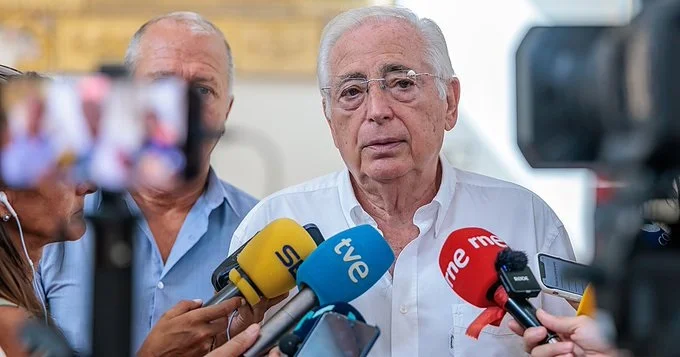
The reaction of Melilla’s president, Juan José Imbroda, shows precisely how the debate can shift ground. The Spanish daily ABC reported a phrase attributed to him: “Why do you want Ceuta and Melilla if your young people are escaping you?”
🗣️ Imbroda responde a Marruecos: «¿Para qué queréis Ceuta y Melilla si no podéis con lo que tenéis y se os escapan vuestros jóvenes?»https://t.co/CSALZIgDJq
— ABC.es (@abc_es) August 12, 2026
Imbroda did not respond to Ouahbi’s argument about regularisation on its substance. He shifted the centre of the debate towards Morocco’s internal situation and that of its youth. Politically, this shift is significant: a discussion that initially concerned Spanish immigration policy was brought back to the question of Ceuta and Melilla, and then to Moroccan youth and their desire to leave the country. The opposing discourse therefore changes the terrain and turns the migration issue into an argument against Morocco.
This is where the political paradox of Ouahbi’s statement becomes visible. An intervention intended to question Madrid over the consequences of its regularisation policy can ultimately give its opponents an opening to talk about Moroccan youth, then Ceuta and Melilla, and finally Morocco’s ability to retain its own young people. In foreign policy, a statement is therefore not measured only by the intention of the person making it, but also by the space it leaves the adversary to construct his own response.
The question, then, is not simply whether Abdellatif Ouahbi criticised Spain’s regularisation policy. It concerns the consequences of such a position when it is expressed in the middle of a crisis, when it links migration regulation to border cooperation and when it is followed by a threat concerning a judicial agreement. The issue becomes whether such pressure actually serves Moroccan interests or whether it makes an already sensitive dossier more readily available for political exploitation in Spain. The Ceuta crisis demonstrated how deeply migration had become a field of political confrontation, mechanically increasing the cost of any statement that can be misinterpreted.
The question therefore returns to the role of Nasser Bourita: who carries and coordinates the Moroccan message addressed to Madrid? And how can diplomacy maintain a coherent line when immigration, regularisation and judicial cooperation simultaneously become subjects of government statements? This is not merely a formal question of the distribution of competences. It concerns a state’s ability to control its own discourse within a strategic relationship in which negotiation and firmness must constantly coexist.
Morocco and Spain are emerging from a crisis that once again demonstrated their mutual dependence on the migration dossier. But the same crisis also shows that the slightest rupture in language can open several fronts at once: in Madrid, for the right and the far right; in Melilla, for Imbroda; among Moroccans waiting for regularisation; and in the judicial sphere, where the extradition agreement has now entered the same zone of tension.
The question left behind by Ouahbi’s statements is therefore not merely what he intended to say to Spain, but who will bear the cost of what was said if the message intended to put pressure on Madrid ultimately becomes an instrument of pressure against Morocco itself?


