

Rabat is moving ahead of new calls for a collective crossing toward Ceuta and Melilla, after the events of July 30 and 31 revealed that the border no longer begins at the fence, but much earlier — inside a phone.
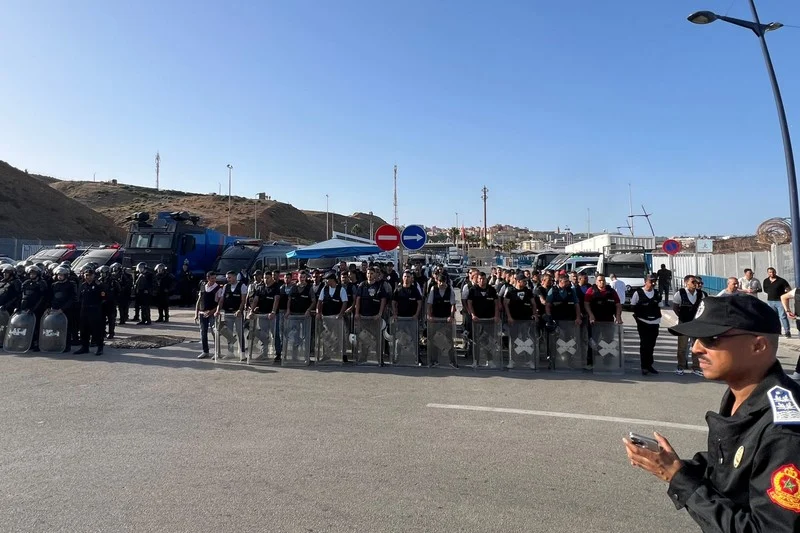
In Rabat, the security alert came this time before the calls circulating on social media could turn into a gathering on the ground. Rachid El Khalfi, spokesperson for Morocco’s Ministry of Interior, confirmed that the authorities had detected posts and messages from unidentified sources calling for collective and illegal crossing attempts toward Ceuta and Melilla on August 15. The authorities, he said, had taken “all necessary measures” to prevent them and had arrested people suspected of involvement in incitement activities before referring them to the judiciary. The significance of the announcement therefore lies not only in the measures themselves, but in their timing: Rabat wants to confront the call while it is still a message on a screen, rather than wait until it becomes a crowd gathered near the border.
That change in timing is rooted in the experience of the past few weeks. On July 30 and 31, the area around Ceuta faced an exceptional human pressure after tens of thousands of people moved toward the Spanish-administered city from the Moroccan side within a very short period. The figures have varied according to the authorities and sources involved, with Spanish estimates speaking of around 50,000 people and other local assessments putting the number closer to 60,000, while some accounts have suggested even higher figures. The dispute over the exact number does not alter the central fact: this was a massive and rapid human movement, large enough to catch the city off guard and put its border-control, reception and crisis-management systems under extraordinary pressure.
What is particularly revealing about the episode is that part of the mobilization did not follow the traditional channels associated with migration, but developed inside an information environment shaped by rumours, messages and social-media posts. False claims circulated about the border being open or about the possibility of entering Spain and remaining there, giving the rumour a practical force far beyond that of an ordinary piece of misinformation. To mobilize thousands of people, there is no need for an organizer to persuade each one individually. It is enough to produce information that appears credible, allow networks to circulate and amplify it, and eventually turn it into an individual decision repeated thousands of times.
At that point, the question changes. It is no longer simply how many people might appear at the border on August 15, but where the call originated, how it spread, who gave it a date and who turned that date into a gathering. Choosing a specific day is already an attempt to transform an individual desire to migrate into a coordinated collective action. Once a date begins circulating, the border has effectively received its first warning before a single person has approached it.
This is what gives particular meaning to El Khalfi’s description of the situation as part of a “permanent vigilance system.” Rabat is not presenting the issue as an operation designed solely to prevent an event scheduled for August 15, but as a recurring phenomenon capable of resurfacing in different forms. Social networks can move a mobilization rapidly from one page to another, from one account to a closed group, or toward less visible digital spaces. An operation of this kind does not necessarily disappear when an account is closed or one individual is arrested.
From this perspective, the arrest of people suspected of involvement in incitement serves a purpose that goes beyond ordinary law enforcement. It is an attempt to break the chain before it reaches its final link: the young person leaving home for Fnideq or another area close to the border. But the effectiveness of this approach will not be measured simply by the number of arrests. It will also depend on the authorities’ ability to distinguish between an individual expression of a desire to migrate and an organized campaign designed to push people, sometimes very young people, into a situation whose consequences can be unpredictable.
The danger exposed by the July events was not merely a security issue. When tens of thousands of people converge on a geographically confined area, the possibility of an accident becomes part of the equation itself. The more powerful the rumour, the weaker an individual’s ability to assess the risks may become. A message claiming that “the route is open” does not merely provide false information; it removes from the recipient’s mind a whole series of questions that should normally precede a decision of such magnitude. Disinformation therefore becomes a direct factor in creating humanitarian risk.
Morocco also understands that the issue can no longer be addressed exclusively through security measures, because part of the phenomenon now exists outside the physical space of the border. The mobile phone has become the first gathering point, the post can be the starting point, and the digital group can perform a function once carried out by an intermediary or a network of people. This explains the growing importance of monitoring online content in migration management and the involvement of European institutions in efforts to counter disinformation connected to the recent events around Ceuta.
At this level, Ceuta appears in a different light. It is not simply a migration crossing point, but a point of contact between Morocco, Spain and Europe. Any large-scale collective pressure on the city quickly acquires a political dimension far beyond its geographical boundaries. The events of late July therefore revived European debates over border control, the Schengen area and the respective responsibilities of Madrid and Rabat. Ceuta becomes the symbol of a border crisis that cannot be separated either from Moroccan-Spanish relations or from Europe’s wider migration policy.
This is also the context in which Moroccan-Spanish security cooperation must be understood. The two countries may hold different positions on Ceuta and Melilla or on questions of sovereignty, but they share a practical interest in preventing the border from becoming a permanent zone of disorder. For Morocco, the issue involves avoiding security and humanitarian pressure on its own territory and protecting young people from dangerous attempts. For Spain, it involves protecting its external border and preventing a local crisis from becoming a European one. Migration cooperation therefore becomes one of the most sensitive, but also most pragmatic, areas of the relationship between the two countries.
The hardest question, however, remains on the other side of the border: why do these calls find an audience willing to respond? Social networks can amplify an illusion, but they cannot create the desire to migrate on their own. Behind every mobilization lies a social, economic or psychological vulnerability that can make certain people particularly receptive to the promise of a quick route to Europe. Closing an account or pursuing an organizer can therefore interrupt one operation without eliminating the conditions that allow another to emerge.
That is precisely where the July episode acquires its wider significance. An event can quickly become a narrative, and the narrative can then be turned into a new date. The simple fact that thousands of people managed to reach Ceuta, even though the overwhelming majority were subsequently returned or prevented from continuing their journey, can be transformed on social media into an entirely different story: if they managed to do it, why shouldn’t I? The power of the image then overwhelms reality, because the user sees the moment of arrival, but rarely what came before it and even less of what followed.
Rabat’s announcement of its preventive measures therefore carries a political message as much as a security one. To young people, it says that information circulating online is neither a guarantee of safe passage nor a promise of easy access to Europe. To those organizing the calls, it signals that the state will no longer necessarily wait for a crowd to appear before acting. And to Madrid and Brussels, the message is different again: Morocco intends to treat the protection of its borders as a first line of defence, while also insisting that collective migration movements be regarded as a shared security, information and humanitarian issue rather than simply a problem to be pushed toward the other side.
The paradox of August 15 is that the date intended to serve as a rallying point may already have lost part of its surprise precisely because the authorities say they have detected it. Once a state knows the date, monitors the circulation of calls and reinforces its presence before participants arrive, reproducing the scenario seen at the end of July becomes considerably more difficult. That does not mean the risk disappears. A network capable of creating a date can also change the date, the location or the method of mobilization.
The real battle is therefore taking place well beyond the fence separating Fnideq from Ceuta. It is a battle over control of information itself: who has the power to define reality before people encounter it on the ground? Who can convince thousands of young people that the border is open, that a judicial decision has changed the rules, or that access to Europe has suddenly become possible? Traditional borders are guarded by fences, cameras and security forces; the new borders also require scrutiny of the narratives being constructed long before people reach them.
By acting before the announced date, Morocco is trying to move the battle precisely into that space. But the effectiveness of this strategy will not be measured only by its ability to prevent another gathering on August 15. It will depend on its ability to understand and dismantle the mechanism that makes such calls reproducible: the account that publishes, the group that amplifies, the false information that feeds hope, the interests that may accompany it, and above all the social reality that makes a young person willing to believe it. Only then will anticipation become more than a security presence along the border. It will become an attempt to cut off a process that begins on a small screen and can end at a fence opening onto Europe, a humanitarian catastrophe, or a new crisis between Rabat and Madrid.


