

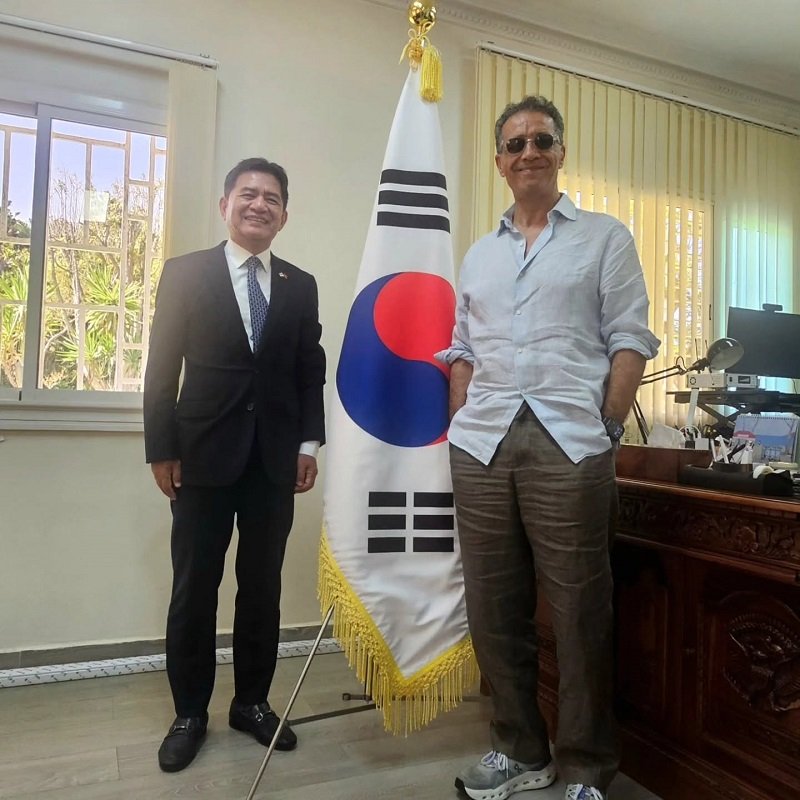
Relations between two countries do not always need a new agreement to reveal a new direction. Sometimes, it is enough for an ambassador to sit down with a filmmaker and for the conversation to move from films to society, from the director’s experience to the way an image can cross borders.
That is what emerged from the meeting on Monday, August 24, between Korean Ambassador to Morocco Yun Yoon-jin and Moroccan filmmaker Nouredine Lakhmari. Cinema was not merely a subject of discussion. It appeared instead as a possible space for expanding a cultural relationship beyond screenings and festivals, toward the creation and circulation of stories.
The meeting brought together two cinematic experiences shaped by different contexts, yet connected by one essential idea: a film does not simply present a country to the outside world. It also reveals how a society sees itself, what it chooses to show, what it leaves hidden, and what it wants to say about its own life.
Lakhmari, whose name is associated with films such as Casanegra, Zero and Burnout, spoke about several Korean films that had left an impression on him, as well as his relationships and experiences with Korean directors. He expressed his strong interest in the distinctive character of Korean cinema and the artistic worlds it has created.
His own career gives him a particular position in this conversation. Having studied film in Norway, he has developed a body of work largely concerned with examining Moroccan society from within.
But perhaps the most important point of the exchange lay elsewhere: in the idea of cinema as a way of understanding a society, rather than simply entertaining audiences or promoting a tourist image of a country.
Ambassador Yun Yoon-jin, for his part, outlined elements of the development of the Korean film industry and the factors that helped Korean films reach a broad international audience. This is not a minor point. The rise of Korean cinema forms part of a wider transformation that has made cultural production — from films and television series to music — an important element of Korea’s global presence.
Today, that industry is also confronting new questions about the future of cinema, including the financing of mid-budget productions and the place of Korean films in international festivals and markets.
Morocco faces a different equation. It has built up a substantial cinematic heritage, has filmmakers present at international festivals and has accumulated significant production experience. But it operates within a smaller market and a different production and distribution structure.
That is why cooperation with Korea should not be reduced to an exchange of films or the organization of cultural weeks.
The more interesting question is whether this rapprochement can move toward something more practical: co-productions, exchanges of expertise, training, cooperation between producers and directors, or even films capable of bringing the two experiences into dialogue.
The timing of the meeting is worth observing in that context.
Ambassador Yun Yoon-jin has not limited his cultural initiatives to cinema. In July, he met with the director of Al Mansour Theatre in Rabat to discuss expanding cultural cooperation between the two countries, with particular attention to access to culture for children, young people and vulnerable groups.
Korean engagement in Morocco also extends into other forms of soft power, including the promotion of Korean products and the culture associated with them. In June, the ambassador visited one of Morocco’s major Korean cosmetics stores as part of efforts to promote K-Beauty and expand the presence of Korean products in the Moroccan market.
These initiatives do not, by themselves, prove the existence of a single cultural programme linking all of these activities. It would be excessive to attribute a broader meaning to every diplomatic meeting. They do, however, point to a visible interest in using culture and content as additional channels for bringing the two societies closer.
Cinema has a particular capacity in this regard.
A film can reach people who have never heard of a bilateral agreement or an economic forum. A cinematic character can open a conversation where an official communiqué might have little impact. A single film can sometimes present a society in all its complexity more powerfully than a lengthy promotional campaign.
For Morocco, drawing lessons from the Korean experience does not mean trying to reproduce the Korean model. The circumstances, markets and industrial histories are different. The real value may lie in understanding how Korea transformed deeply local stories into productions capable of reaching global audiences.
That may be the most important question opened by the meeting between Yun Yoon-jin and Nouredine Lakhmari.
The issue is no longer simply how Moroccans watch Korean cinema or how Koreans discover Moroccan cinema. The broader question is whether the two countries can move from watching each other’s stories to producing stories together.
If that happens, cultural cooperation will no longer be confined to diplomatic encounters, occasional events and formal exchanges. The image itself could become an instrument for bringing the two societies closer.
And in that case, the starting point would not have been a negotiating table, but a conversation between an ambassador and a filmmaker about a film that had left an impression on them.


