

Sometimes the meaning of a statement lies not only in the words that are spoken, but also in where they are spoken, the occasion surrounding them and, above all, in the way the other side chooses to interpret them.
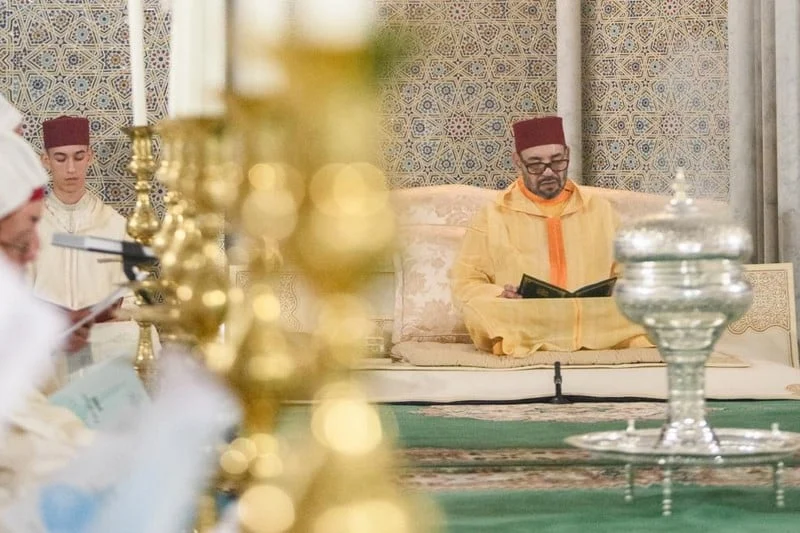
That is precisely what happened with the intervention of Morocco’s Minister of Habous and Islamic Affairs, Ahmed Toufiq, on Monday evening at the Royal Palace in Rabat. In the presence of King Mohammed VI, the minister was presenting a report on the activities of the Supreme Council of Ulema and local councils of Ulema on the occasion of the celebration of the Mawlid. In that context, he referred to Ceuta, to two scholars associated with the city’s intellectual history, and then to the work Dalail Al-Khayrat by Imam Al-Jazouli and its historical role in mobilizing Moroccans to liberate occupied cities along the Atlantic coast during the early modern period.
The reference did not go unnoticed in the Spanish media.
El Faro de Ceuta gave it an explicitly political headline: “Another Moroccan minister claims Ceuta and Melilla at an event presided over by Mohammed VI,” placing particular emphasis on the fact that the words were spoken before the King rather than at an academic conference or in an informal statement.
That reading may be understandable from the perspective of a Spanish media outlet directly concerned with the issue of Ceuta. But it reduces the Moroccan context to a dimension that needs to be put back into its proper setting.
The ceremony was not a government meeting devoted to the future of Ceuta and Melilla. Nor was it a negotiating session with Madrid, or a speech addressed to Spain. It was the celebration of the Mawlid at the Royal Palace in Rabat, presided over by Mohammed VI in his capacity as Amir Al Mouminine, Commander of the Faithful.
That is not merely a matter of protocol.
In Morocco, the Mawlid cannot be separated from the institution of Imarat Al Mouminine or from the religious dimension embodied by the monarchy and institutionally framed by the relevant authorities. The presentation delivered by the Minister of Habous therefore belonged, first and foremost, to a religious sequence devoted to the place of the Prophet in Moroccan religious memory and to the legacy of Moroccan scholars who contributed to the literature surrounding his life, virtues and memory.
That is where Ceuta enters the picture.
Ahmed Toufiq did not initially invoke the city as a contemporary border issue between Morocco and Spain, but as a city that produced important figures of Moroccan religious scholarship. Among them were Qadi Ayyad, author of Al-Shifa bi Ta’rif Huquq Al-Mustafa, and Abu Abbas Al-Azafi, author of The Organized Pearl on the Birth of the Illustrious Prophet.
These references are not a construction by the Moroccan media to justify a current political position. They belong to the intellectual and religious history of the city.
The minister then referred to Dalail Al-Khayrat, the work of Imam Mohammed Ibn Souleymane Al-Jazouli, recalling its historical role in the mobilization of Moroccans for the liberation of occupied cities along the Atlantic coast.
It is precisely at this point that the political dimension of the reading begins.
The reference is not simply a matter of accidental wording. But neither is it necessarily what some Spanish media outlets want to turn it into: the announcement of a new direct Moroccan claim to Ceuta and Melilla during a religious ceremony.
The distinction matters.
Morocco did not announce a new position on the two cities during this ceremony. The Moroccan position has been known for decades. What is new, therefore, is not the existence of the claim, but the reappearance of the issue in official discourse at a moment when other political statements have also brought it back into the spotlight.
A few days earlier, Morocco’s Justice Minister, Abdellatif Ouahbi, had publicly reaffirmed what Morocco considers its historical and geographical rights over Ceuta and Melilla, while stressing that dialogue with Spain remains the path through which the issue should be addressed.
Spain, for its part, responded by reaffirming its position on the two cities.
If there is a political reading to be made, then, it should focus more on the succession of references than on Ahmed Toufiq’s intervention alone.
This is precisely where Moroccan journalism has no reason to shy away from the debate.
After several years in which Moroccan-Spanish relations have been largely dominated by economic, security and migration cooperation, the question of Ceuta and Melilla has once again become more visible in Moroccan political discourse. A statement by the Justice Minister, a response from Madrid, and then a reference to Ceuta and to the historical memory of the liberation of occupied cities in a religious address delivered before the King.
Otro ministro marroquí reivindica Ceuta y Melilla en un acto presidido por Mohamed VI
This does not mean that Morocco has entered a logic of confrontation with Spain.
Ouahbi’s own remarks left the door to dialogue open. Rabat and Madrid also continue to cooperate on numerous issues, which places the question of Ceuta and Melilla within a bilateral relationship far broader than a territorial dispute alone.
But cooperation does not erase disagreement.
That is precisely where the Spanish interpretation requires some qualification.
Saying that a Moroccan minister “claimed Ceuta and Melilla” during a religious ceremony may leave the reader with the impression that the minister was directly addressing Spain. Yet the substance of the intervention was first devoted to the scholars of Ceuta, to the city’s religious and intellectual heritage, and then to the historical role of Dalail Al-Khayrat in Moroccan mobilization around the liberation of occupied cities.
That does not eliminate the possible political significance of the reference. But it places that significance in its actual context.
Perhaps the most significant point is that the reference did not come out of nowhere.
The Royal discourse itself had previously referred to Dalail Al-Khayrat in the context of Morocco’s religious and historical heritage, recalling its connection with the mobilization of Moroccans to liberate occupied territories.
Ahmed Toufiq’s intervention therefore reactivated an existing historical and religious thread. It was not, by itself, a rhetorical invention born out of the recent events surrounding Ceuta.
But politics never exists entirely outside history.
That is why recalling a historical episode can acquire a particular political dimension when it occurs in a context in which a territorial issue has already returned to the forefront, even if the statement itself does not amount to a new political announcement.
This is probably where the essential point lies.
The history of Ceuta was not “discovered” by the Minister of Habous on Monday. Nor did Morocco announce for the first time that it considers the two cities part of its historical claims.
What deserves attention is that Ceuta has appeared, over the past few weeks, at several levels of Moroccan discourse: in political language concerning historical and geographical rights, in diplomatic reactions, and also in a religious discourse recalling the city’s intellectual history and the Moroccan historical memory associated with occupied territories.
On the other side, Madrid quickly reaffirmed its established position.
The fundamental disagreement has therefore not changed.
What has changed is its visibility.
And that may be the real issue for Moroccan journalism.
This is not the story of a Minister of Habous who used the Mawlid to launch a new claim over Ceuta and Melilla. It is rather the story of how an old issue, one that has never disappeared from Morocco’s political memory, is once again coming to the surface through several channels at the same time.
The two cities remain present in Morocco’s position, and Spain knows that perfectly well. Morocco also knows that Madrid will not change its position because of a statement or a speech.
The real question, therefore, is not simply what Ahmed Toufiq said about Ceuta.
It is why Ceuta has once again found itself, at the same moment, at the intersection of politics, history, religion and media discourse in both countries.
The facts available so far allow for a simpler answer than some headlines suggest: events have reopened the issue, political statements have brought it back into the public arena, and religious discourse has placed it once again within historical memory. As for the future of the Ceuta and Melilla question, it remains tied to a much broader balance than a speech delivered during a Mawlid ceremony.


