

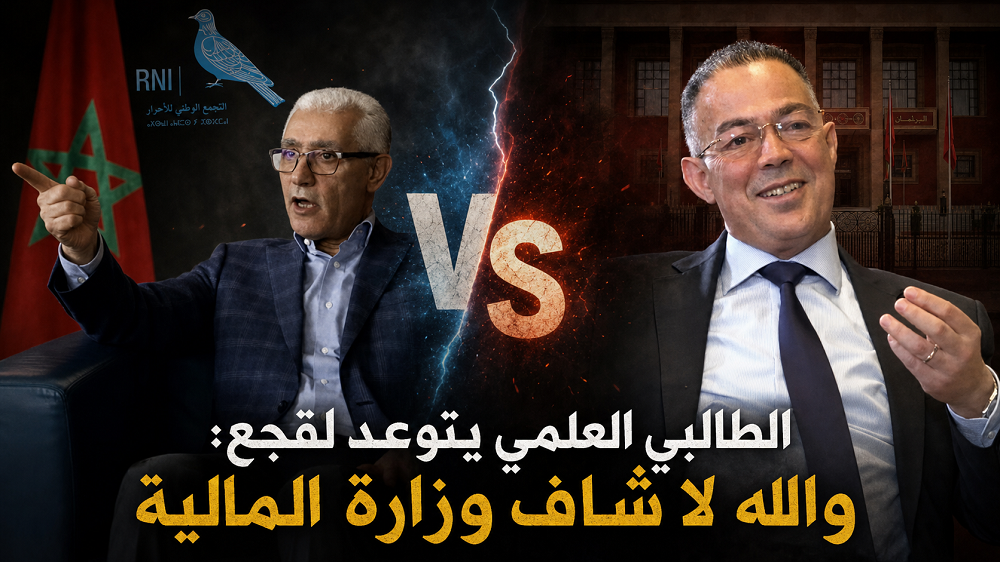
Talbi Alami to Lekjaa: “He will never get it” — Has the battle over the next government already begun?
In politics, power is not always measured by the decisions that have already been taken. Sometimes it appears in the confidence with which political leaders speak about decisions that have not yet been made.
That is what gives the leaked audio attributed to Rachid Talbi Alami its political significance.
In the recording circulating on social media, the senior Rassemblement National des Indépendants (RNI) figure speaks about Fouzi Lekjaa, who has recently joined the political leadership of the Authenticity and Modernity Party (PAM). The discussion concerns the possibility of Lekjaa entering the next government, particularly as Minister of Economy and Finance.
🚨 خطير جدا ! في تسجيل صوتي مسرب
رشيد الطالبي العلمي يتوعد لقجع ويقول إن المرتبة الأولى لا تهمه، وما يهمه هو الدخول إلى الحكومة وحرمان لقجع من تولّي منصب وزاري#المغرب #القجع #المنتخب_المغربي #الصحراء_المغربية #المملكة_المغربية pic.twitter.com/3KwEC315Cg
— إتري (@itripress_ma) August 25, 2026
The message attributed to Talbi Alami is blunt: “By God, he will never get it.”
The phrase is colloquial, direct and politically loaded.
But the important question is not simply what Talbi Alami said about Lekjaa.
It is why a senior figure in the RNI is already speaking in such categorical terms about a ministerial position in a government that does not yet exist, before the elections that will determine the next parliamentary balance have even taken place.
That is where the recording becomes more than a political exchange.
A message about Lekjaa — and perhaps something larger
Lekjaa is no longer only the minister responsible for the Budget and president of the Royal Moroccan Football Federation.
His move into the political leadership of the PAM has changed the meaning of his position.
He is now part of a political formation that competes directly with the RNI, the party that leads the current government.
The two parties remain part of the same governing majority today. But the electoral campaign is gradually transforming that relationship.
The question is no longer simply who belongs to the current majority.
It is who will have enough weight in the next one.
That distinction matters.
Because when the voice attributed to Talbi Alami speaks about preventing Lekjaa from obtaining the Finance portfolio, it is not necessarily revealing a formal decision. No individual party leader can simply decide who will become a minister in a future government.
But it may reveal something about the political calculations taking place inside the parties before the voters have expressed themselves.
And that is potentially more significant than the phrase itself.
Is this confidence — or political calculation?
It would be too much to conclude from one recording that Talbi Alami possesses the power to block Lekjaa from entering the next government.
That is not established by the recording.
The more interesting reading is different.
The language suggests a degree of political confidence: confidence that the RNI will remain strong enough after the elections to participate in the next government, confidence that the party will have a say in its composition, or simply confidence that the political balance may not allow Lekjaa to claim one of the most strategic portfolios.
Those are possibilities, not established facts.
But the very existence of such calculations before the election is revealing.
The next government has not been formed.
The electoral results are unknown.
The alliances have not yet been negotiated.
And yet names and ministerial portfolios are already being discussed.
That tells us something about the stage the political competition has reached.
The Finance Ministry is not just another portfolio
The choice of the Finance Ministry is particularly significant.
It is one of the most powerful positions in any government. The person who occupies it has a central role in the budget, public finances, economic policy and the allocation of financial priorities.
For Lekjaa, the position would also carry a particular political meaning.
He already combines a high-profile role in public finance with enormous national visibility through football. His entry into the PAM leadership adds a direct partisan dimension to that profile.
His potential move from the technical sphere of government into a more explicitly political role therefore changes the balance around him.
That does not mean that he is destined to become Minister of Finance.
Nor does the recording prove that anyone has formally decided to prevent him from doing so.
But it shows that the possibility is already being discussed politically.
And once that happens, the story stops being simply about two men.
It becomes a story about the distribution of influence after the election.
The timing matters
The timing of the recording is perhaps more important than its language.
Moroccan political parties are preparing for elections that could significantly alter the balance between the forces currently making up the governing majority.
At the same time, the RNI has publicly complained about what it describes as attempts by the PAM to attract some of its elected officials and political figures.
The issue is therefore no longer hypothetical.
There is already a struggle over political personnel, electoral networks and local influence.
Lekjaa’s move to the PAM has added a nationally visible figure to that confrontation.
The recording, if authentic and correctly contextualised, can therefore be read as part of a broader political response.
Not necessarily a threat.
Not necessarily a formal veto.
But a message.
And the message appears to be that the RNI does not intend to treat Lekjaa’s political rise inside the PAM as an ordinary development.
Who actually decides who enters the government?
This is where political language and institutional reality must be separated.
Talbi Alami can express opposition to Lekjaa becoming Minister of Finance.
He can influence the political debate.
He can speak on behalf of a significant party within the current governing majority.
But he does not, by himself, appoint the next government.
The composition of the future government will depend on the election results, the constitutional process, negotiations between political forces and the broader balance that emerges after the vote.
Therefore, presenting the recording as proof that Talbi Alami has personally decided Lekjaa will not become a minister would go beyond the evidence.
The more defensible conclusion is narrower — and perhaps more revealing.
A senior RNI figure is already speaking about the composition of the next government with a level of certainty that suggests the post-election political battle has begun before the election itself.
That is the real story.
What does this say about political power?
This is where the recording opens a wider question.
Political power is not only the ability to make a decision.
It is also the ability to believe that you will be sitting at the table when the decision is made.
The tone attributed to Talbi Alami suggests that he is not speaking as someone who expects the RNI to disappear from the next governing equation.
On the contrary, the discussion assumes that the party will still matter when ministerial positions are being negotiated.
Again, this does not prove that assumption will become reality.
Elections have a way of disrupting political calculations.
But it reveals how the political class is already thinking about the next stage.
The battle is no longer only about winning seats.
It is increasingly about what those seats will allow each party to demand afterwards.
Lekjaa has become a political issue
For the PAM, Lekjaa is potentially a valuable political asset: a nationally recognised figure, a senior government official and a personality with a public profile extending well beyond party politics.
For the RNI, his departure to a competing party inevitably changes the equation.
That does not automatically mean that the conflict is personal.
It may be much more structural.
A political figure who moves from one governing party into the leadership of another party before an election carries with him not only his name, but also political weight, networks, experience and expectations about the future.
This is why Lekjaa has become more than a candidate or a potential minister.
He has become part of the struggle over who will shape the next political landscape.
The recording still needs to be treated with caution
There remains one essential condition.
The authenticity of the audio and the full context in which the words were spoken must be independently established before the statements can be treated as definitively attributable to Talbi Alami.
That distinction is not a technical detail.
A leaked recording can reveal a genuine political conversation. It can also be edited, taken out of context or presented in a way that changes its meaning.
The fact that its content fits into an already existing political confrontation does not, by itself, authenticate the recording.
But if the recording is ultimately confirmed as genuine and its context is accurately presented, its significance will go beyond the sentence about Lekjaa.
It would show that the next government’s political arithmetic is already being discussed inside the parties — before the voters have produced the numbers.
And that is perhaps the strongest meaning of the entire episode.
The question is not whether Rachid Talbi Alami alone has the power to keep Fouzi Lekjaa out of the next government.
There is no evidence to establish that.
The more revealing question is why a senior figure is already speaking as though he will have a seat at the table where that decision is made.
The elections will determine who actually gets that seat.
But the struggle to secure it has already begun.


