

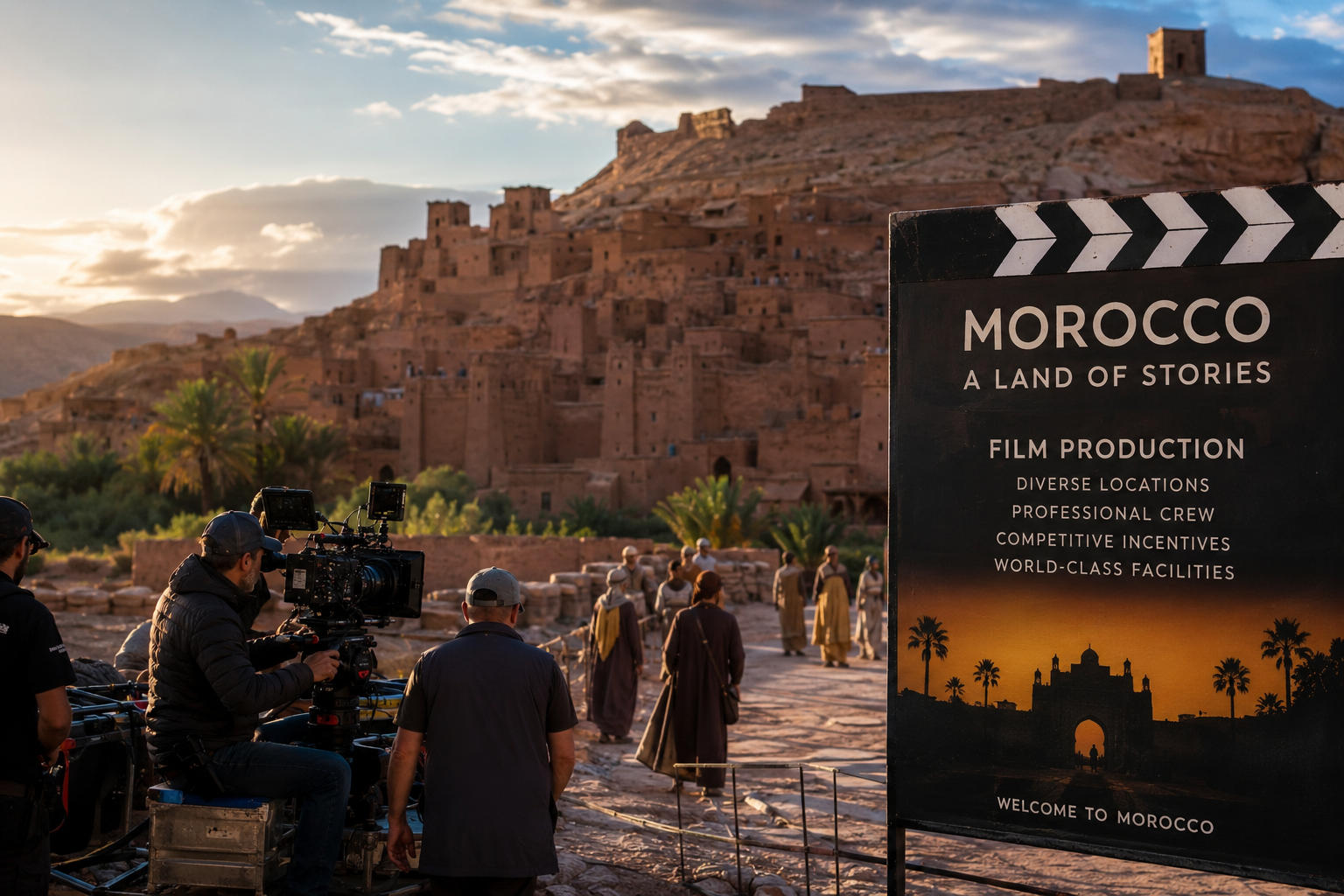
There are few countries where a filmmaker can move, within the same production, from the narrow streets of an ancient medina to the Atlantic coast, from snow-covered mountains to vast desert landscapes. Morocco is one of them.
For decades, this geographical diversity has made the Kingdom a familiar name in international cinema. Ouarzazate in particular has become almost inseparable from the history of foreign filmmaking in North Africa, while Marrakech, Essaouira, Tangier and other Moroccan cities have repeatedly appeared on screens around the world.
But Morocco’s relationship with cinema is entering a different phase. The country is no longer positioning itself simply as an attractive backdrop for foreign productions. New legislation, growing investment, a changing national film industry, modern cinemas and an expanding festival culture are gradually turning cinema into an industry in its own right.
A New Legal Framework for a Changing Industry
One of the clearest signs of this transition is Morocco’s new legal framework for cinema.
Law No. 18.23 on the film industry and the reorganisation of the Moroccan Cinematographic Centre (CCM) was promulgated in December 2024 and entered into force on 1 September 2025. Its ambitions go beyond regulating filmmaking. The framework is intended to make the sector more transparent and competitive while strengthening Morocco’s attractiveness to both Moroccan and international investors. (Maroc)
This matters because filmmaking today is not merely an artistic activity. A major production brings together technicians, actors, construction crews, costume designers, transport companies, hotels, caterers and countless other professions. Attracting a film therefore means attracting an entire temporary economy.
The new framework gives the CCM a broader role in supporting the industry and promoting Morocco as a filming destination. It also introduces clearer rules governing production, distribution, cinema operation and filming permits, alongside provisions for international accreditation allowing Moroccan companies to provide production services for foreign filmmakers.
The philosophy behind the reform is relatively straightforward: if Morocco wants to compete internationally for major productions, beautiful landscapes alone are not enough. Filmmakers and investors also need predictable rules, professional services and institutions capable of keeping pace with an increasingly competitive global industry.
And the economic figures suggest why this market matters. According to figures presented by the Ministry of Youth, Culture and Communication, international film production expenditure in Morocco reached approximately 1.5 billion dirhams in 2024, compared with around one billion dirhams in 2023 and 600 million in 2022.
When Hollywood Comes to Morocco:
The Odyssey
Perhaps few recent productions illustrate Morocco’s international appeal better than Christopher Nolan’s The Odyssey.
The production brought one of contemporary cinema’s most prominent directors to Morocco as part of an international shoot spanning several countries. Among the Moroccan locations associated with the production was the extraordinary ksar of Aït Benhaddou, near Ouarzazate, which was used to recreate ancient Troy. Other filming locations reportedly included areas around Marrakech, Essaouira and Tahnaout, while the production later headed south towards Dakhla. (Gulf News)
The choice feels almost natural.
Aït Benhaddou has spent decades transforming itself for the camera. Its earthen architecture has allowed filmmakers to evoke different periods and civilisations without constructing an entire world from scratch. Ouarzazate and its surroundings have similarly built an international reputation through generations of productions.
Yet The Odyssey is significant not simply because another Hollywood director came to Morocco. It demonstrates something more important: after decades of international productions, Morocco continues to compete for some of the world’s most ambitious filmmaking projects.
Each production of this scale is also a form of international promotion that traditional advertising would struggle to reproduce. Moroccan landscapes reach millions of viewers, while local crews accumulate experience working alongside major international production teams.
Cinema, in that sense, becomes simultaneously an artistic industry, an economic activity and a form of cultural diplomacy.
Moroccan Cinema Is Changing Too
The international story should not overshadow what is happening at home.
Moroccan cinema has developed considerably from the period when national productions were relatively scarce and access to filmmaking was far more limited. Today, a new generation of directors, actors, screenwriters and technicians is working alongside established figures, while Moroccan films increasingly circulate between domestic theatres and international festivals.
The challenge now is not merely producing more films, but creating a sustainable ecosystem around them.
A national cinema cannot thrive if films are produced but audiences have nowhere to watch them. Nor can it develop sustainably without distribution networks, professional training, financing and opportunities for young filmmakers to enter the industry.
This explains why recent public policy has increasingly treated production, distribution, cinemas and professional development as interconnected parts of the same ecosystem.
The National Film Festival in Tangier remains one of the most visible showcases of this evolution. Organised by the CCM, it was created specifically to promote Moroccan cinema, present recent national productions and provide a space where filmmakers, professionals, critics, students and audiences can meet and debate the future of the industry. (FNF)
Moroccan cinema therefore finds itself at an interesting moment: it is looking outward towards international markets while simultaneously trying to strengthen the relationship between Moroccan films and Moroccan audiences.
Bringing Audiences Back to the Cinema
Perhaps the most tangible transformation is happening in the cinema itself.
For years, Morocco faced the familiar problem of disappearing neighbourhood theatres and limited access to cinemas outside major urban centres. The response has increasingly involved both public initiatives and private investment.
A national programme was launched to introduce 150 cinema screens across Morocco’s twelve regions, with the first phase involving 50 screens. Importantly, the initiative was designed not only for Casablanca, Rabat or Marrakech but also to bring cinema to smaller and medium-sized towns. (Youth, Culture, and Communication Ministry)
Private investment is moving in the same direction.
In April 2025, for example, a new five-screen “Ciné Boutique” complex opened in Bouskoura with financial support from the CCM. The Moroccan company behind the project announced a strategy to develop a national network of 25 complexes containing 150 digital screens and approximately 30,000 seats. (Youth, Culture, and Communication Ministry)
These developments are about more than installing screens. The new generation of cinemas is being designed around digital projection, modern technical standards, comfort and a viewing experience capable of competing with the ease of streaming at home. Morocco’s regulatory framework has also introduced technical, safety, equipment-quality and audience-comfort criteria for classifying cinemas. (CCM)
And audiences appear willing to return.
Cinema attendance reached approximately 2.2 million spectators in 2024, compared with 1.7 million the previous year. Box-office revenue rose from 89 million dirhams in 2023 to approximately 127 million dirhams in 2024. (Youth, Culture, and Communication Ministry)
For the industry, those numbers matter. A healthy cinema culture ultimately requires people sitting in front of screens.
Festivals: Taking Cinema Beyond the Screen
Yet cinema culture cannot be measured only through ticket sales.
Across Morocco, film festivals have become meeting points between filmmakers, critics, students, journalists and ordinary moviegoers. Some are international showcases; others focus on Moroccan, African, Mediterranean or specialised cinema.
At the international level, the Marrakech International Film Festival has become Morocco’s most visible cinematic meeting place, bringing major international filmmakers and performers into direct contact with Moroccan cinema and audiences. Its 22nd edition in 2025 featured more than 80 films from over 30 countries. (Youth, Culture, and Communication Ministry)
Tangier plays a different but equally important role through the National Film Festival. Its purpose is fundamentally tied to Moroccan filmmaking: encouraging national production, promoting Moroccan films, recognising professionals and creating a space for dialogue within the industry. (FNF)
But the wider importance of festivals lies in what happens beyond red carpets and award ceremonies.
Screenings, discussions, workshops and encounters with directors can introduce audiences—particularly young people—to films they might otherwise never discover. When such events reach different parts of the Kingdom, cinema stops being an activity concentrated in a handful of major cities and becomes part of a broader cultural conversation.
That may ultimately prove as important as attracting another blockbuster.
From Filming Location to Film Nation
Morocco already possesses something that cannot easily be manufactured: landscapes, architecture, light, cultural diversity and decades of filmmaking experience.
The next challenge is to turn those advantages into a sustainable industry.
The arrival of productions such as The Odyssey shows that Morocco remains capable of attracting the attention of global cinema. The development of Moroccan productions shows that the country has stories and filmmakers of its own. New cinemas are rebuilding the link between films and audiences, while festivals are carrying film culture beyond the traditional theatre.
The new legal framework attempts to connect all of these elements under a more modern and investment-friendly system.
The real measure of success, however, will not simply be how many international films use Morocco as their backdrop. It will be whether international productions generate lasting expertise and employment; whether Moroccan filmmakers find the means to tell their own stories; whether modern cinemas remain accessible beyond the country’s largest cities; and whether a new generation grows up seeing cinema not as an occasional luxury, but as part of Morocco’s cultural life.
For decades, Morocco has helped the world tell stories on screen.
The opportunity now is for Morocco to build an even stronger cinematic story of its own.


