

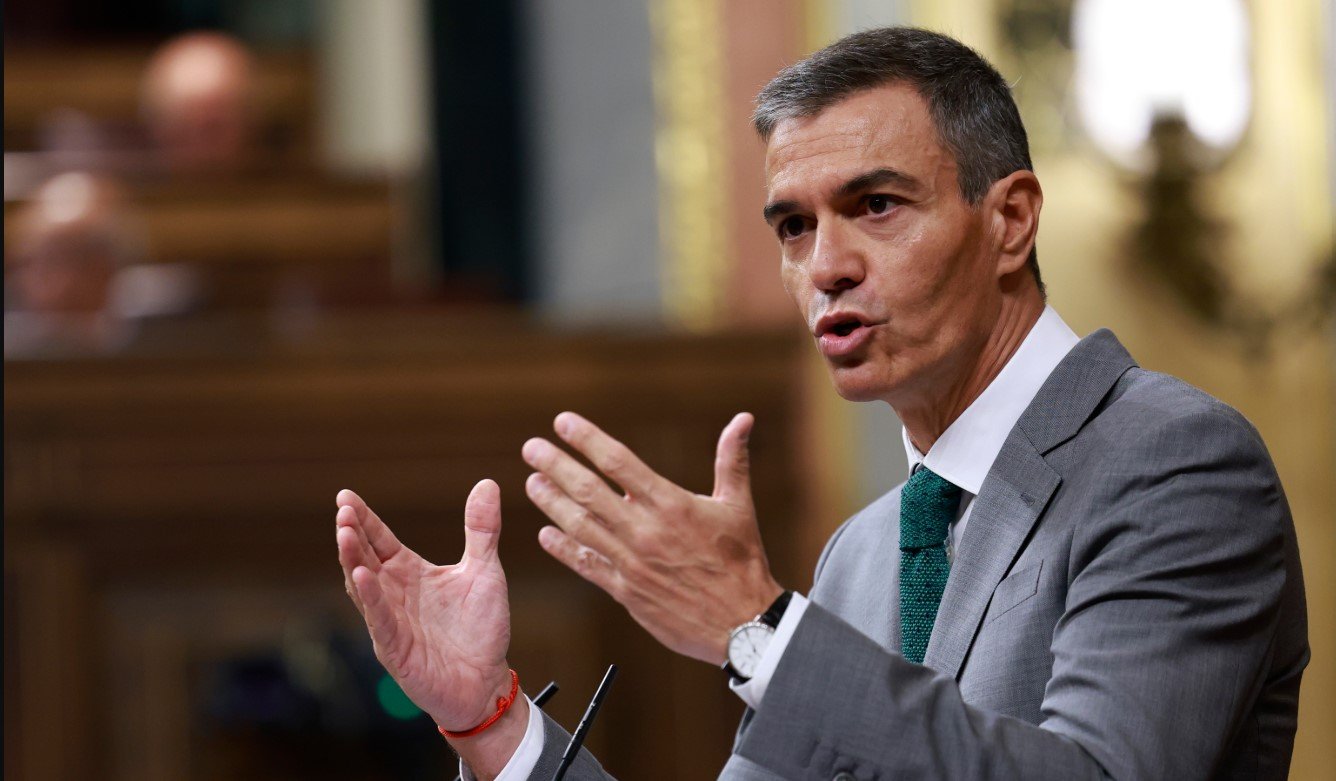
Madrid — Pedro Sánchez did not accuse Morocco on Thursday, before the Spanish Congress of Deputies, of being behind the migration crisis that struck occupied Ceuta at the end of July. In fact, his statement pointed in the opposite direction.
The Spanish prime minister said clearly that Madrid had no “strong evidence” proving that Morocco had planned or organized the flow of migrants towards the city, or that any Moroccan side had coordinated the operation. But that official distancing did not bring the Ceuta issue back to calm.
During the same parliamentary session, Sánchez revealed that the Spanish government had summoned Morocco’s ambassador in Madrid, Karima Benyaich, on August 21, in response to statements by Moroccan officials concerning the status of Ceuta and Melilla.
Then Sánchez opened another, far more sensitive, front: he invited King Felipe VI to visit the two cities in the coming weeks.
El pasado 30 de julio nuestros agentes tuvieron que elegir entre garantizar momentáneamente la estanqueidad de la frontera o defender la vida humana.
Eligieron lo segundo.
Hicieron lo correcto, lo más inteligente y valiente. Respondieron con humanidad en lugar de barbarie. pic.twitter.com/7b6Vdx3uZ3
— Pedro Sánchez (@sanchezcastejon) September 3, 2026
That was the order in which the Spanish message was delivered. The migration crisis was not officially linked to Rabat, but the sovereignty issue was not left outside the discussion.
Over the past few weeks, the two questions had increasingly become intertwined in Spain’s political and media debate. The arrival of large numbers of migrants in Ceuta on July 30 and 31 revived questions about the role of Moroccan authorities in monitoring the area surrounding the city, particularly because the arrivals occurred under exceptional circumstances and raised questions about the level of Moroccan security deployment.
Then, on Wednesday, a document presented as originating from the Spanish police began circulating in several media outlets. It referred to a “much lower than usual” presence of Moroccan security forces and to allegations of a degree of leniency in dealing with migrants.
El Gobierno no tiene nada que ocultar. He dado la orden de publicar un dosier con todos estos informes. TODOS.
Reconozcamos la excepcionalidad del episodio vivido.
Es absurdo pensar que el Gobierno fue avisado y no hizo nada adrede. pic.twitter.com/CcuwAhsGrC
— Pedro Sánchez (@sanchezcastejon) September 3, 2026
The document, however, did not withstand the official denial for long. The head of Spain’s National Police denied its existence, weakening an important part of the material being used to support the theory that the events had been deliberately facilitated by Morocco.
The following day, Sánchez’s position before Parliament made the matter clearer: the Spanish government did not have strong evidence showing that Morocco had planned or organized the flow of migrants.
That statement is difficult to overlook when assessing the crisis, because it came directly from the head of government, in a parliamentary setting where the executive is expected to account for its position. At the very least, it means that the narrative portraying Rabat as the party that planned the operation has not become an official conclusion in Madrid.
Quiero enviar un mensaje a toda la ciudadanía ceutí. No os vamos a abandonar.
Sé que estáis viviendo momentos muy difíciles y que la mayoría de vosotros sois personas tolerantes y solidarias.
No vamos a parar de trabajar hasta que Ceuta salga de esta encrucijada más fuerte, más… pic.twitter.com/YXqBciLIol
— Pedro Sánchez (@sanchezcastejon) September 3, 2026
That does not mean, however, that all questions surrounding the events have been settled.
Migration is one issue. Sovereignty is another.
Sánchez was careful to separate the two when he turned to statements made by Morocco’s Minister of Justice, Abdellatif Ouahbi, and to remarks delivered by Minister of Habous and Islamic Affairs Ahmed Toufiq before King Mohammed VI on the occasion of the commemoration of the Prophet’s birthday.
According to the account given by the Spanish prime minister, those statements included an assertion of Morocco’s rights over Ceuta and Melilla. For that reason, he said, Madrid had categorically rejected them and summoned the Moroccan ambassador to convey the Spanish government’s position.
The summons was not merely a routine administrative gesture. Nor does it, by itself, mean that relations between the two countries have entered a full diplomatic crisis. Madrid chose a familiar diplomatic channel while maintaining, at the same time, its position that the migration issue should be kept separate from the dispute over sovereignty.
¿En qué hubiera diferido la gestión de un Gobierno del PP y Vox en esta crisis?
¿Habrían ordenado a la Guardia Civil y la Policía Nacional disparar a la población civil, Sr. Feijóo?
Yo, desde luego, un Gobierno así no lo quiero ni para mi país ni para ningún otro. pic.twitter.com/HRIrKn7fem
— Pedro Sánchez (@sanchezcastejon) September 3, 2026
That distinction matters for Sánchez himself.
Acknowledging evidence of Moroccan involvement in preparing the migration crisis would have placed the Spanish government before an entirely different kind of dispute, particularly given the importance of cooperation with Rabat in combating irregular migration and managing the borders.
By saying instead that there was no strong evidence, Madrid keeps the affair within the framework of a migration crisis whose full circumstances have yet to be established, rather than turning it into a direct confrontation with Morocco.
Sánchez was less cautious, however, when it came to Moroccan statements concerning sovereignty.
The debate therefore moved from the movement of migrants to the question of sovereignty.
Ceuta and Melilla are not, in Spanish politics, simply two border points. Their status has for decades been one of the most sensitive issues in relations between Morocco and Spain. Any Moroccan statement concerning sovereignty over the two cities can quickly move beyond the official who made it and become a political issue in its own right inside Spain.
It was in this context that Sánchez invited King Felipe VI to visit the two cities.
If it goes ahead, such a visit would carry an obvious symbolic weight. The last visit by a Spanish monarch to Ceuta and Melilla took place in November 2007, when King Juan Carlos I and Queen Sofia travelled to both cities. The visit triggered a serious diplomatic crisis with Morocco at the time.
No Spanish monarch has repeated such a visit since.
For Sánchez to invite Felipe VI today, following the July migration crisis and the summoning of the Moroccan ambassador, indicates that Madrid wants to reaffirm the presence of the Spanish state in the issue.
It would nevertheless be difficult, on the basis of the available information alone, to conclude that the invitation necessarily signals an imminent visit or that it marks the beginning of another diplomatic confrontation with Rabat.
The King has not announced, in the information presented by Sánchez, a date for such a visit.
The distinction between a political invitation and its actual implementation therefore matters.
Spain’s policy towards Morocco in recent years has been based precisely on an attempt to reconcile security and economic interests with the management of political disputes, particularly those surrounding Ceuta and Melilla. The July crisis exposed that difficulty once again: Madrid needs Rabat’s cooperation on migration, but it does not want that cooperation to appear to weaken its position regarding sovereignty over the two cities.
Sánchez’s position before Parliament therefore points in two directions, without necessarily being contradictory.
On migration, he did not officially accuse Morocco, because there was no strong evidence to support such an accusation.
On sovereignty, however, he raised the level of Spain’s objection to statements by Moroccan officials, before bringing the Spanish monarchy itself into the picture by inviting Felipe VI to visit Ceuta and Melilla.
As for what actually happened on July 30 and 31, the case still requires a distinction between established facts and the political narratives that emerged afterwards. A major migrant influx did take place. Deaths and disappearances were among the documented consequences of the crisis. Questions over the level of preparedness of the Moroccan authorities at the border also remain.
But moving from those elements to the assertion that the operation was planned by Rabat requires evidence that Sánchez says his government does not have.
That gives his parliamentary statement its most immediate significance. It does not end the controversy, but it officially sets aside the most serious accusation hanging over Morocco: that it planned the migration crisis.
At the same time, Sánchez has not closed the Ceuta file.
He has shifted its centre of gravity instead: from the question of who organized the migrant influx to a more directly political question for Spain — how Madrid should respond to Moroccan statements reaffirming Morocco’s rights over the two cities.
The summoning of the ambassador was the first diplomatic response.
The invitation to Felipe VI could become the next symbolic step, if it eventually turns into an actual visit.
For relations with Rabat, the balance therefore remains, for now, based on an attempt to keep the two files separate: migration cooperation on one side, and the dispute over Ceuta and Melilla on the other.
The question is how long that separation can hold as Madrid clarifies its response to the Moroccan statements, and as the invitation to Spain’s King moves — or does not move — from the political sphere to an actual decision.


