

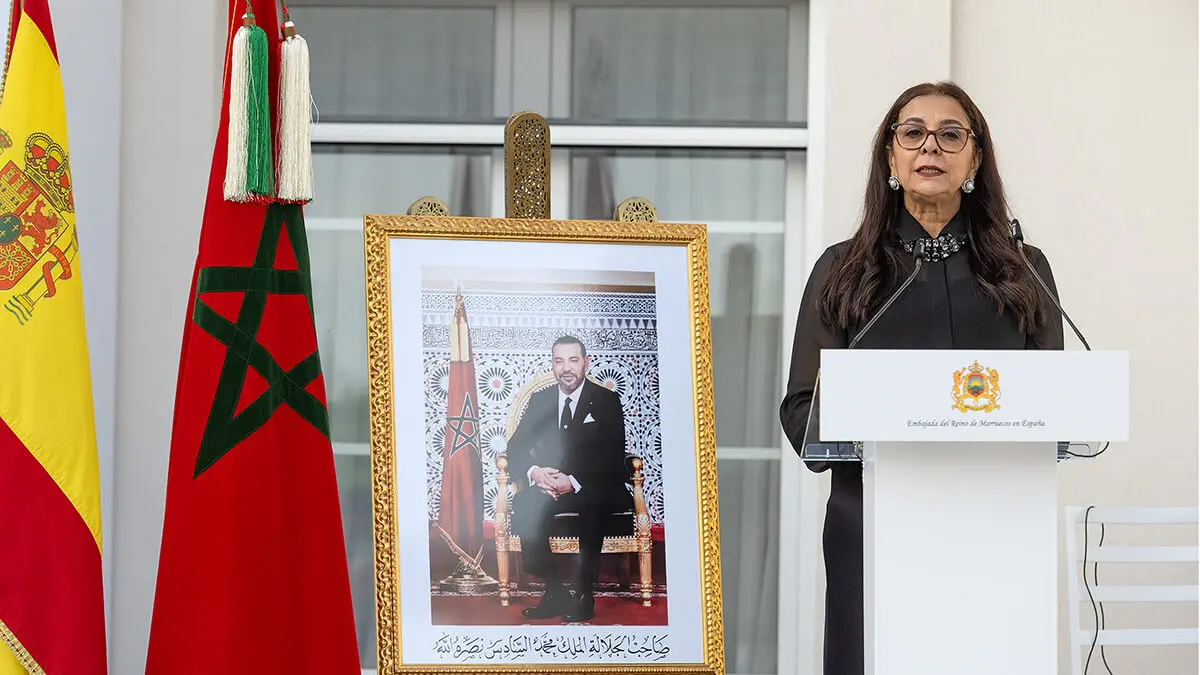
Madrid — When Spanish Prime Minister Pedro Sánchez told the Congress of Deputies on Thursday that Morocco’s ambassador in Madrid, Karima Benyaich, had been summoned on August 21 over statements made by two Moroccan ministers regarding Ceuta and Melilla, the episode initially looked like another diplomatic confrontation between Madrid and Rabat.
But the previous case shows that this is also an old dispute, one that returns whenever the sovereignty of the two cities moves back into the public debate.
Sánchez described the Moroccan statements as “unacceptable” and reiterated before Parliament that Ceuta and Melilla would remain Spanish. According to the Spanish prime minister, Madrid’s protest concerned remarks by Justice Minister Abdellatif Ouahbi and Minister of Endowments and Islamic Affairs Ahmed Toufiq, amid the fallout from the events in Ceuta on July 30 and 31.
Yet this is not the first time Spain’s diplomatic authorities have asked Karima Benyaich for explanations over the two cities.
The last comparable confrontation took place in December 2020.
At the time, Morocco’s head of government was Saad Dine El Otmani. During a televised interview with Asharq on December 18, he was asked about Moroccan-Spanish relations and, specifically, about Ceuta and Melilla.
His answer did not amount to an announcement of any immediate change.
El Otmani said that the issue of the two cities was among the questions that “must be opened for discussion”. He also recalled that the status quo had existed for several centuries and stressed that Morocco first had to settle the issue of the Moroccan Sahara, which he described at the time as the priority.
But he reaffirmed the basic position: from Rabat’s perspective, Ceuta and Melilla are Moroccan.
Three days later, on December 21, 2020, Spanish Secretary of State for Foreign Affairs Cristina Gallach summoned Karima Benyaich. Madrid asked the ambassador for explanations regarding the Moroccan prime minister’s remarks and told her that Spain expected its partners to respect its sovereignty and territorial integrity.
The more revealing part, however, was the response attributed to the ambassador.
According to Spanish media reports at the time, Benyaich explained that El Otmani’s remarks were not new. Morocco had always regarded Ceuta and Melilla as occupied territories.
In other words, the message conveyed to Madrid was not that Morocco had adopted a new policy.
It was that the existing position remained unchanged.
In December 2020, Spain was asking for explanations after the Moroccan prime minister spoke publicly about the two cities. The Moroccan response, as reported by Spanish media, essentially amounted to a reminder that Rabat’s position was well known and had not changed.
Since then, the bilateral context has changed considerably.
Relations between Rabat and Madrid went through a serious diplomatic crisis before entering a new phase following Spain’s shift on the Moroccan Sahara issue. Security, economic and political ties subsequently resumed.
Ceuta and Melilla, however, never disappeared from the broader relationship.
They simply remained in the background.
That is what gives this week’s reported summons a particular significance. The territorial dispute has resurfaced this time after a major migration crisis in Ceuta and following statements by Moroccan ministers that once again placed the sovereignty question openly at the centre of the debate.
There is nevertheless an important distinction between what the facts establish and what they do not yet establish.
Nothing in the information made public by Madrid, at this stage, demonstrates that Rabat has decided to move from a political claim to an attempt to alter the existing situation in the two cities.
The same distinction applies to the other part of the crisis: the mass arrival of migrants in Ceuta. Sánchez himself acknowledged on Thursday that his government does not have solid evidence proving that Morocco planned or carried out the operation.
The story is therefore more complicated than a succession of Moroccan statements followed by Spanish protests.
Morocco’s claim over Ceuta and Melilla is longstanding. So is Spain’s reaction to that claim. What has changed is the environment in which the issue has returned: border control, migration, security, sovereignty and the strategic relationship between Rabat and Madrid are now intersecting in the same political space.
In 2020, the question put to Karima Benyaich was, essentially, the same one that has resurfaced today: what does Morocco’s position on Ceuta and Melilla mean?
The answer reported at the time was clear on one point: there was nothing new in Morocco’s position.
Six years later, then, the change may not lie in the claim itself.
It may lie in the circumstances in which that claim has returned.


