

In Ceuta, the story began as a border crisis. A few weeks later, it has reached the Moroccan ambassador.
Vox is now calling for the suspension of the Treaty of Friendship, Good-Neighbourliness and Cooperation with Morocco, the recall of Spain’s ambassador from Rabat and the expulsion of Morocco’s ambassador from Madrid.
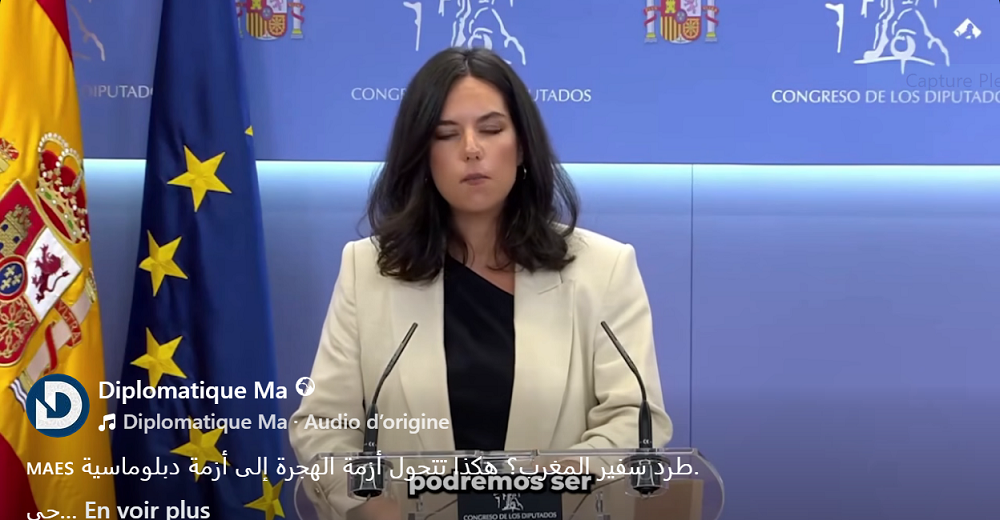
🇲🇦🇪🇸 طرد سفير المغرب؟ عندما تعجز السياسة عن حل أزمة سبتة، يصبح المغرب شماعة جاهزة.
الدولة ذات السيادة لا تبني قراراتها على التحريض والاتهامات، بل على الأدلة والمسؤولية والحوار.
سبتة لا تحتاج إلى مزيد من التصعيد… بل إلى الحقيقة. pic.twitter.com/UElMoJ0geF
— Diplomatique.ma الدبلوماسية (@diplomatique_ma) September 1, 2026
The demand comes as Pedro Sánchez’s government says that its security and intelligence services have provided no information establishing the involvement of Moroccan authorities in the wave of mass arrivals recorded in the city on July 30 and 31.
Between these two positions, another story is taking shape, one that goes well beyond what happened at the border.
Are we looking at a migration crisis that has turned into a diplomatic crisis, or at a migration crisis now being used to reopen older disputes in relations between Madrid and Rabat?
From the first days of the crisis, Vox did not wait for the full picture to emerge.
On July 30, a party official in Ceuta described the events as an “invasion” and called for the border to be closed and the army to be deployed. Days later, the language went further, with references to a Moroccan “hybrid operation” and the use of migration as a geopolitical weapon. On August 2, party leader Santiago Abascal called for the militarisation of the border.
The latest initiative is different in nature. It is no longer limited to border management or migration policy. It targets the framework governing a significant part of relations between Madrid and Rabat since the 1991 treaty.
That gives the call to expel the ambassador a significance beyond another escalation in the political rhetoric over Ceuta.
What does Madrid actually know?
This is where Sánchez’s statements matter.
The Spanish prime minister has not played down the seriousness of what happened in Ceuta, nor has he suggested that the border did not face a major security challenge.
His statement was more specific: according to the information provided to his government by security and intelligence services, there is no evidence pointing to the involvement of Moroccan authorities in the mass arrivals.
At the same time, he offered another explanation for part of the crisis.
He spoke of false information spreading across social media, including claims that migrants reaching Ceuta by sea would be allowed to remain in Spain. He also said that research by the European External Action Service had concluded, according to his account, that Russian, Israeli and far-right networks were involved in spreading the information.
Moscow rejected the accusations.
But establishing that misleading information circulated is one thing. Identifying who produced it, and then proving that it actually drove thousands of people to move toward Ceuta, is another. Each link in that chain requires separate evidence.
So far, Madrid has not made public all the details needed to turn that account into an established fact.
That distinction matters.
Morocco is at the centre of the crisis, even without public evidence
Morocco’s presence at the centre of Spain’s political debate is hardly surprising.
Ceuta and Melilla remain sensitive issues in relations between the two countries. Migration, borders and security cooperation are directly connected to them. When a major crisis erupts in Ceuta, older disputes between Madrid and Rabat inevitably return to the political debate.
But the existence of strategic disagreements does not, by itself, establish Moroccan responsibility for a specific event.
If Spanish investigations later establish official Moroccan involvement, Madrid will have a different basis on which to act.
If they do not, the questions will move elsewhere: How did the information spread? Who was behind the networks that circulated it? What did the Spanish authorities know before the migrants arrived? And why did the crisis reach such a scale?
Those are questions that party statements cannot answer.
The problem is that the relationship is bigger than Ceuta
Politically, it is easy to turn a migration crisis into a battle over security and sovereignty.
Foreign policy is more complicated.
Spain does not deal with Morocco on a single issue. There is security cooperation, the fight against irregular migration and trafficking networks, trade and economic interests, alongside political issues and longstanding disputes.
That is why suspending the 1991 treaty would be very different from making a tough political statement on migration.
If it became official policy, it would reopen a wide range of issues at the same time.
So far, there is no indication that Sánchez’s government is moving in that direction. On the contrary, the prime minister has said that dealing with the Ceuta crisis requires cooperation with Morocco.
That contrast between the government and Vox is important.
For Vox, the crisis offers an opportunity to harden the debate over borders and migration and connect it directly to sovereignty. The government, by contrast, is trying to separate border protection from breaking cooperation channels with Rabat.
It is too early to know which of these positions will have the greater influence on Spanish policy.
What remains when the crisis is over?
The investigations may still reveal something that changes the picture.
They may not.
If new evidence establishes official Moroccan responsibility, Madrid will naturally have to reconsider its position. If no such evidence emerges, it will become harder to explain the entire crisis through Morocco alone.
Either way, another question will remain: How can information posted on social media move so quickly from a phone screen to a collective movement of this scale?
That question is not only about Morocco, and it is not only about Spain. It points to a wider problem facing states when migration, digital disinformation, criminal networks and domestic politics intersect.
That is why Ceuta reveals something larger than the border itself.
A crisis that began with the arrival of thousands of migrants has become a battle over how the events should be interpreted and who should be held responsible. While the Spanish government says the available evidence does not point to Morocco, Vox is pushing for a diplomatic step that would affect the relationship with Rabat at its foundations.
The difference between those two positions is not a detail.
It is the difference between waiting for an investigation to establish what happened and taking a political decision before the full account of events is known.
In relations between neighbouring states, it is easy to raise the level of confrontation. The harder task is knowing when that confrontation is based on established facts and when it has simply become an extension of a political crisis looking for a new target.
In Ceuta, the story is not over.
And its most important question may not yet be who will be accused, but whether the investigations will establish the truth before politics takes a decision that may be difficult to reverse.


