

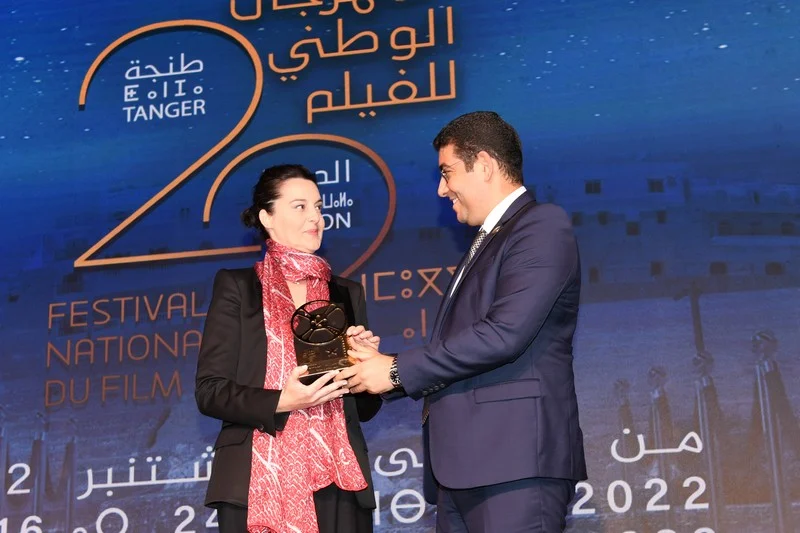
Moving the National Film Festival in Tangier from October to March is more than a simple change of date. By responding positively to requests from several professional organizations and industry stakeholders, the Moroccan Cinematographic Centre is making a decision that points to a broader discussion about how Morocco’s film calendar should be organized, and about the place of the national festival in the journey Moroccan films undertake toward major international festivals.
The 26th edition, initially scheduled to take place in Tangier from October 23 to 31, 2026, will now be held in March 2027. The Centre does not present the move as a withdrawal from the original schedule, but as a response to a concern raised by professionals: the heavy concentration of national and international film festivals and events in October, and the difficulties this creates for professionals and Moroccan films.
On the surface, it is simply a change of date. In a film industry, however, timing is rarely just an administrative detail.
The National Film Festival is a major gathering point for Moroccan cinema. It is where films meet audiences, professionals, critics and institutions, in a setting that goes beyond competition and awards. Since its creation in 1982, the festival has gradually become one of the defining events in Morocco’s cinematic life.
The real question raised by the move, therefore, is not simply why March rather than October. It is what this new timing could change in the festival’s position within the Moroccan film season.
October has become too crowded
The reason given by the Moroccan Cinematographic Centre is straightforward: October has become heavily concentrated with national and international film festivals and events, creating scheduling conflicts and making it more difficult for professionals and Moroccan films to participate across different events.
This is also the result of a positive development in Morocco’s cinematic landscape. The country now has a much denser network of festivals, covering different forms of cinema, different regions and different audiences.
The issue, therefore, is not necessarily the number of festivals. That diversity can itself be a sign of a dynamic industry.
The problem emerges when several events compete at the same time for the same films, directors, producers, journalists, critics and sometimes the same audiences.
At that point, abundance can turn into fragmentation.
Moving the national festival to March can therefore be understood as an attempt to ease that pressure, rather than simply as an administrative adjustment to one edition.
A film’s journey does not end at the festival
There is another professional dimension that makes timing particularly important.
A film shown at a national festival does not necessarily end its journey there. For producers and directors, the order and timing of screenings can form part of a broader strategy aimed at reaching international festivals, professional markets and distribution opportunities.
This is why the Centre’s reference to first-screening and premiere requirements at certain major international festivals is particularly significant.
The national calendar can affect a film’s international strategy.
Moving the Tangier festival to March could, in principle, give Moroccan productions more room to plan their journeys before some of the major international dates later in the year.
That should not be overstated. A film’s international visibility depends on many other factors: its artistic quality, distribution strategy, professional networks and the choices made by producers.
But a less congested calendar can certainly help.
Tangier opens the season
Perhaps the most significant aspect of the decision lies in the new role the Centre seeks to give the Tangier festival.
By moving it to March, the National Film Festival is intended to become the first major cinematic event of the year in Morocco, effectively opening the national film season.
That could gradually change the festival’s function.
Instead of arriving during an already crowded period, Tangier could open the Moroccan cinematic year at a time when professional and media attention can be more strongly focused on national production.
The festival could then serve not only as a showcase for films, but also as a professional meeting point and an early moment for the industry to look ahead to the year that is beginning.
This remains consistent with the festival’s longstanding mission: showcasing national productions, encouraging dialogue among professionals and contributing to discussion about the development of Morocco’s film industry.
If this new position takes hold, Tangier will not simply have changed its date.
It will have changed its place in the calendar.
And Marrakech as the international extension
The story does not stop in Tangier. In its statement, the Moroccan Cinematographic Centre places the new schedule within a broader sequence linking the beginning of the national film season to the international visibility provided notably by the Marrakech International Film Festival.
That relationship is worth watching.
Tangier could become, in March, an early national gathering focused on Moroccan production, professionals and emerging talent. Films and filmmakers would then pursue their individual paths through the various international events taking place during the year, before Marrakech becomes, toward the end of the year, one of Morocco’s major international showcases for cinema.
This does not necessarily mean setting Tangier against Marrakech. On the contrary, the new distribution of dates could create a form of complementarity between their respective roles.
Tangier at the beginning of the season. Marrakech as part of its international extension.
Between them lies an entire year in which films can travel, projects can develop and filmmakers can meet new professional partners.
A decision whose real test will come after March 2027
The move, however, is a first step, not yet a result.
The real test will begin in March 2027.
Will professionals actually experience less pressure on the calendar? Will Moroccan films have greater flexibility in planning their international trajectories? Will the festival succeed in establishing itself as the genuine starting point of Morocco’s national film season?
It is too early to answer.
What is already clear, however, is that the Moroccan Cinematographic Centre has chosen to treat a request raised by professionals as an issue concerning the organization of the sector as a whole, rather than as a difficulty affecting one edition alone.
That is what gives the decision its broader professional significance.
The National Film Festival does not belong only to its organizers. By virtue of its nature and its place within the national ecosystem, it is also part of Morocco’s film industry, its creators and the image Moroccan cinema seeks to project beyond its borders.
Reconsidering its calendar can therefore prove useful if this change becomes the starting point for a broader reflection on the complementarity of festivals, the circulation of films and the coordination of professional events.
Ultimately, the success of March will not be measured simply by whether it has successfully replaced October.
It will be measured by whether it becomes a better starting point for Moroccan cinema: the beginning of a season, a space for national productions and emerging talent to gain visibility, and a stage that gives films more time and greater opportunities to find their way into the international arena.
That may be the deeper meaning of a decision that, on the surface, appears to concern nothing more than a date.


