

The Ceuta crisis is no longer being played out solely behind the border fences. It has moved to the heart of the Spanish Parliament, where Pedro Sánchez has been forced to confront a question that has become increasingly uncomfortable for his government: what does Spain actually know about what happened at the end of July, and how far can Madrid go in accusing Morocco without possessing evidence that Rabat planned or directed the operation?
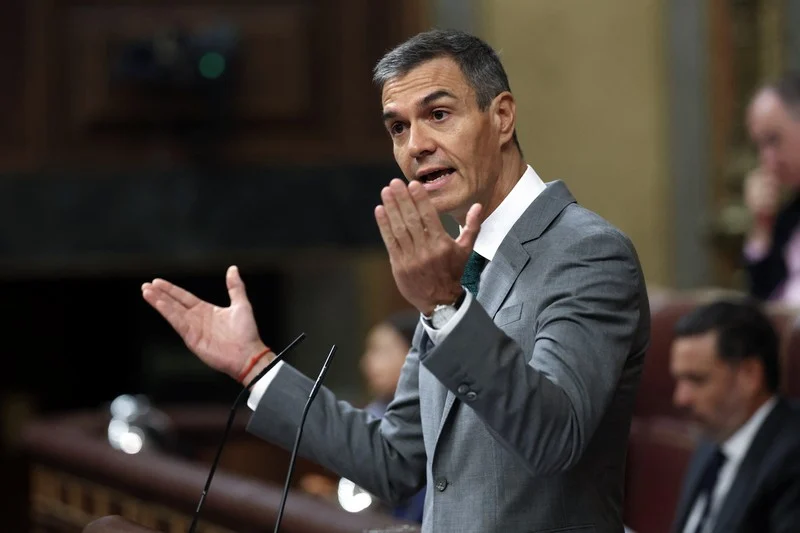
The Spanish prime minister’s answer was revealing. Speaking before Congress, Sánchez said that, at this stage, there was no solid evidence allowing Spain to conclude that Morocco had planned or carried out the massive influx towards Ceuta. At the same time, however, he acknowledged that Moroccan forces had allowed groups to cross during a decisive period on 30 July.
That distinction is crucial. It separates two realities that the Spanish political debate increasingly tends to merge: possible permissiveness or failure by forces responsible for controlling the border, on the one hand, and a political decision by a state to organise an operation, on the other. The first can be documented and investigated. The second requires considerably stronger evidence.
This is precisely where Madrid’s difficulty now lies.
A Spanish police report, cited by several media outlets, refers to an unusually high degree of permissiveness on the Moroccan side and suggests that movements of people may have been facilitated by elements within the security forces. Videos, testimonies and various reports have fuelled questions for weeks. But the report, however significant, does not by itself establish that the Moroccan state ordered the operation.
The Sánchez government knows this perfectly well. That is probably why the prime minister has chosen such careful language: he has not dismissed every question concerning Morocco, but neither has he crossed the line of accusing Rabat of planning the crisis without conclusive evidence.
This position places the Spanish government in an increasingly uncomfortable political situation.
The problem is no longer simply one between the government and the opposition. It now reaches into the different components of the Spanish state itself. Questions concern the security services, intelligence, diplomacy, the Interior Ministry and Defence. Some of the information reported by Spanish media appears to point towards interpretations that do not entirely coincide with the official government narrative.
That discrepancy is more important than an ordinary political controversy. It raises an institutional question: how could an operation of such magnitude take place when Spanish services say they did not possess information capable of assessing its scale or probability?
Madrid will have to answer that question regardless of whether Morocco bears any responsibility.
It is also in this context that another development must be understood: the summoning, on 21 August, of the Moroccan diplomatic representation following statements deemed “unacceptable” regarding Ceuta and Melilla.
Pedro Sánchez confirmed this before Parliament, referring to statements by Moroccan Justice Minister Abdellatif Ouahbi and Minister of Endowments and Islamic Affairs Ahmed Toufiq.
But one diplomatic detail deserves attention. Contrary to some accounts, Morocco’s ambassador to Madrid, Karima Benyaich, was not personally present at the meeting. She was absent, and the Moroccan representation was handled by the chargé d’affaires.
The Spanish government’s decision to make the démarche public days after it occurred was not without significance. In diplomacy, a summons can remain a strictly bilateral act. Once made public, however, it also becomes a message directed at domestic public opinion.
And this is precisely the terrain on which Pedro Sánchez is now under pressure.
Spain’s right-wing opposition has accused him since the beginning of the crisis of adopting an excessively conciliatory attitude towards Morocco. Ceuta has consequently become an instrument of domestic political confrontation. Morocco is no longer simply a strategic partner of Spain; in the discourse of some parties, it is becoming an electoral issue.
That carries a risk for Madrid: transforming a complex bilateral relationship, built around security, migration, trade and a wide range of shared interests, into a variable in Spain’s partisan competition.
Sánchez appears determined to prevent precisely that.
His parliamentary intervention shows him trying to maintain two positions simultaneously. On the one hand, he defends cooperation with Rabat and refuses to accuse Morocco of organising the crisis without evidence. On the other, he insists that Spain categorically rejects any challenge to its sovereignty over Ceuta and Melilla and makes public the diplomatic steps taken towards Morocco.
This is not necessarily a contradiction.
It is rather an attempt to separate two issues that the crisis risks merging: strategic cooperation with Morocco and the question of Spanish sovereignty over the two cities.
This is where Morocco’s official silence acquires particular significance.
Since the beginning of the controversy, Rabat has not responded on the same register as some Spanish political figures or media outlets. That restraint can be read as an effort not to allow the Ceuta crisis to become a broader crisis in Moroccan-Spanish relations. But caution is necessary: diplomatic silence, by itself, does not allow us to establish Morocco’s precise intentions.
One fact, however, is observable: the channels of cooperation have not been closed.
And that continuity is precisely what still allows Madrid to manage security and migration files without opening a much wider diplomatic confrontation.
The paradox is therefore clear. The Spanish government says it has no evidence proving that Morocco organised the massive influx, while facing growing political pressure to adopt a tougher line towards Rabat.
The question is no longer simply what happened in Ceuta.
It has become a question of how far Spanish politics is prepared to go in turning the episode into a confrontation with Morocco.
For the moment, the facts do not justify speaking of a rupture. Economic exchanges continue, institutional mechanisms remain in place, and strategic cooperation has not been dismantled. What has hardened is the political rhetoric.
That is precisely what makes the current situation more delicate.
Political statements can evolve much faster than strategic interests. And in the relationship between Madrid and Rabat, those interests are extensive: security, migration, trade, investment, regional cooperation and, above all, stability in the Western Mediterranean.
The European Union is watching this evolution with a degree of caution that is not difficult to understand. Unlike during the 2021 crisis, Brussels now appears to favour de-escalation and the preservation of cooperation channels with Rabat. The stakes go beyond the bilateral relationship between Spain and Morocco.
For Europe, a prolonged deterioration between Madrid and Rabat would have consequences for several sensitive areas, particularly migration and security.
That is why the Ceuta crisis is producing an unexpected effect: it is forcing Spain to look more closely at itself.
Sánchez’s real political problem may not be that Morocco has become an adversary. It is that part of Spain’s political class wants to turn Morocco into an adversary, while the government still considers Rabat a necessary strategic partner.
Between these two positions, the prime minister is trying to maintain a narrow line.
For Morocco, meanwhile, the real challenge is not to allow itself to be trapped in Spain’s political timetable. A crisis originating around Ceuta does not necessarily have to become a crisis between two states.
But silence can only be effective when it is backed by a clear strategy.
Because when others speak on Morocco’s behalf, define its position, interpret its intentions and use its name in their own internal political battles, the absence of a response can eventually allow the narrative to be constructed elsewhere.
What is unfolding in Madrid today therefore goes far beyond the question of a few hours of chaos at the border of Ceuta. Spain still has to establish what actually happened, determine why its own security mechanisms failed to anticipate the scale of the event, and distinguish facts from political accusations.
Morocco, for its part, has no interest in accepting responsibility for something that even the Spanish government says it cannot prove.
And perhaps that is the most important fact to emerge from this crisis: so far, Madrid has not produced evidence of a planned Moroccan operation against Ceuta. But Spain has discovered, through this crisis, a vulnerability that is first and foremost its own: that of a government forced to defend a strategic relationship with Morocco while facing, at home, those who want to turn that very relationship into evidence of its alleged weakness.


