

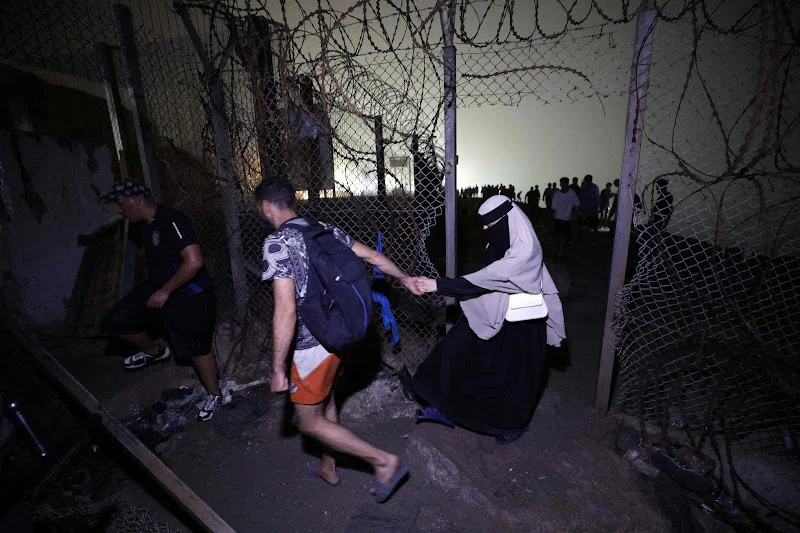
Ceuta, One Month After the Mass Arrivals: When a Migration Crisis Becomes a Security and Political Test
The crisis in Ceuta can no longer be measured only by the number of people who arrived at the end of July. It has to be measured by what remains after the first shock has passed. Following weeks of mass arrivals, the voluntary return of thousands of people, and an unprecedented security and political mobilisation, the Spanish authorities have now entered a different phase: identifying those who remain, establishing individual responsibilities, and removing those found to have committed offences or crimes.
The Spanish government says that more than 200 migrants who entered Ceuta in late July have now been expelled after being detained over alleged unlawful conduct. The figure was announced by Territorial Policy Minister Ángel Víctor Torres, who is also responsible for the unified coordination of the crisis response. On August 28, Interior Minister Fernando Grande-Marlaska had reported that more than 100 migrants had already been expelled.
But the number itself is not the most significant development.
What matters more is the shift from a collective crisis to individual files: identity, fingerprints, legal status, possible international-protection claims, the status of minors, previous criminal records and any offences committed after arrival. Security screening has consequently become a central part of the next stage of the response.
Spain is therefore trying, after an initial period dominated by emergency measures, to regain control through the individual processing of those who remain in the territory.
That is where the paradox of the crisis lies.
At the end of July, Ceuta appeared to be facing a temporary breakdown in control of its border infrastructure. A month later, the city has become the setting for a broad administrative and security screening operation whose consequences have not yet run their course.
The Spanish government has sought support from Frontex, Europol and the European Union Agency for Asylum, particularly in identification, screening and case processing.
The crisis is therefore no longer entirely a local Spanish matter. It has become more clearly embedded in a wider European security-cooperation framework.
The 200 figure does not tell the whole story
Spanish Interior Ministry sources say that three of those expelled since July 30 had previous records linked to offences related to jihadism.
The information is sensitive. It therefore requires more precision than a headline can usually provide.
The fact that three people had previous records connected to terrorism or extremism does not mean that the mass arrival itself was a terrorist operation. Nor does it mean that these individuals committed terrorist acts in Ceuta after arriving. The figure alone cannot establish a general link between irregular migration and terrorism.
It does, however, help explain from a security perspective why identity checks and the verification of previous records have become central to the new phase of the response.
This is precisely what Spanish authorities have begun putting in place. The screening process includes identification, fingerprinting and the collection of biometric data, alongside assessments of vulnerability, before each individual is directed toward the legal procedure applicable to their specific circumstances.
In other words, the Spanish state is now attempting to recover, through individual case files, the degree of control it temporarily lost in the face of a collective movement of people.
From thousands of arrivals to around 5,000 still present
On August 28, Fernando Grande-Marlaska told the Spanish Parliament’s Interior Committee that around 72,000 people had entered Ceuta during July 30 and 31. According to government figures, the overwhelming majority subsequently returned voluntarily to Morocco, while around 5,000 people remained in the city, including approximately 1,500 minors.
Those figures have been contested politically in Spain, with opposition parties putting forward substantially higher estimates.
But beyond the dispute over numbers, one fact remains: after a month, several thousand people are still there.
That is why the crisis has not simply disappeared. The authorities are no longer dealing only with a mass irregular entry. They are dealing with the legal, and in some cases humanitarian and security, circumstances of each individual.
The meaning of the crisis has therefore changed.
On July 30, the question was: how did so many people manage to enter?
A month later, the questions are different: Who is still there? Who can be returned? Who is seeking protection? Who is a minor? Who has a previous record? Who may pose a security risk? And who instead falls within a duty of protection or assistance?
These are not interchangeable situations. They cannot therefore be treated with a single collective response.
From the border to the schools
Another element of the response shows how the local climate has changed: security planning is now directly connected to the reopening of schools on September 8.
The Education Ministry has announced increased surveillance around schools and along school routes, with security forces deployed near educational institutions during school hours.
That shift is revealing.
The crisis that began at the border and around Ceuta’s entry points is now present in the city’s everyday life: streets, neighbourhoods, reception centres and, soon, schools.
The issue has consequently become more complicated than a migration question alone.
The longer migrants remain, the more the debate moves from border control towards public services, everyday security and coexistence in urban space. And as local concerns increase, the government is increasingly required to demonstrate that control is not simply a political message, but a real capacity to manage the situation on the ground.
At the same time, Spain’s response is beginning to incorporate other dimensions. Madrid has announced economic measures to support Ceuta and additional resources to deal with the situation of unaccompanied migrant minors.
This confirms that Spanish authorities now view the consequences of the crisis as a problem operating on several levels: security, social policy, finance, humanitarian protection and politics.
What is actually left of July 30?
The greatest mistake would be to regard the events of late July as a closed episode simply because most of those who arrived subsequently returned.
The crisis has already changed the way Spain manages Ceuta. The need for unified command and coordination emerged during the first days, before Madrid established a mechanism aimed at centralising the management of the crisis and strengthening cooperation with European agencies.
But the episode also exposed the vulnerability of a border when confronted with a sudden and massive movement of people, regardless of how many later returned.
There is another dimension that cannot be ignored: the digital environment surrounding the arrivals.
Before and during the movement, social-media posts circulated disputed interpretations of Spanish judicial decisions, helping to spread the idea that people arriving by sea in Ceuta could not be immediately returned.
That adds a new layer to an already complex migration crisis: a border, social networks, fragmented legal information, collective movement, followed by a security, administrative and European response.
The Spanish authorities are now trying to break that collective episode down into individual cases: one person at a time, one file at a time.
That is perhaps the real change revealed by the announcement of more than 200 expulsions.
After trying to prevent Ceuta from becoming the scene of an uncontrolled mass arrival, the Spanish state must now manage what that movement left behind: thousands of different situations, without turning security into collective suspicion and without reducing migration to a single number.
The July 30 crisis is not over.
It has simply changed form.


